

Podcast outreach often fails before the first pitch is even written. Either you lose a morning chasing contacts that bounce. Or you pay for a database and find half the shows went quiet a year ago. The pitch takes the blame, but the data was broken first.
Both failures share one root. The data was built for something other than outreach, and outreach was bolted on later. A tool built to help people discover shows answers a different question than the one you are actually asking.
This guide explains what a podcast contact database actually is. It covers why most tools that borrow the name do not qualify. It also shows what you see when you open a purpose-built one like MillionPodcasts, in 2026.
What is MillionPodcasts? A podcast contact database built for outreach, not listening. It pairs every show with SMTP-verified contacts, audience demographic data, and publishing activity. MillionPodcasts covers more than 3 million shows across Apple Podcasts, Spotify, and YouTube, with 1.2 million of them carrying verified host, producer, and booker contacts. The free plan needs no card, and paid plans start at $12 per month billed yearly.
1. What a Podcast Contact Database Actually Is
A podcast contact database is a searchable, structured record of podcasts built for outreach rather than listening. It pairs each show with verified contacts, audience data, and publishing activity. Then it lets you filter millions of shows down to the few that fit your campaign.
Some teams call the same tool a podcast media database or a podcast contact list. The job is identical. The difference from a podcast directory is structural. Spotify and Apple Podcasts are built for listeners finding shows to play. Their data reflects that job: episode art, listen counts, recommendations. A podcast database is built for the person doing outreach. It stores what a directory never needs: verified emails, audience demographics, and publishing frequency. It also holds 17 filter fields to apply across millions of shows at once.
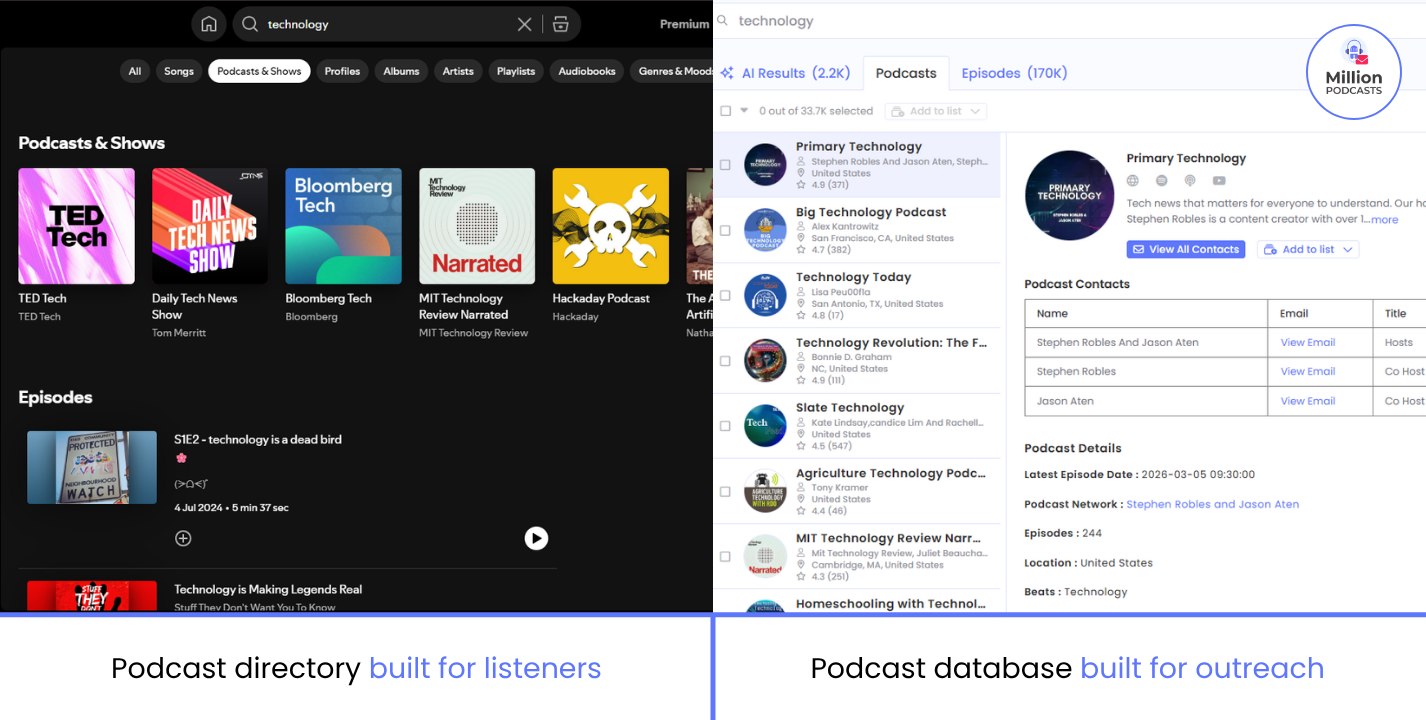
| Feature | Podcast directory | Podcast contact database (MillionPodcasts) |
|---|---|---|
| Built for | Listeners finding shows to play | PR and outreach teams finding shows to pitch |
| Verified contact emails | No | Yes, SMTP-checked and manually researched |
| Audience demographics | No | Yes, Listener Type, Income, Age, Gender |
| Publishing activity filter | No | Yes, from this week back to the last 25 months, or a custom range |
| Geographic listener data | No | Yes, country-level distribution per show |
| CSV and Excel export | No | Yes, custom column selection |
| Boolean search | No | Yes, 4-field Advanced Search panel |
| Free plan to test | Listening only | Yes, no card required |
MillionPodcasts is organized entirely around the outreach question. Every feature exists to move a brief to a pitch-ready list. The three-tab search, demographic filters, and export all serve that one job. The current scale of the database looks like this.
Platform figures are as of June 11, 2026. To check whether your own beat is covered before signing up, browse the MillionPodcasts directory of categories. For a detailed comparison of when to use each format, the podcast directory vs podcast database breakdown explains the difference in full.
2. Why Podcast Contact Databases Fail You
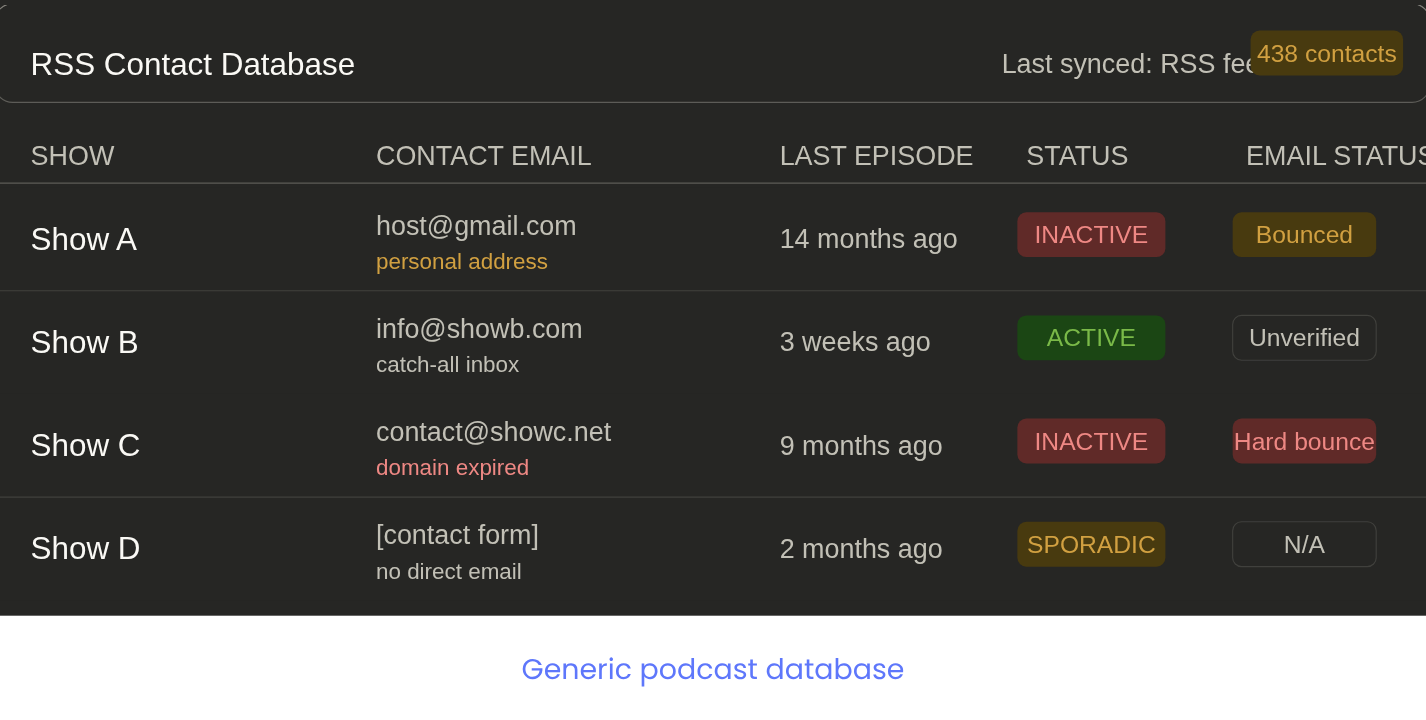
Most outreach problems start with the list, not the pitch. A database that looks complete on the surface will quietly destroy a campaign before the first email is sent. Four structural failures cause this in most competing tools.
- RSS-scraped contact emails. Most aggregators source contacts from the RSS feed field each host fills in on launch day. That field is rarely updated. In practice it holds a personal inbox from three years ago, a catch-all nobody monitors, or a dead contact form.
- No publishing activity tracking. Listen Notes indexes about 3.8 million podcasts and 192 million episodes, but counted only 519,708 shows as active across the first half of 2026. That is roughly one show in seven. A database that does not track publishing dates is mostly a record of shows that once existed, and every inactive show you pitch is a bounce that degrades your sender domain.
- No audience data. Many tools list shows but nothing about who listens. Topic match then stands in for audience match, and a campaign aimed at high-income decision makers lands on student-heavy shows.
- Data drift over time. Hosts move. Shows change contact points. Emails valid 18 months ago are now dead. Without active maintenance, any podcast database becomes obsolete the moment it is built.
MillionPodcasts addresses each failure directly. Contacts go through manual research and SMTP verification rather than RSS scraping, and the methodology section sets out exactly how. Publishing activity is tracked, so the Latest Episode Date filter removes dormant shows before you apply anything else. The data is handled under GDPR and CAN-SPAM standards, and entries are kept current rather than left to decay.
Make Latest Episode Date your first filter on every campaign. Set it to Last 30 Days, or use the Custom option for a 90-day window when your niche publishes less often. That one step removes most inactive shows from any result set. Every filter you apply after it runs only against currently publishing podcasts.
3. How MillionPodcasts Search and Filters Work
Every session begins at the search bar. Type a topic and the results split across three tabs, each answering a different question about what you are looking for.
Results index shows across Apple Podcasts, Spotify, and YouTube. That coverage includes 180.9K Spotify Exclusive podcasts and 134.2K video podcasts on YouTube, content a single-platform tool never sees. Cross-platform shows are tagged so you see at a glance where each show publishes. AI Results is available on Pro plans and above. Keyword search across the Podcasts and Episodes tabs works on every plan, including Free.
Sort By reorders any result set by Relevancy, Latest Episode Date, Number of Episodes, Apple Rating, or Apple Reviews. On the Episodes tab, Create Alert turns any search into a standing alert. With 300K new episodes added in the last 1 month, an alert catches fresh coverage of your topic without re-running the query. Podcast Charts surfaces the top-ranked podcasts on Apple, Spotify, and YouTube by country and category. When a campaign calls for established shows, Charts is faster than any keyword search.
Advanced Search and Boolean logic
Advanced Search opens a four-field panel that maps Boolean operators to plain-English labels.
| Field label | Boolean operator | Example value | What it returns |
|---|---|---|---|
| All these words | AND | personal finance investing | Shows covering all three terms |
| This exact word or phrase | Exact match | retirement planning | Only shows with this exact phrase |
| Any of these words | OR | wealth savings money financial | Shows covering any one of these synonyms |
| None of these words | NOT | crypto trading NFT gambling | All matched shows with these terms stripped out |
The filter sidebar stacks every field below, grouped by the job each one performs. Each filter applies live, and most can be set to include or exclude. The third column maps each filter to what it removes from your list when applied correctly.
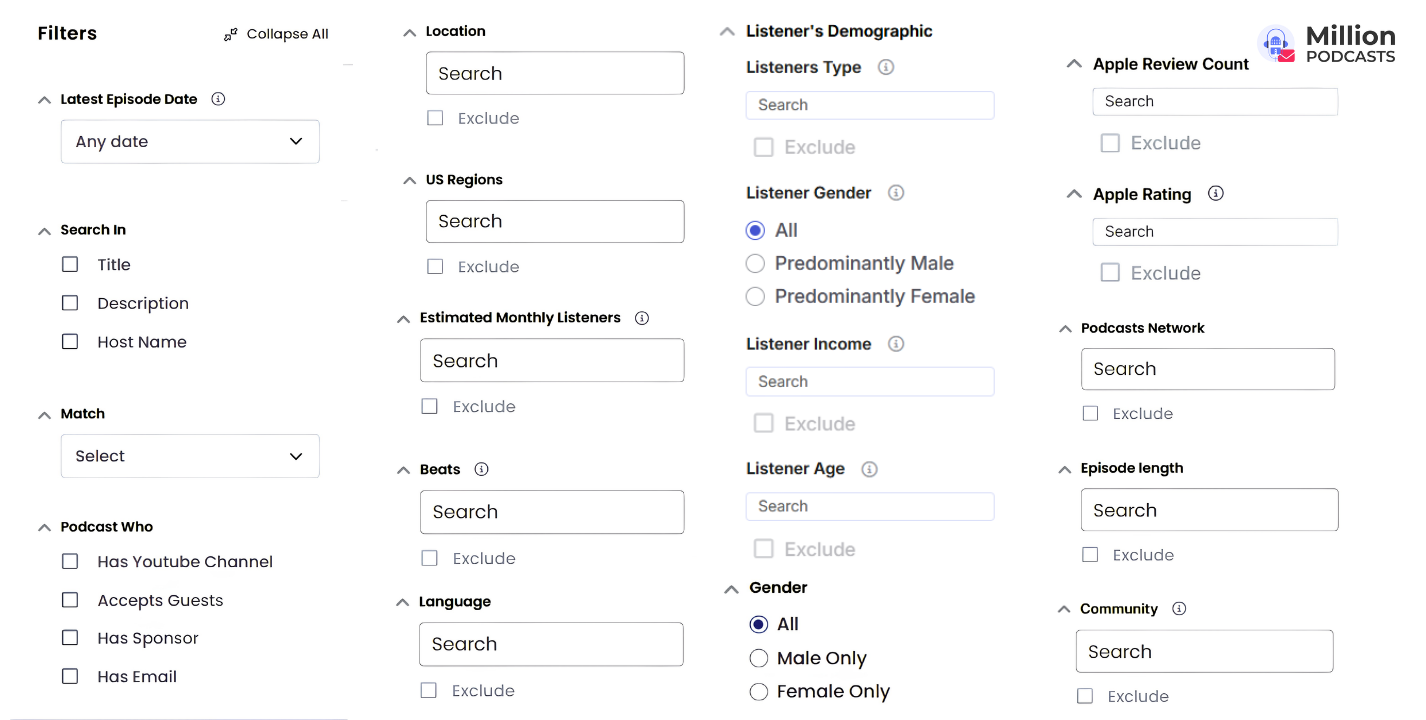
Activity and search scope filters
| Filter | Options | What it removes |
|---|---|---|
| Latest Episode Date | This Week, This Month, This Year, Last Week, Last Month, Last 30 Days, Last 12 Months, Last 25 Months, Custom | Inactive and dormant shows |
| Search In | Podcast Title, Podcast Description, Host Name | Irrelevant keyword matches in wrong fields |
| Match | All of these words (AND), Any of these words (OR), This exact word or phrase | Off-target keyword combinations |
| Podcast Who | Has YouTube Channel, Accepts Guests, Has Sponsor, Has Email | Shows with no booking path or contact |
Location and language filters
| Filter | Options | What it removes |
|---|---|---|
| Location | Any country or city, with an exclude option | Shows outside your geographic target |
| US Regions | SF Bay Area, New York Metro, Chicago, Dallas-Fort Worth, Houston, Miami, others | Shows outside your target US metro area |
| Language | Include or exclude any of 180 supported languages | Shows in languages you cannot pitch in |
Audience demographic filters
| Filter | Options | What it removes |
|---|---|---|
| Listeners Type | Entrepreneur, CEO, Spiritual Seeker, Mental Health Advocate, Personal Development Advocate, Educator, Investor, Tech Enthusiast, and more | Shows whose audience does not match your offer |
| Listener Gender | All, Predominantly Male, Predominantly Female | Audience gender mismatches |
| Listener Income | Low Income, Medium Income, High Income | Wrong purchasing power for your product |
| Listener Age | Gen Alpha (0-13), Gen Z (14-29), Millennials (30-45), Gen X (46-61), Baby Boomers (62-80), Silent Generation (81-98) | Wrong life stage for your campaign |
| Estimated Monthly Listeners | Up to 1K (Nano), 1K to 10K (Micro), 10K to 50K (Mid-Tier), 50K to 250K (Macro), 250K to 1M (Mega), 1,000,000+ (Celebrity) | Shows too small or large for your campaign scale |
Show format and network filters
| Filter | Options | What it removes |
|---|---|---|
| Beats | Technology, Business, Health, Society, Politics, True Crime, and more (multi-select) | Shows misaligned editorially with your pitch angle |
| Gender (host) | All, Male Only, Female Only | Off-brief host profile |
| Podcasts Network | Include or exclude any named network | Competitor networks or incompatible groups |
| Episode Length | Less than 10 min, 10-20, 20-40, 40-60, 60-90, Over 90 min | Format mismatches with your pitch style |
Brief: Spanish-language fintech podcasts in the US that accept guests, reach a high-income audience, and published in the last 30 days.
Filters: Language = Spanish | Location = United States | Podcast Who = Accepts Guests + Has Email | Listener Income = High Income | Latest Episode Date = Last 30 Days
Result: A shortlist of active, reachable, audience-matched shows ready to add to a list and export with verified contacts attached. What takes most of a morning manually takes under 5 minutes here.
For the complete step-by-step walkthrough of stacking these filters and exporting the result, the MillionPodcasts advanced features guide covers every stage.
4. What Does a Show Profile Contain?
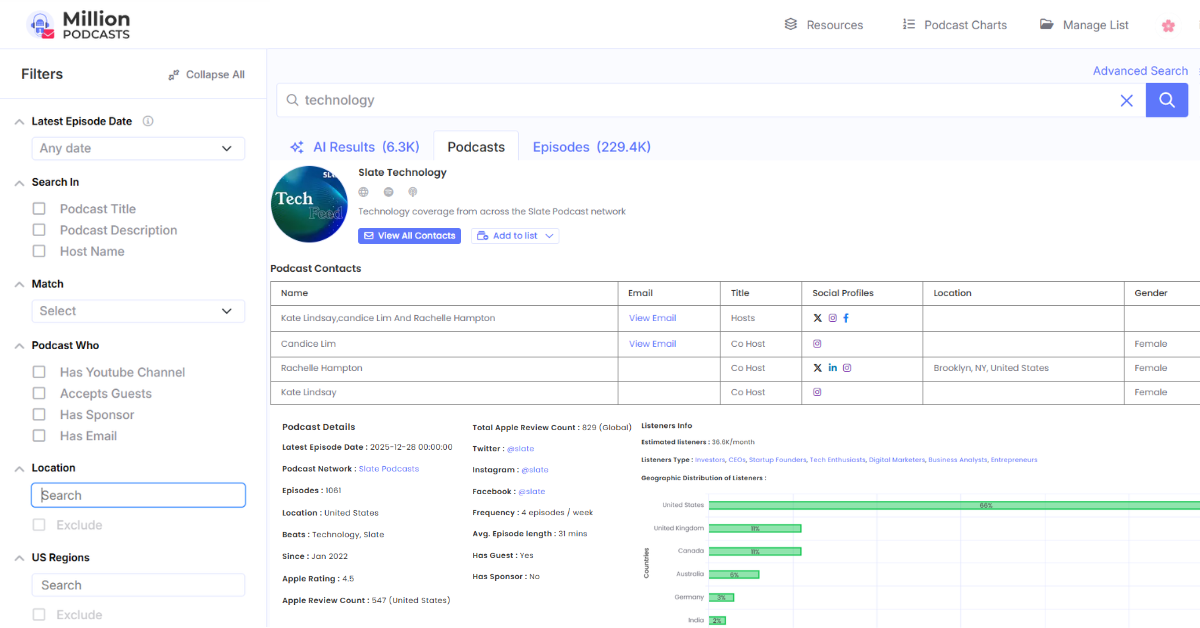
Clicking a show opens a profile built to answer the questions of outreach in the order they actually matter. By the time you reach the bottom, you know who to contact and whether the show is active. You also know whether the audience fits your campaign. Four blocks provide those answers.
Podcast Contacts
This block names the specific people associated with the show. Each row includes the contact's Name, verified Email, Title or role, Social profiles, Location, and Gender. A show may list multiple contacts: co-hosts, a producer, a booking agent where one exists, and the show's own general inbox.
Choosing who to address is a tactical decision. Pitch the host directly for guest appearances. Reach the booking agent for faster calendar access. Contact the producer for editorial conversations. Having all of them on one screen means you make that choice before you draft a word.
Podcast Details
| Field | What it tells you before you pitch |
|---|---|
| Latest Episode Date | Whether the show still publishes. Over 90 days ago is a stop signal on most campaigns. |
| Episode Count | Total output over the show's lifetime. Consistent high counts signal a disciplined operation. |
| Since | The launch date. Context for audience development and show maturity. |
| Apple Rating | Audience satisfaction. Read alongside review count, not in isolation. |
| US and Global Apple Reviews | Regional reach split. A show with a modest US count but a high global one has its main audience elsewhere. |
| Frequency | How often new episodes publish. Affects your pitch timing window. |
| Average Episode Length | Format context. A 10-minute daily show will not run a 45-minute guest interview. |
| Estimated Monthly Listeners | Scale. Does this show reach enough of your target audience? |
| Podcast Network | Whether the show belongs to a network. Affects who controls booking and sponsorship decisions. |
| Has Guest | Binary go or no-go for guest placement campaigns. If no, move on immediately. |
| Has Sponsor | For sponsorship campaigns: yes means the commercial model already exists. |
| Beats | Content themes the show covers, across multiple beats simultaneously. Tells you how the host thinks. |
Listeners Info
This block shows the demographic profile of the actual audience for that specific show. It covers Listener Type, Age generation, Income band, and Gender balance, each shown as a percentage split. Two shows can share a topic and a size band yet reach entirely different people. This is the layer that confirms the audience fits your offer, not just the topic.
Geographic Distribution
A country-level bar chart shows where the listener base actually sits. A New York business show can hold 73 percent of its listeners in the US, with the rest spread across eight countries. A show recorded in Canada might draw most of its audience from the United States. The chart confirms or overrides any geographic assumption before a contact is unlocked.
5. Where the Contact Data Comes From
Every database claims verified contacts. Very few explain what that word covers, so here is the actual process behind the 1.2 million contacts in this one.
How a contact is sourced and checked
Contacts are researched by hand, the way a publicist would find them: show websites, About and press pages, and host bios, using publicly available sources only. Nothing is taken from the launch-day RSS field. Each address then runs through SMTP verification before it appears in a profile, and it is refreshed through direct outreach and corrected when a user reports a bounce.
Maintenance is the part that decides whether a list still works six months from now. In the last 3 months, 19.5K contacts were updated. Beyond individual hosts, 6K networks and producers carry a direct contact of their own, which is the route that matters when a network controls booking rather than the host.
What does not ship as a verified contact
- Addresses that fail a check. A failed SMTP result means the record does not appear as a verified contact.
- Pattern guesses. No invented first-name-dot-surname combinations. Where no reachable contact exists, the show appears without one.
- Scraped feed emails. The RSS contact field exists on most shows and is deliberately not treated as a contact.
- Out-of-scope personal data. Handling follows GDPR and CAN-SPAM: business contact details, a clear source, and removal on request.
One number on the platform deserves a plain explanation. The database reports 340.5K new podcasts added in the last 3 months, which is far above the global launch rate. That figure is index backfill, meaning existing shows newly discovered and added, not shows created in that window.
Why verification decides your reply rate
The temptation in outreach is to optimize for list size. A 500-row export feels more productive than a 100-row one. In practice the bigger unverified list loses, and the reason shows up in deliverability.
Dead and wrong addresses are what push a domain toward those numbers, because bad targeting produces the complaints that Gmail counts. The damage is not limited to one campaign either. It follows the sending domain into every campaign after it.
A verified podcast contact list of 80 relevant shows can outperform a scraped list of 500. The verified list lands in inboxes, protects the sending domain, and produces replies. The scraped list produces bounces, reputation damage, and cleanup work before a single pitch gets a fair chance.
6. Is Million Podcasts Legit?
Yes, and the useful version of that answer is a list of things you can verify without taking this page's word for it.
Pricing is published on the site, free-plan limits included. Payments run through Stripe. The free plan needs no card, so the data can be inspected before any money changes hands. Data handling follows GDPR and CAN-SPAM, and support runs through an in-app Help widget and email.
Reviews are signed rather than anonymous. Francesca De Franco, a public relations consultant, writes about targeting podcasts without wading through a general media database. Paulina Colwell, a public relations account executive at KCSA Strategic Communications, describes receiving a niche coffee podcast list her intern had spent months assembling by hand. Rochelle Brandvein, president of Brandvein-Aaranson Public Relations, uses it to place nonprofit clients.
Their full reviews, with titles and firms, sit on the MillionPodcasts customers page. Naming what the product does not do belongs here too. MillionPodcasts does not send email, write or schedule follow-ups, run sequences, or track replies. It is not a CRM and not a sequencer, and it ends when a filtered, verified list reaches your CSV.
Test the data, not the copy. Look up two shows you already know well, then compare the named contact, the latest episode date, and the listener split against what you can confirm independently. Familiar shows expose an inflated database faster than any review does.
7. What MillionPodcasts Costs
Plans bill monthly or yearly, and yearly billing saves up to 40%. The prices below are the yearly rate, shown per month.
| Plan | Price | Contact unlocks | Suits |
|---|---|---|---|
| Free | $0, no card | None, search and profiles only | Testing coverage before you commit |
| Starter | $12 per month | 1,500 a year | Freelancers and single-campaign work |
| Pro | $30 per month | 12,000 a year | In-house teams pitching monthly |
| Business | $60 per month | 60,000 a year | Agencies running several clients at once |
| Business Plus | $150 per month | Unlimited | High-volume teams wanting concierge research |
Unlocking a contact means revealing one verified email, and each reveal draws down the plan's yearly allowance. Exports come with column selection on every paid plan, and a single list holds up to 10,000 shows.
The free plan gives 100 searches a month, 250 results per query, and 3 lists. It deliberately withholds the commercial parts: verified emails, exports, Location and US Region filters, and listener demographics. Full limits sit on the MillionPodcasts pricing page, and the Business tiers add concierge contact research and list building on request.
Build the list. Skip the cleanup.
Search more than 3 million podcasts, filter to shows that match your brief with 17 filters, and unlock verified host and booker contacts. Export to CSV or Excel for your own pitching tool.
Start free, no card needed →8. Who Uses a Podcast Database and Exactly How
The same database serves three distinct jobs, and each user runs the same four-step build in a different order. The three cards below put the workflows side by side, so you can compare them step for step.
One habit applies to all three. Name lists by campaign rather than by topic, and re-apply Latest Episode Date before exporting from any list older than a month, because shows go quiet between campaigns.
9. How to Choose a Podcast Database in 2026
Not every tool that calls itself a podcast database qualifies for outreach. Six questions separate tools built for this job from directories with contact fields bolted on. Ask them of any vendor, including this one.
1. Are contacts verified or scraped from RSS?
RSS-sourced emails are the default for most aggregators. Ask specifically how contacts are sourced and whether they pass SMTP verification. If not, the bounce rate on any export will reflect that on the first send.
2. Does it track publishing activity?
A podcast database that cannot filter by last episode date is a static archive. Filtering by recency is not optional. It separates a list you can send from a list you must clean first.
3. Can you filter by audience demographics?
Topic filtering tells you what the show covers. Audience filtering tells you who listens. For any campaign where audience identity determines fit, topic filtering alone is insufficient. Listener Type, Income, Age, and Gender need to be filterable fields, not just display data inside profiles.
4. Does it cover Apple, Spotify, and YouTube?
The podcast ecosystem is split across platforms. A database that only indexes Apple Podcasts misses Spotify-exclusive shows and the growing population of video podcasts on YouTube. Cross-platform coverage with shows tagged by platform is the minimum viable standard in 2026.
5. Can you export to your own tools?
A database that keeps your list inside the platform is a walled garden. CSV and Excel export with column selection makes the data portable and actionable outside the platform. The file arrives shaped for your CRM or pitch tool.
6. Is there a free tier to test with real data?
Running a real search against a real campaign brief is the only reliable way to evaluate any podcast database. Do that before paying. A platform confident in its data quality offers a free plan that lets you test the search, filters, and profile quality first. MillionPodcasts has a free plan with no card required for exactly that reason.
Evaluate with your hardest brief, not your easiest. A niche, non-English, or metro-specific brief exposes coverage gaps in minutes. A generic brief makes every database look complete.
Where other tools are stronger is worth saying plainly. Podchaser indexes a larger catalogue and adds transcript-level brand monitoring with a public API. Rephonic is well regarded for listener estimates and network visualizations. Muck Rack covers journalists and outlets alongside podcasts, which a podcast-only database does not attempt. If you want the wider market laid out, our podcast database platforms comparison covers each one.
So where does that leave you?
If your job is podcast placement and your current list came from a scraper or an old spreadsheet, spend fifteen minutes on the free plan with your hardest brief. That single test answers the question better than any page can. If you need one database covering journalists and podcasts together, a general media tool fits you better. If raw catalogue size is what you are buying, buy on size.
Whichever way that goes, stop judging a podcast database on its headline number. Ask how many of those shows published this month, carry a contact that resolves, and take guests. Those three answers decide whether your next campaign lands.
10. Podcast Database FAQ
What is MillionPodcasts?
MillionPodcasts is a podcast contact database built for outreach rather than listening. It indexes more than 3 million shows across Apple Podcasts, Spotify, and YouTube, and pairs 1.2 million of them with verified host, producer, and booker contacts. You filter that index down to the shows that fit a campaign, unlock the contacts you need, and export the list to CSV or Excel.
Is it MillionPodcasts, Million Podcasts, or Millions Podcast?
They all refer to the same product. The site writes it as one word, MillionPodcasts, at millionpodcasts.com. Million Podcasts with a space, million podcast in the singular, and millions podcast are all common variations people type. There is no separate company behind any of those spellings.
How many podcasts does MillionPodcasts have?
MillionPodcasts covers more than 3 million podcasts and 62.1 million episodes across 11.4K categories and 180 languages, with 1.2 million shows paired with verified contact details for hosts, producers, and bookers. A further 6K networks and producers carry a direct contact of their own. Platform figures are as of June 11, 2026.
Is Million Podcasts legit?
Yes. Million Podcasts, written MillionPodcasts on the site itself, is a working podcast contact database used by PR teams, marketers, and podcasters who review it publicly under their own names, titles, and firms. Contacts are manually researched, SMTP checked, and kept current rather than scraped from launch-day RSS feeds, with 19.5K contacts updated in the last 3 months alone. Data handling is GDPR and CAN-SPAM compliant, payments run through Stripe, pricing is published on the site, and the free plan needs no card.
Is MillionPodcasts free to use?
Yes. There is a free plan with no credit card required, giving you 100 searches a month, 250 results per query, and 3 saved lists, so you can search the database and open show profiles first. Unlocking verified contacts, exports, location filters, and listener demographics happens on a paid tier, which starts at $12 per month billed yearly.
Can MillionPodcasts send my outreach emails?
No. MillionPodcasts is the sourcing and list-building step. It finds the right shows and verified contacts and exports a pitch-ready list to CSV or Excel. The pitching, sending, and follow-up happen in your own email tool or CRM.
References
Listen Notes. (August 2026). Podcast Stats: How many podcasts are there? https://www.listennotes.com/podcast-stats/ Listen Notes data, reported by Inside Audio Marketing. (July 2026). Fewer New Podcasts In June, Yet Stronger Activity Marks First Half Of 2026. https://www.insideaudiomarketing.com/post/fewer-new-podcasts-in-june-yet-stronger-activity-marks-first-half-of-2026 Google. (2026). Email sender guidelines. https://support.google.com/a/answer/81126 MillionPodcasts. (June 2026). Our database. https://www.millionpodcasts.com/ MillionPodcasts. (2026). Plans and pricing. https://www.millionpodcasts.com/pricing