
Your choice of media database can make or break your PR outreach before you send a single pitch. Not all databases offer the same reach or depth, and the difference matters when you value quality more than quantity.
Choosing the best media database for PR comes down to three questions. How deep does it go in your beat and your markets? Does it send the pitch, or only find the address? And what are you agreeing to when you commit to a multi year contract?
Six of the seven below are journalist contact databases. One is a podcast database, and this guide says plainly where each of them stops. Every media contacts platform here is measured on the same six criteria, and prices come from each vendor's own live pages, checked in August 2026. If podcasts are part of the plan, the same coverage test applies when you build a podcast outreach list.
Which media database should you commit to before signing a multi year contract? Choose on coverage depth in your market, not on total contact count. Cision leads on countries, Muck Rack on data upkeep, JournoFinder on price from $119 a month, MillionPodcasts on podcasts.
1. MillionPodcasts: best for podcast outreach lists
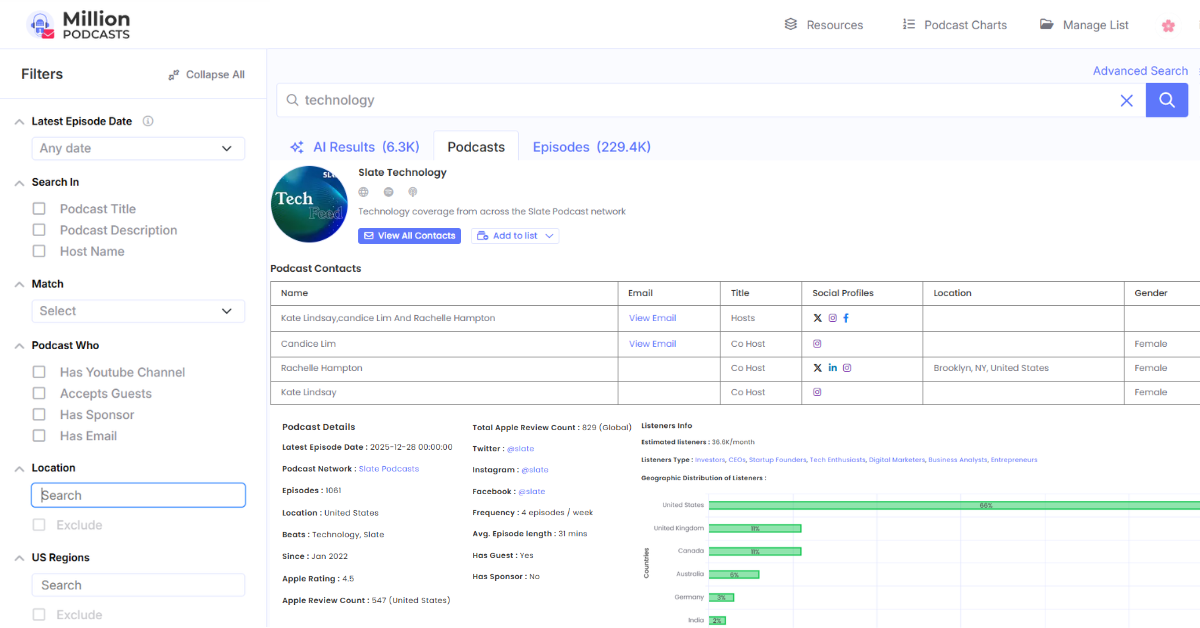
Podcasts are the media type most journalist databases treat as an afterthought. This one is built the other way round. It indexes shows, hosts, producers and bookers rather than reporters, and 379.7K of those shows are flagged as accepting guests. The trade is narrowness, because it goes deep on one format and ignores the rest.
- Best for: PR teams and publicists who book podcast guest spots as a repeating channel. It complements a journalist contact database rather than replacing one.
- Standout: 17 filter dimensions, including listener demographics that cover listener type, income band, age generation and gender skew. Pitch the marketing shows whose audience is founders, not every show tagged marketing.
- Pricing: free plan with no card. Starter $11, Pro $30, Business $60 and Business Plus $150 per month billed yearly. Contact unlocks, exports, location and demographics filters need a paid tier.
- Watch out for: no newspaper, magazine or broadcast journalists, and no sending. It builds and exports the list, then your outreach tool does the rest.
You can browse the same index by category, without a login, in the MillionPodcasts podcast directory.
Stack three filters before you export: accepts guests, your beat keyword, and a minimum monthly listener band. That turns 3M+ shows into a few hundred in about two minutes. Anything broader gives you a list you will never finish pitching.
2. Cision: best for global campaigns across 225 countries
Cision gets bought as a whole suite more often than as a database. Its journalist outreach product is researched and verified in house. The country figure is the widest anyone here publishes.
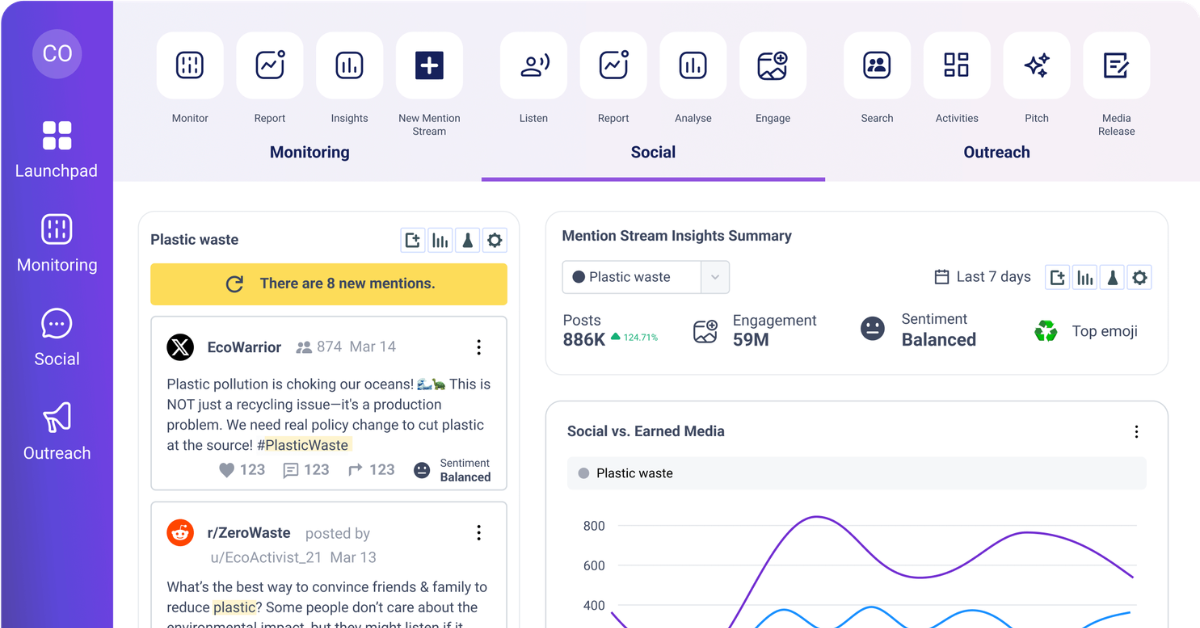
Contact management sits alongside it, so you can write personalised pitches, schedule responses and keep the interaction history in one place. The catch is that you rarely get to buy only the database.
- Best for: teams running campaigns across several regions at once, especially where wire distribution sits in the same budget line.
- Standout: reach into 225 countries and territories. That is the widest published figure in this comparison, and the reason multi region teams stay.
- Pricing: custom, quote only. Procurement data from 102 verified purchases puts the median buyer at $12,677 a year, with non enterprise deals from $3,400 to $33,700.
- Watch out for: breadth is not depth. Test your smaller and non English markets during evaluation instead of trusting the country count.
3. Muck Rack: best for accuracy in US and UK outreach
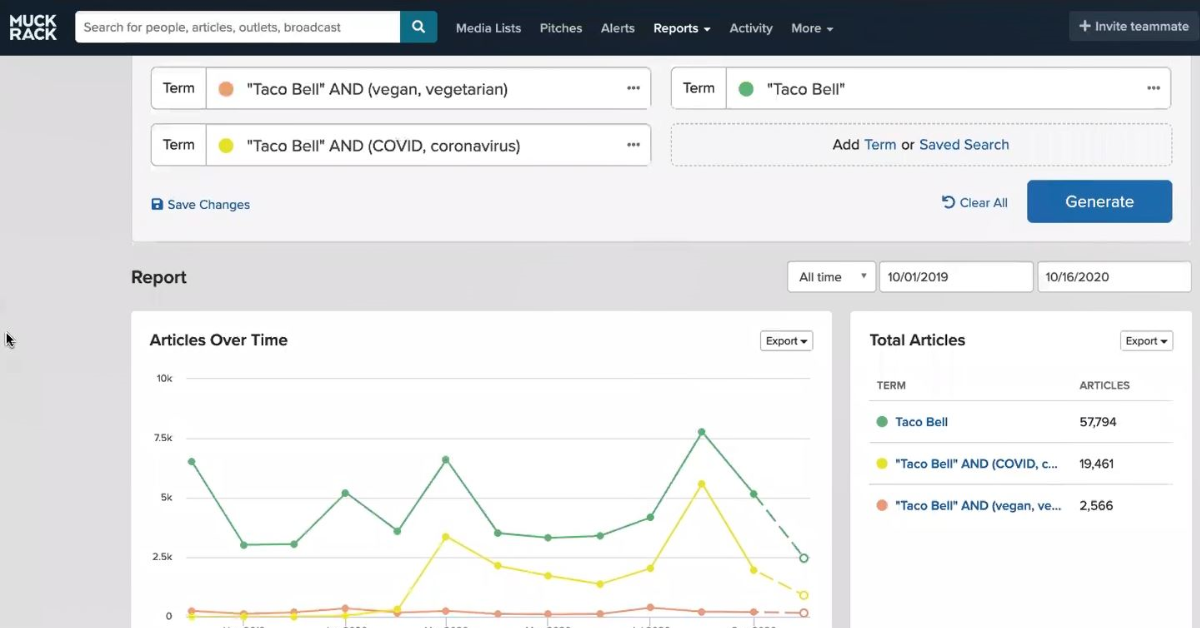
Muck Rack does not lead with a contact count. It leads with how the data is kept alive. Its research team reviews listings continuously, and the platform reads pitch bouncebacks as a signal that a journalist has moved on. Role changes and beat shifts then alert whoever owns the list, which is the part that saves a campaign.
- Best for: US and UK earned media teams where a bounced pitch costs more than the seat does.
- Standout: AI Visibility Badges, launched in March 2026 and drawn from more than 15 million AI response citations, which rank journalists and outlets by how often AI answers cite them. Muck Rack's own research found only 2 percent of pitched journalists are the ones AI systems actually cite.
- Pricing: custom, quote only. Annual contracts, with a demo required before any figure gets shared.
- Watch out for: no published contact count and no country breakdown. Size your own beat during the trial rather than assuming coverage.
4. Meltwater: best for outreach plus media monitoring
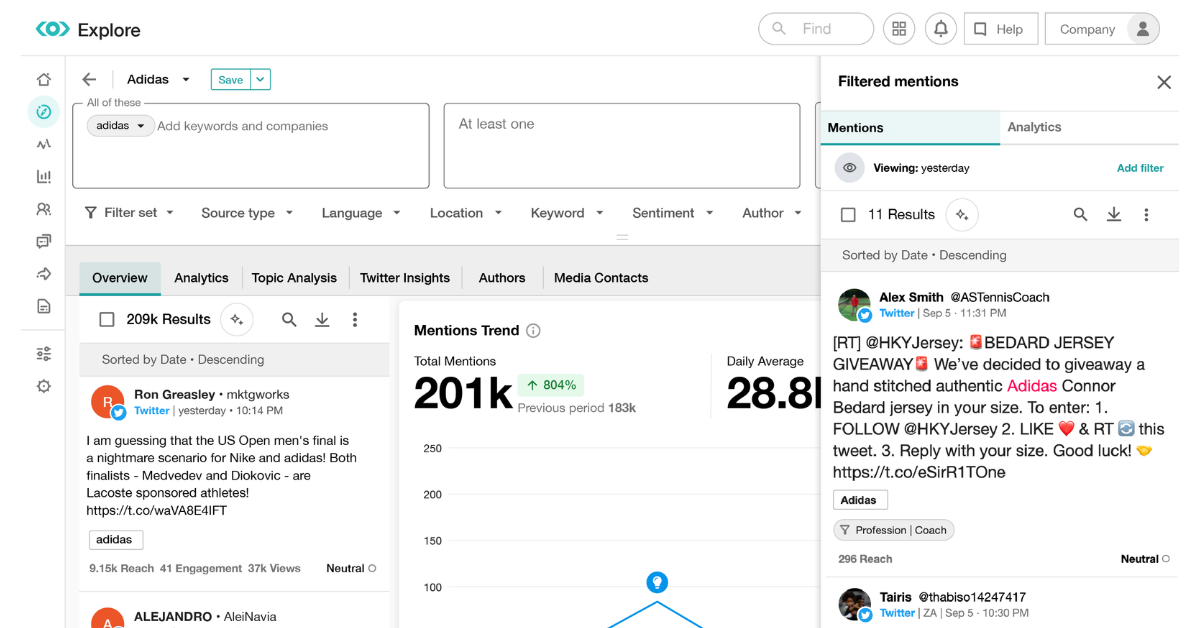
Meltwater grew out of monitoring and now sells the whole media relations loop. Profiles carry outreach history plus beat and role change alerts, so you avoid pitching someone a colleague contacted last week. You can send from inside the platform, then read opens, clicks and bounce types in the same view. Contacts are a separate module, not a default inclusion.
- Best for: teams where brand monitoring and executive reporting matter as much as finding the contact.
- Standout: bounce type reporting inside the outreach view. You learn which addresses died, not just that a pitch failed, which is rare in this category.
- Pricing: custom, quote only. Procurement data from 91 verified purchases puts the median buyer near $25,000 a year across the platform.
- Watch out for: get it in writing that the contacts module sits inside the tier you are quoted, before the proposal arrives.
Ask any monitoring led vendor one question before the proposal arrives. Is the contacts database included in this tier, or priced separately? Get the answer by email. It is the most common source of surprise cost in this category.
5. Agility PR Solutions: best for mid market global reach
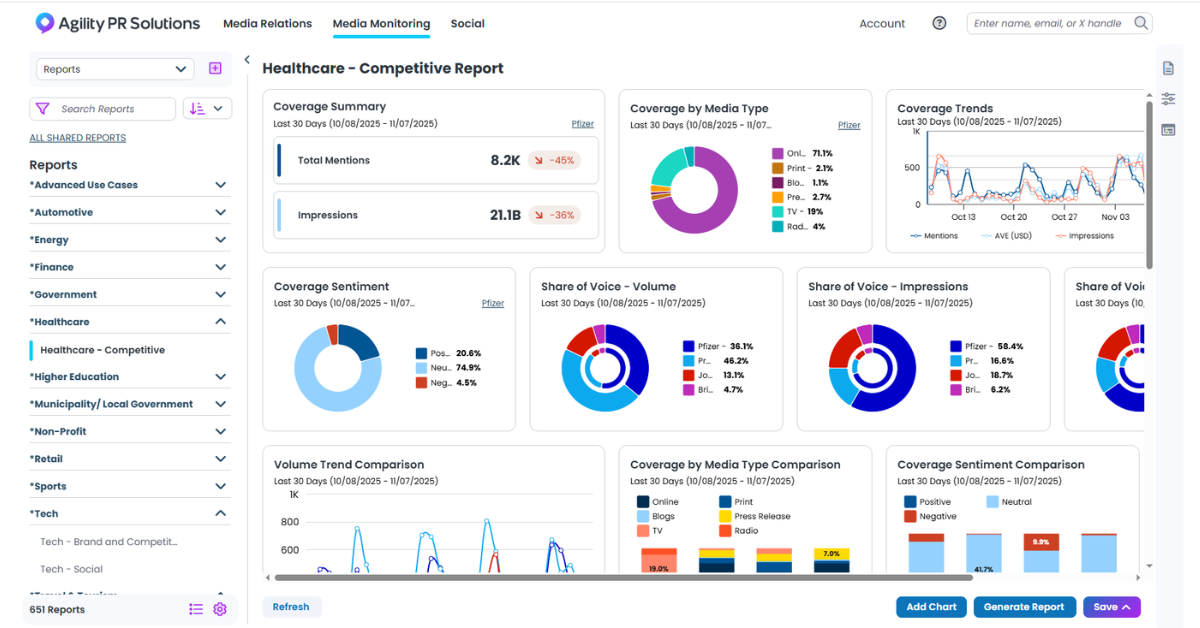
Agility sits between the enterprise suites and the self serve tools. Its parent company Innodata describes a global database of traditional media contacts and social media influencers, spanning more than 200 countries. Monitoring runs across online, print, broadcast and social in the same platform, so you are not stitching three vendors together. Pricing still runs through a sales conversation.
- Best for: mid market teams that want database, distribution and monitoring on a single invoice.
- Standout: 820,000+ contacts across more than 200 countries, without an enterprise level commitment.
- Pricing: custom, quote only. There is no published self serve tier and no public free trial.
- Watch out for: ask what share of contacts in your verticals are named journalists rather than shared newsroom inboxes. That ratio decides your reply rate.
6. JournoFinder: best for freelancers and small agencies
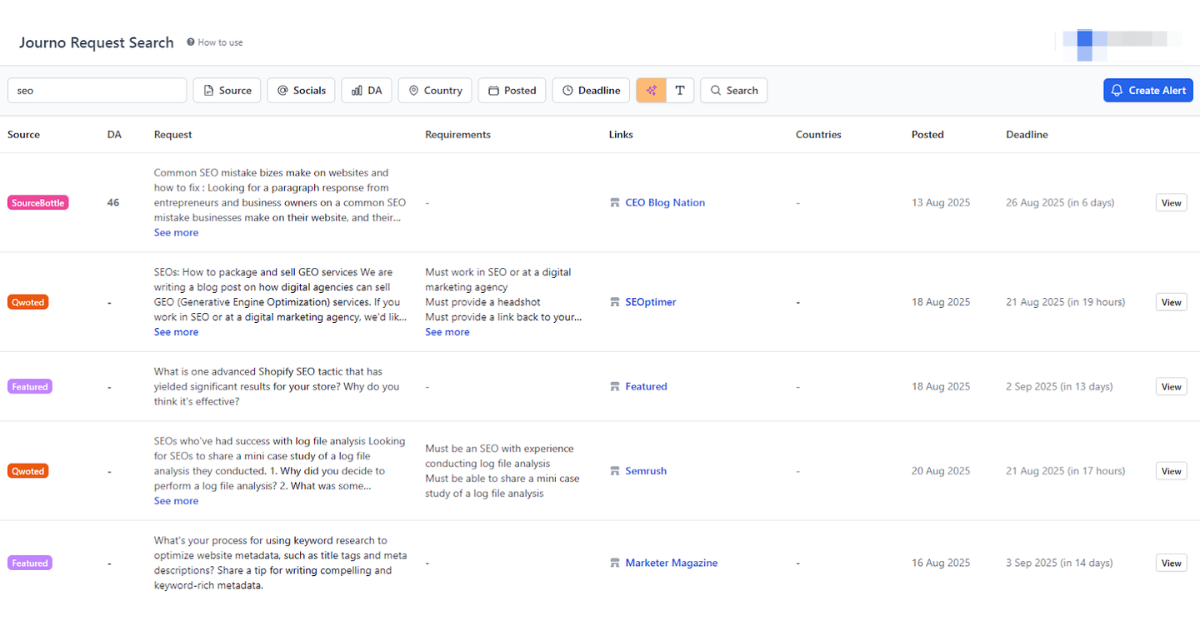
JournoFinder is the cheapest full function journalist contact database here and the easiest to try. It indexes published articles rather than serving a static directory, so results skew towards reporters writing about your topic now. It also pulls journalist source requests into one feed, which covers reactive pitching alongside proactive lists. There is no sending layer at all.
- Best for: freelancers, solo publicists and small agencies who need real contacts without an annual negotiation.
- Standout: a 7 day free trial with no sales call. You can test coverage in your own beat before spending anything, which nothing above this price allows.
- Pricing: $119 per month billed annually for one user and $229 for a 3 user team. The free tier covers journalist request alerts only, not the database.
- Watch out for: a smaller database than the enterprise suites, and no sending. Expect gaps in narrow verticals and smaller language markets.
7. Anewstip: best for pitching breaking stories fast
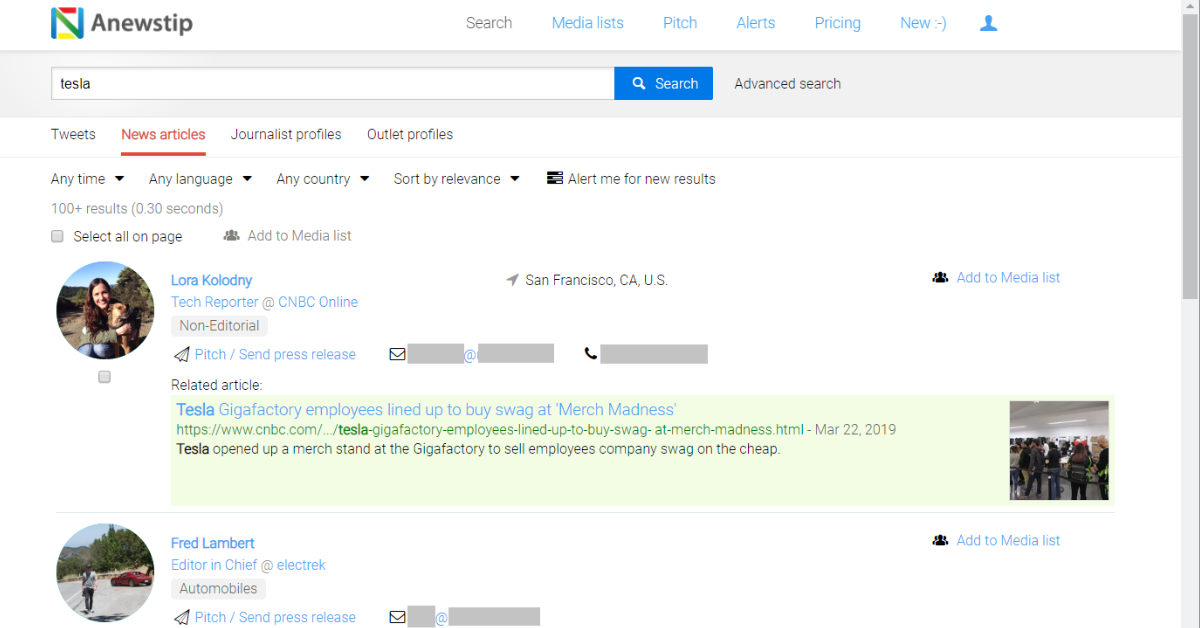
Anewstip inverts the usual model. Instead of browsing a profile directory, you search what journalists published and posted recently, then pull contact details from those results. A team pitching an AI regulation story can find everyone who covered it in the last 72 hours. Depth drops for outlets whose reporters post little in public.
- Best for: teams pitching newsy or fast moving stories, where recency beats a journalist's historical beat.
- Standout: date ranged search across journalist posts and articles, so the list reflects this week rather than last year.
- Pricing: Standard $200 and Professional $400 per month. An Early Stage plan runs $99 for eligible solo pros and early stage companies.
- Watch out for: built for discovery and first contact. Campaign analytics and long term relationship history need a separate tool alongside it.
8. All 7 media databases compared side by side
Same criteria, all seven, in the order they appear above. There is no single best media database for PR, only the one that fits your constraints. Where a row says custom, the figure shown is a procurement median from verified purchase data.
| Tool | Best for | Key strength | Sends the pitch | Try without a sales call | Starting price |
|---|---|---|---|---|---|
| MillionPodcasts | Podcast guest outreach | 3M+ shows, 17 filter dimensions including listener demographics | No, export and send elsewhere | Permanent free plan, no card | Free, then $11 a month billed yearly |
| Cision | Multi region enterprise campaigns | 500,000+ profiles across 225 countries and territories | Yes, with pitch history and scheduling | No, demo required | Custom, median buyer $12,677 a year |
| Muck Rack | Accuracy led US and UK outreach | 100+ researchers and bounceback driven data upkeep | Yes, pitching sits in the platform | No, demo required | Custom, quote only |
| Meltwater | Monitoring and reporting alongside outreach | 800k+ AI verified profiles with bounce type reporting | Yes, personalised or mass email | No, demo required | Custom, median buyer near $25,000 a year |
| Agility PR Solutions | Mid market global campaigns | 820,000+ contacts across 200+ countries | Yes, outreach and distribution bundled | No, demo required | Custom, quote only |
| JournoFinder | Freelancers and small agencies | Article verified contacts and a journalist request feed | No, export and send elsewhere | 7 day free trial, self serve | $119 a month billed annually |
| Anewstip | Breaking and fast moving stories | Profiles for 1M+ journalists, searchable by recent posts | Yes, pitches and bulk releases | 7 day free trial, self serve | $99 a month on the Early Stage plan |
Decision flow: pick by format, then by budget
- Podcasts anywhere in the plan: start with MillionPodcasts. The free plan tests your niche before you spend, and no journalist database matches its filters for shows. Then choose one of the four below for journalists.
- Under $1,500 a year: JournoFinder at $119 a month. Article verified contacts and a 7 day trial, with no sales call in the way.
- $1,500 to $2,500 a year: Anewstip. Search by what journalists posted this week, which helps when stories break faster than databases refresh.
- Roughly $3,000 a year: Agility PR Solutions. Global coverage with distribution and monitoring bundled. Verify data quality in your niche during evaluation first.
- $5,000 and above: Muck Rack if accuracy decides your campaigns, or Cision if you need 225 countries. Choose Meltwater if monitoring matters as much as contacts.
9. Which media database covers international markets?
Coverage is what separates a working media contacts database from an expensive address book. Headline counts are global totals, and your campaign is not global. A million records help nobody if forty of them cover your vertical in your country, and half have left the outlet.
What each vendor publishes tells you something on its own. Country counts are easy to advertise. Depth inside a single market or a niche vertical is harder to express in one number, so it is worth asking for directly.
| Tool | What it publishes about coverage | What you have to test yourself |
|---|---|---|
| Cision | 500,000+ profiles, 225 countries and territories | Contact depth inside any single country or vertical |
| Agility PR Solutions | 820,000+ contacts, 200+ countries | The split between named journalists and shared inboxes |
| Meltwater | 800k+ AI verified profiles | Country and regional breakdown, which is not published |
| Muck Rack | Verification process rather than volume | Both size and geography, since neither is published |
| JournoFinder | Contacts verified against recently published articles | Depth in narrow verticals and non English markets |
| Anewstip | Full profiles for 1M+ journalists and outlets | Coverage of reporters who rarely post in public |
| MillionPodcasts | 3M+ shows, 1.2M with contacts, 180 languages, plus the market by market depth published below | Nothing outside podcasting, which it does not claim to cover |
Coverage depth in our own index, market by market
Here is the same depth cut we ask other vendors for, run on our own data. The full index holds 3M+ shows and 1.2M with contacts. The figures below are stricter than that. They count only shows that published an episode in the last 12 months.
On that basis MillionPodcasts holds 630K active shows, and 417.4K of them carry a contact email. Ask for shows that accept guests and have an email, and 169.3K remain. That last number is the one a podcast campaign actually runs on.
Read the table by the market you pitch into rather than the global row, since a single market decides whether a campaign has enough to work with.
| Market filter | Active shows, last 12 months | Of those, shows with a contact email |
|---|---|---|
| Every market | 630K | 417.4K |
| United States | 97.7K | 83.2K |
| United Kingdom | 11.3K | 9.8K |
| German language | 32.3K | 26.9K |
| Spanish language | 30.1K | 22.2K |
Notice how many of the active shows in each market carry a working email, because that ratio is what a list is built from. These counts were run in August 2026, with the search box empty and the date filter set to the last 12 months. Ask every shortlisted vendor for the same cuts in the markets you pitch.
Send that table to each vendor and ask them to fill their own version. Two numbers per market is all you need. Anyone who answers with a global total, or with a country count, has told you the answer anyway.
The 10 minute coverage test
You can run this inside a single demo, before any trial starts.
- Write down 10 outlets you already pitch. Include two regional or trade titles and one in your second language market.
- Have the vendor search each one live. Count how many return a named journalist with a personal address, not a newsroom inbox.
- Check the last published date on every result. A profile with no article in eight months is a dead contact wearing a live badge.
- Repeat for your narrowest beat. Under 30 usable contacts means that platform cannot carry the campaign alone.
- Ask for those counts in writing. A vendor confident in its coverage will send them without hesitating.
This is also why plenty of teams end up running two tools. Journalist databases carry podcasts as one media type among many, so the fields that decide a podcast pitch are missing. Whether a show takes guests, how often it publishes, and who listens are not there. The gap between a podcast directory and a podcast database is worth understanding before you buy either.
Close the podcast gap in your media list
Filter 3M+ shows by beat, host location, listener demographics and whether the show accepts guests. Unlock verified host, producer and booker emails. Export to CSV or Excel and pitch from your own tool.
Search 3M+ podcasts free →10. Does a media database send your pitches for you?
Five of the seven do. Cision, Meltwater, Muck Rack, Agility and Anewstip let you write and send from inside the platform, then report on opens and clicks. JournoFinder and MillionPodcasts stop at the export. You take the file to whatever tool you already send from.
Neither model wins in the abstract. What matters is which one fits how your team already works, and where you want the risk to sit. If you are assembling monitoring and reporting around it too, the wider PR tool stack is a separate decision.
Sending from inside the database ties contact accuracy straight to your sender reputation. Every bounce lands on a domain the vendor helped configure, so a stale record becomes your deliverability problem. Exporting keeps that control with you, which usually suits teams already running a warmed up outreach tool.
If a platform sends on your behalf, ask how fast a hard bounce flags that contact for every other customer. Real time flagging protects the whole user base. Systems waiting on manual reports keep circulating dead records for months.
11. What does a media database cost, and is any free?
There is no single price for the best media database for PR. The media database services here split two ways. Three publish figures you can budget against: MillionPodcasts starts free and runs to $150 a month, JournoFinder is $119 a month billed annually, and Anewstip lists $99 for eligible early stage teams.
The other four need a call first. Verified purchase data puts the median Cision buyer at $12,677 a year and the median Meltwater buyer near $25,000. Muck Rack and Agility publish nothing at all.
Which media databases are actually free
Free means different things across these seven, and the difference matters. MillionPodcasts has a permanent free plan with no card, though contact unlocks and exports sit behind a paid tier. Anewstip offers a free version alongside a 7 day trial of its paid plans.
JournoFinder's free tier is the one most often misread. It covers journalist request alerts only, not the database, so the 7 day trial is the real way in. Cision, Muck Rack, Meltwater and Agility have no free tier at all.
The expensive mistake is rarely overpaying on the headline rate. It is buying capacity you never touch. List the features you will genuinely use in your first 90 days, then hold that list against the annual cost. A short list means the simpler platform was the right answer.
The contract terms that cost more than the price
Annual lock in is normal here. What varies is how easily you leave, and none of it appears in a proposal unless you ask. Put these in writing before signature.
- Auto renewal window. Get the exact number of days before expiry when renewal triggers, then set a reminder five days earlier.
- Cancellation method. Confirm whether notice must be written, to which address, and how many days ahead.
- Price escalation. Ask whether an annual uplift clause exists and what its maximum percentage is.
- Data portability. Confirm you can export lists and outreach history at any point, and for how long after you leave.
- Ownership changes. Ask what happens to your account if the product is sold, as covered in the questions below.
12. How to test a media database before you sign
Four of these media contacts platforms hide pricing behind a call. That call is also the best chance you get to surface what the marketing pages leave out. Work through these in order.
- Can I see 50 sample contacts from my beat? Run the addresses through a verification tool yourself and count the failures.
- How often are individual records re verified, and how? Ask for the refresh cycle and the method. Regularly is not an answer.
- Are these personal addresses or newsroom inboxes? Ask for the split in your verticals, not across the whole database.
- Where do the contacts come from? You want this on file, and the answer shows how the vendor treats the people you will email.
- Can a journalist request removal, and what happens to my list? Opt outs at the source should reach your saved lists too.
- Is the contacts database inside this tier or a separate module? Ask even when the quote looks complete, then repeat the answer by email.
- What are the renewal window, cancellation method and escalation clause? Get all three in one written reply.
- Can I export everything if I leave? Confirm the file format and how long access lasts after cancellation.
Those eight questions take about 15 minutes, and they narrow the best media database for PR faster than any feature list. Start with the three platforms that need no demo at all, because a real trial beats a good answer every time.
The smallest next step
If you are one person or a small agency, start with JournoFinder and trial it against your own beat. If you pitch several regions at once, Cision is the only one publishing coverage that wide.
If a bounced pitch costs you a relationship, pay for Muck Rack. If monitoring and board reporting matter as much as sourcing, Meltwater earns the extra spend. If podcasts are involved in your PR work, you can try out MillionPodcasts for free.
Then do the small thing first. Write down the 10 outlets and the one niche you must reach this quarter, and run the coverage test against them. Most shortlists drop from five names to two within the hour.
13. Frequently asked questions
What is a media database?
A media database, also called a media contacts database or a press contacts database, is a searchable directory of journalists, editors, producers and podcast hosts, organised by beat, outlet, location and audience. PR teams use one to build targeted media lists and find working contact details. The better ones also record what each contact published recently. That lets you time a pitch to current coverage rather than a two year old job title.
What is the best database for PR teams?
It depends on where you pitch and how you send. Muck Rack suits US and UK teams that judge a database on data upkeep. Cision covers 225 countries and territories, more than anything else here. JournoFinder is the cheapest full function option at $119 a month billed annually. If podcasts are part of the plan, MillionPodcasts covers the format the journalist platforms treat as a sideline.
Can you use a media database for free?
Partly. MillionPodcasts has a permanent free plan with no card, though contact unlocks and exports need a paid tier. Anewstip offers a free version plus a 7 day trial of its paid plans. JournoFinder's free tier covers journalist request alerts only, and Cision, Muck Rack, Meltwater and Agility have none.
Is Prowly still available as a media database in 2026?
Not as a standalone product. Prowly is now presented as the Semrush AI PR Toolkit, and new signups run through Semrush. Adobe completed its acquisition of Semrush on April 28, 2026, so the PR roadmap now sits inside Adobe. Current customers should confirm renewal terms and export options with Semrush before the next billing date.
Does a 2 percent bounce rate get your domain blocked by Google?
No. Google publishes no hard bounce percentage that triggers rejection. The threshold it enforces is the user reported spam complaint rate, which should stay below 0.10 percent and never reach 0.30 percent. Hard bounces still matter, because invalid addresses damage the reputation that keeps you under that line.
Is it legal to email journalists from a media database?
In most cases yes, but the legal basis sits with you rather than the vendor. Under GDPR, outreach to a named professional usually relies on legitimate interest, which needs a relevance test and a working opt out. US outreach falls under CAN SPAM, which requires accurate headers, a postal address and honoured unsubscribes. Ask any vendor where its contacts come from, and whether a journalist can request removal.
References
Cision. (2026). Journalist Outreach [500,000+ media profiles across 225 countries and territories, researched and verified in house]. https://www.cision.com/journalist-outreach/ Cision. (2026). PR and Corporate Communications [CRM tools generate personalised email pitches, schedule responses and keep a record of every interaction]. https://www.cision.com/use-cases/pr-and-corporate-communications/ Muck Rack. (2026). Media Database [team of over 100 people reviewing and updating listings; pitch bouncebacks used as a job change signal; continuous profile refresh with role and beat change alerts]. https://muckrack.com/pr-software/media-database Muck Rack. (March 5, 2026). Muck Rack Launches AI Visibility Badges [rankings drawn from more than 15 million AI response citations; tiers updated monthly; 2 percent overlap between pitched journalists and AI cited journalists]. https://www.globenewswire.com/news-release/2026/03/05/3250530/0/en/Muck-Rack-Launches-AI-Visibility-Badges.html Meltwater. (2026). Media Relations [800k+ AI verified profiles; beat and role change alerts; send personalised or mass emails from the platform; track opens, clicks and bounce types]. https://www.meltwater.com/en/capabilities/media-relations Innodata. (2026). Agility PR and Media Platform [global database of over 820,000 traditional media contacts and social media influencers; more than 200 countries; monitoring across online, print, broadcast and social]. https://innodata.com/pr-media/ JournoFinder. (2026). Pricing [$119 per month billed annually for one user; $229 per month for a 3 user team; 7 day free trial; free tier covers journalist request alerts only]. https://journofinder.com/ Anewstip. (2026). Pro Plans [full profiles of more than 1 million journalists and media outlets; $99 per month plan for eligible solo PR pros and early stage companies; free version; 7 day free trial of Standard and Professional]. https://anewstip.com/plans/ G2. (2026). Anewstip Pricing, provided by Anewstip [Standard $200 per month; Professional $400 per month]. https://www.g2.com/products/anewstip/pricing Vendr. (2026). Cision Pricing [median buyer $12,677 per year across 102 verified purchases; non enterprise range $3,400 to $33,700]. https://www.vendr.com/marketplace/cision Vendr. (2026). Meltwater Pricing [median buyer approximately $25,000 per year across 91 verified purchases]. https://www.vendr.com/marketplace/meltwater Google Workspace Admin Help. (2026). Email sender guidelines FAQ [spam rates above 0.10 percent harm delivery; bulk senders above 0.30 percent are ineligible for mitigation until the rate holds below 0.30 percent for 7 consecutive days]. https://support.google.com/a/answer/14229414 Adobe. (April 28, 2026). Adobe Completes Semrush Acquisition. https://news.adobe.com/news/2026/04/adobe-completes-semrush-acquisition Prowly. (2026). Prowly is now the Semrush AI PR Toolkit [new signups routed to the Semrush AI PR Toolkit rather than a standalone subscription]. https://prowly.com MillionPodcasts. (2026). Our Database [3M+ total podcasts; 1.2M podcasts with contacts; 379.7K podcasts accepting guests; 180 languages; 11.4K podcast categories]. https://www.millionpodcasts.com/ MillionPodcasts. (August 2026). Coverage depth counts, run in the MillionPodcasts database with the search box empty and Latest Episode Date set to Last 12 Months [630K active shows; 417.4K with a contact email; 169.3K accepting guests with a contact email; United States 97.7K and 83.2K; United Kingdom 11.3K and 9.8K; German language 32.3K and 26.9K; Spanish language 30.1K and 22.2K]. https://www.millionpodcasts.com/ MillionPodcasts. (2026). Plans and Pricing [free plan with no card; Starter $11, Pro $30, Business $60, Business Plus $150 per month billed yearly; all 17 filters including Location and Demographics]. https://www.millionpodcasts.com/pricing