
Sending the same press release to hundreds of journalists is not a PR strategy. Cision's 2026 State of the Media Report found that 82% of journalists reject pitches that do not fit their audience. The only PR tools that matter in 2026 are the ones that help you identify the right people and target your outreach accordingly.
So this guide ranks the best PR software in 2026 by the job it does, not the logo on the box. Modern public relations runs on earned, targeted placements, and podcast guesting has become the fastest-growing channel for it. An estimated 167 million Americans now listen to podcasts every month, an all-time high of 58%, per Edison Research. That is why this list opens with podcast outreach, then covers the heavyweights every searcher expects.
Here are the 18 best PR tools for turning targeted outreach into earned media. By the end you will know what each one does, who it fits, and what it really costs. You will also know which contract terms catch buyers out, because on the enterprise suites those matter more than the licence fee.
What are the best PR tools in 2026? The best stack combines a media or contact database, a monitoring tool, and a sourcing tool for your highest-ROI channel. Match each tool to the job: MillionPodcasts for podcast outreach, Muck Rack or Cision for journalists, and Brand24 or Brandwatch for monitoring.
| Tool | Category | Best for | Starts at |
|---|---|---|---|
| MillionPodcasts | Podcast database and sourcing | Earned podcast coverage | Free, paid from $11 a month |
| Cision | Media intelligence suite | Enterprise comms teams | Quote only, median $12,625 a year |
| Muck Rack | Journalist database and outreach | Modern media relations | Quote only, median $13,000 a year |
| Meltwater | Media and social monitoring | Global monitoring at scale | Quote only, median $25,800 a year |
| Prowly | All-in-one PR suite | Small in-house teams | Standalone plans retired, now sold inside Semrush |
| Prezly | Newsroom and CRM | Story-led brands | From about $100 a month |
| Agility PR Solutions | Media database and monitoring | Mid-market teams | Quote only, no free trial |
| Brandwatch | Social listening | Reputation and consumer insight | Quote only, median near $50,000 a year |
| Brand24 | Media monitoring | Affordable mention tracking | From about $199 a month, annual |
| Mention | Media monitoring | Enterprise social listening | From $599 a month, annual |
| CoverageBook | PR reporting | Coverage reports for clients | From about $99 a month |
| BuzzSumo | Content and journalist discovery | Data-led pitching | From about $199 a month ($299 for the PR tier) |
| BuzzStream | Outreach CRM | Digital PR and link building | From about $24 a month |
| Respona | AI outreach | AI-assisted link building | From about $99 a month |
| Pitchbox | Outreach automation | High-volume outreach | From about $165 a month |
| Qwoted | Source request platform | Inbound journalist requests | Free plus paid tiers |
| Featured | Source request platform | Expert quotes, the new HARO | Free plus paid tiers |
| Press Ranger | Media database | Budget media lists | From about $79 a month |
Prices were checked in September 2026 and change often, so confirm current pricing on each vendor's site before you buy. Quote-only figures are median contract values from Vendr's procurement dataset rather than a published rate card.
PR tools fall into a few buckets, and most teams need one from each. A media or contact database finds the right people to reach. An outreach tool or CRM then manages the pitch and the follow-up.
Monitoring and social listening track what gets said about you, and reporting proves the result to a client or a boss. A handful of suites bundle several buckets, while the rest do one job well.
1. MillionPodcasts: best for podcast outreach
Podcast guesting earns the kind of warm, durable coverage a one-off press release rarely buys. A host gives you 30 minutes of trust with a loyal audience, and that audience skews valuable. The hard part has always been finding shows that fit and getting hold of a real contact.
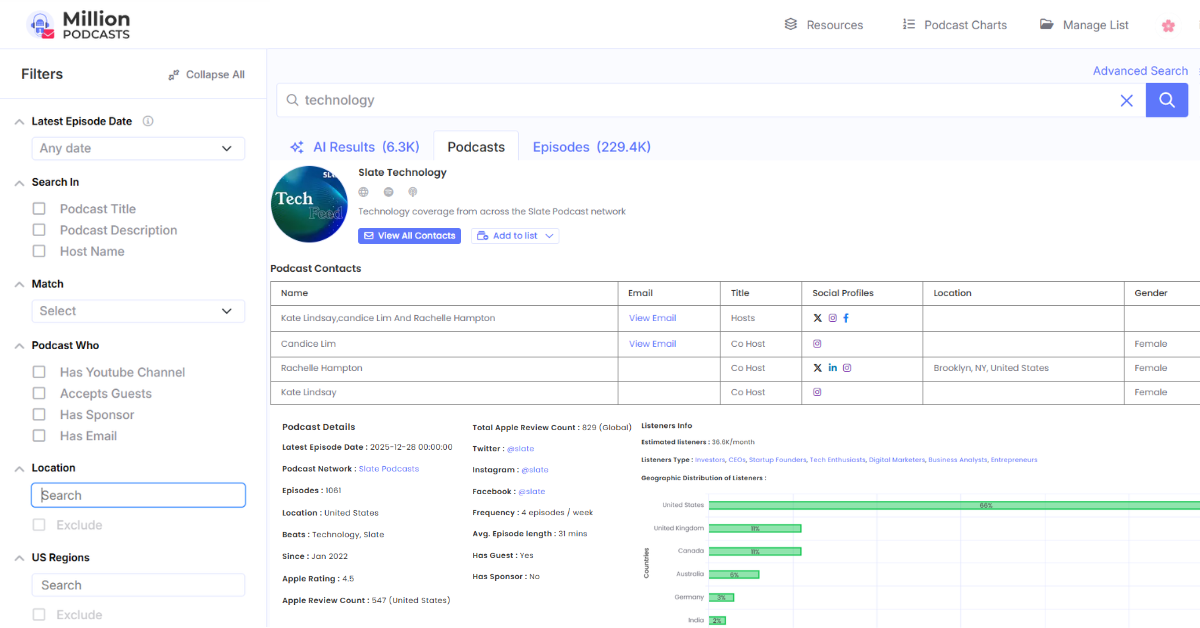
MillionPodcasts is the podcast database built for that exact step, which is why it leads this list. You search 3M+ podcasts and filter on 17 dimensions, including accepts guests, has email, beat, language, location, audience size and listener demographics. The filters do the qualifying, so every result is a show that takes guests and has a reachable inbox.
Scale is the least interesting number here. Of the 3M+ shows indexed, 379.7K say they accept guests and 1.2M carry a verified contact. The rest have nobody attached. Filtering is what turns an index into a list you can pitch tomorrow.
Look closer and each profile carries the intelligence needed to vet a target before pitching. You get estimated monthly listeners, audience age, income and gender splits, and a geographic breakdown. Apple ratings, posting frequency and sponsor history sit alongside them. You can match a show's audience to your client instead of guessing.
When you find the right shows, you unlock verified host, producer and booker emails, manually researched, SMTP-checked and GDPR and CAN-SPAM compliant. Which of those you actually get is the question nobody publishes an answer to, so we pulled ours.
Who you actually email when you pitch a podcast
In August 2026 we exported 13,646 contact records from 9,990 shows in our own index. Every one came from a podcast that accepts guests, lists an email, and published in the last 12 months. A job title was recorded on 5,957 of them. Here is how that group broke down.
| Contact role | Share of titled contacts | What it means for your pitch |
|---|---|---|
| Host or co-host | 94.3% | You reach the person who decides the guest list, with nobody in between. |
| General or media inbox | 3.5% | A shared address someone routes, so your subject line does the qualifying. |
| Booking agent | 1.0% | Rare, and skewed to bigger shows: 13.1% sit above 50K monthly listeners, against 2.0% of the whole export. |
| Producer | 0.5% | Uncommon, so treat a named producer as an alternate route rather than the default. |
| Editor, founder or executive | 0.6% | A mixed tail of named roles, so read the title before you decide the angle. |
Podcast PR is a host-direct channel, and that changes how you write. Booking agents and producers together cover 1.5% of titled contacts. A pitch built for a gatekeeper usually lands on the host's own screen. Roughly 19% of shows in that export carried more than one contact, so you get a second route.
Here is what that lets a PR professional do:
- Target by audience, not vanity: filter to shows whose listener demographics, location and size match the client you are pitching.
- Reach the right person: unlock host, producer and booker emails plus social profiles, rather than a generic inbox.
- Monitor the medium: search 62.1M episodes and set an alert for a topic, a client or a rival named in new episodes.
- Mine the charts: pull trending shows from Apple, Spotify and YouTube by country and category, then add a segment to a list.
- Build and export lists: save shortlists of up to 10,000 shows and export to CSV or Excel with custom columns.
- Hand it off when busy: on the top plans a concierge team researches missing contacts and builds targeted lists for you.
- Best for: founders, publicists and in-house marketers who want earned podcast coverage at scale.
- Standout: host-level contacts on 94.3% of titled records, so the pitch reaches the person who books the guest.
- Pricing: free plan with no card. Starter is $11 a month billed yearly, then Pro $30, Business $60 with concierge list building, and Business Plus $150 unlimited.
- Watch out for: it sources, vets and builds the list, and stops there. Sending and reply tracking happen in your own email tool, and it covers podcasts only.
Add podcasts to your media list
Filter podcasts by beat, host location, listener demographics, whether the show accepts guests, and more. Unlock verified host, producer and booker emails plus social handles. Export lists to CSV or Excel seamlessly.
Try it for free →2. Cision: best enterprise media intelligence
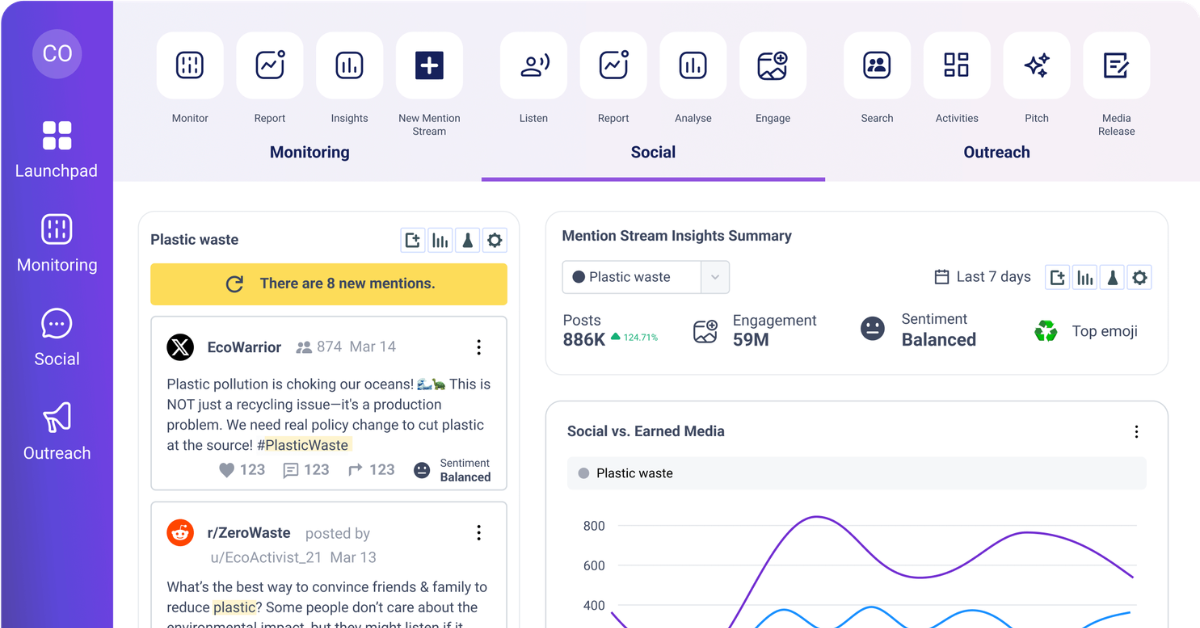
Cision is still the benchmark for media intelligence among large PR teams, and the incumbent most of them measure rivals against. Its CisionOne platform folds a vast global media contact database, monitoring, social listening, journalist outreach and analytics into one suite. For a brand tracking coverage across many markets and languages, that breadth is the whole point.
In practice you build media lists, distribute a release, then monitor and report on reach without leaving the platform. Cision also owns PR Newswire, so wire distribution sits inside the ecosystem. It owns Brandwatch too, which means a shortlist naming both is really one vendor quoted twice.
The cost is weight, and the contract deserves as much attention as the licence. Reviewers report a five-month cancellation notice alongside auto-renewal, so your window to leave opens seven months into a twelve-month term. Buyers who arrive with benchmark data report saving roughly a quarter off the opening quote.
- Best for: enterprise and agency teams needing global reach, broadcast monitoring and consolidated reporting.
- Standout: PR Newswire distribution inside the same account, which no independent competitor can match.
- Pricing: quote only, annual. Vendr's procurement data puts the median contract at $12,625 a year across 107 purchases, with most deals between $3,150 and $30,368 and buyers saving about 26% off the opening quote. A national wire release adds about $1,070.
- Watch out for: the auto-renewal and five-month notice period. Exported coverage links also carry a redirect prefix that breaks a clean CoverageBook import.
3. Muck Rack: best for journalist outreach
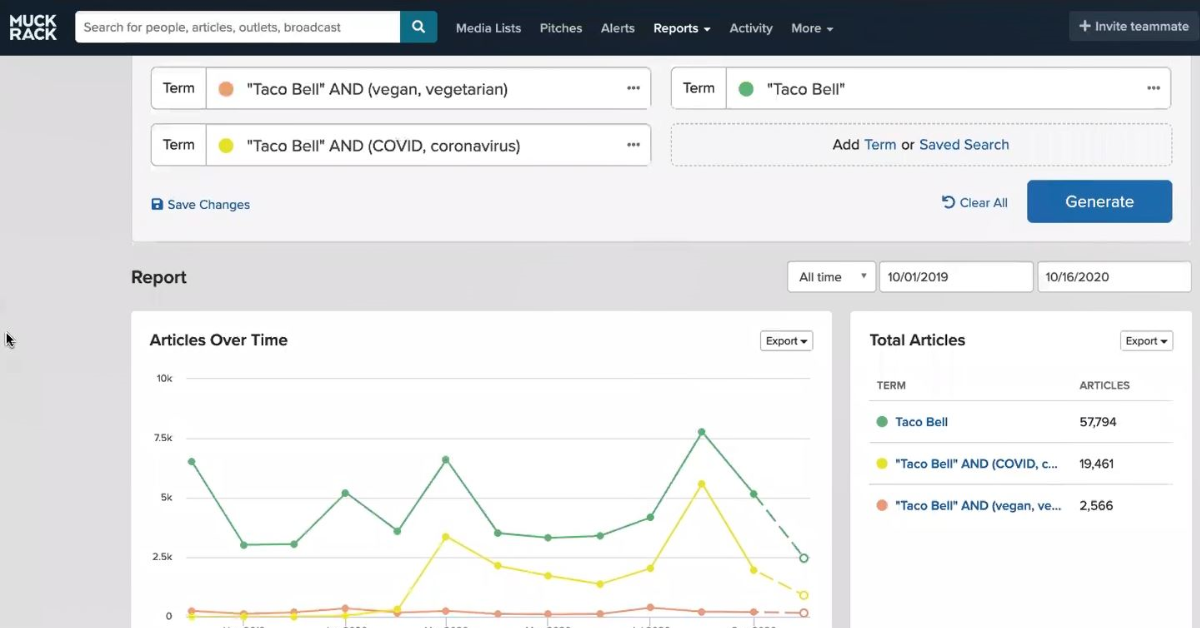
Muck Rack has become the modern default for media relations. It pairs a constantly updated journalist database with pitch sending and tracking, so you see who opened, clicked and covered your story. That feedback loop turns scattered pitches into real relationships over time.
Every profile is tied to that reporter's recent articles, so you can confirm they cover your topic before reaching out. Given that 82% of pitches are rejected for missing the audience, verification is worth more than volume. AI features draft pitches and surface contacts, though journalists in Cision's 2026 survey are blunt about deleting unverified AI output.
Seats are where the budget quietly goes. Vendr's dataset puts the median contract at $13,000 a year, with most deals landing between $8,000 and $20,860 and small teams of one to five seats typically quoted $10,000 to $25,000. Adding seats mid-contract usually costs more per seat than your original rate, so buy twelve months of seats at signing. Data accuracy also draws steady criticism, with practitioners reporting high email bounce rates and gaps in some industries.
- Best for: in-house teams and agencies focused on earned media and lasting reporter relationships.
- Standout: journalist profiles tied to live bylines, so relevance is something you verify rather than assume.
- Pricing: quote only, annual, with no monthly option. Median contract of $13,000 a year, rising past $100,000 for enterprise deployments above 20 seats. Onboarding adds $1,000 to $5,000.
- Watch out for: mid-contract seat additions priced above your contract rate and a 60 to 90 day cancellation window. It covers journalists, not podcast hosts.
4. Meltwater: best for global monitoring
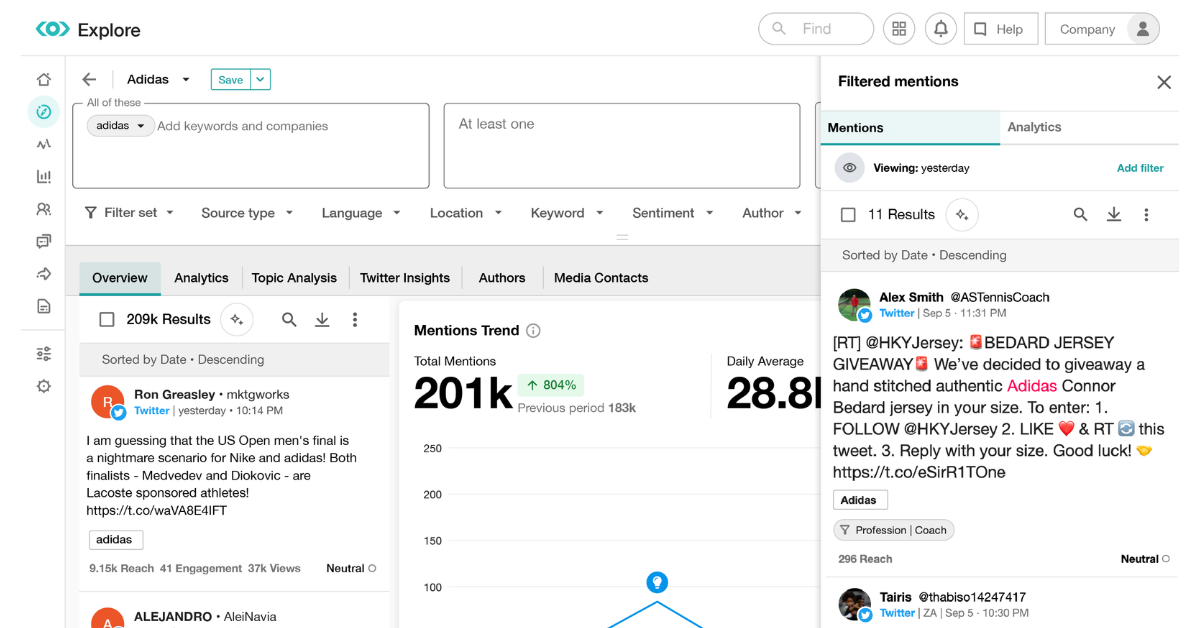
Meltwater leans hardest into media intelligence. It monitors news, social, blogs, podcasts and broadcast worldwide, then rolls the noise into dashboards a board can read. If your core question is what is being said about us everywhere, this answers it.
Beyond monitoring it offers a media contact database, social management and consumer insight, so it doubles as a measurement hub. Sentiment scoring and spike detection flag a brewing story before it breaks. Reviewers generally like the data, and it holds 4.1 out of 5 across roughly 2,900 G2 reviews.
Day-to-day use is more divisive than that score suggests. Practitioners in PR communities describe the interface as clunky and slow, and report coverage, reporter records and social mentions going missing often enough that teams have left over it. Run a paid pilot on your own keywords and check what it fails to catch before you sign anything.
The buying process draws a separate and more consistent complaint, and it follows one pattern. Reviewers describe an auto-renewal clause living in terms of service referenced by the contract rather than printed on it. The cancellation window is commonly cited as 60 days.
- Best for: global brands that want consolidated monitoring, listening and PR measurement in one view.
- Standout: spike detection and multilingual coverage reaching markets most competitors do not cover.
- Pricing: quote only on a twelve-month minimum. Vendr puts the median contract at $25,800 a year across 126 purchases, with most deals between $5,375 and $56,993 and enterprise configurations passing $100,000.
- Watch out for: recurring complaints about speed, usability and missed coverage, so pilot it hard first. Ask for the cancellation terms as a written document and diarise the date, and expect renewal escalators of 3% to 7% that are negotiable only at signing.
5. Prowly: now the Semrush AI PR Toolkit
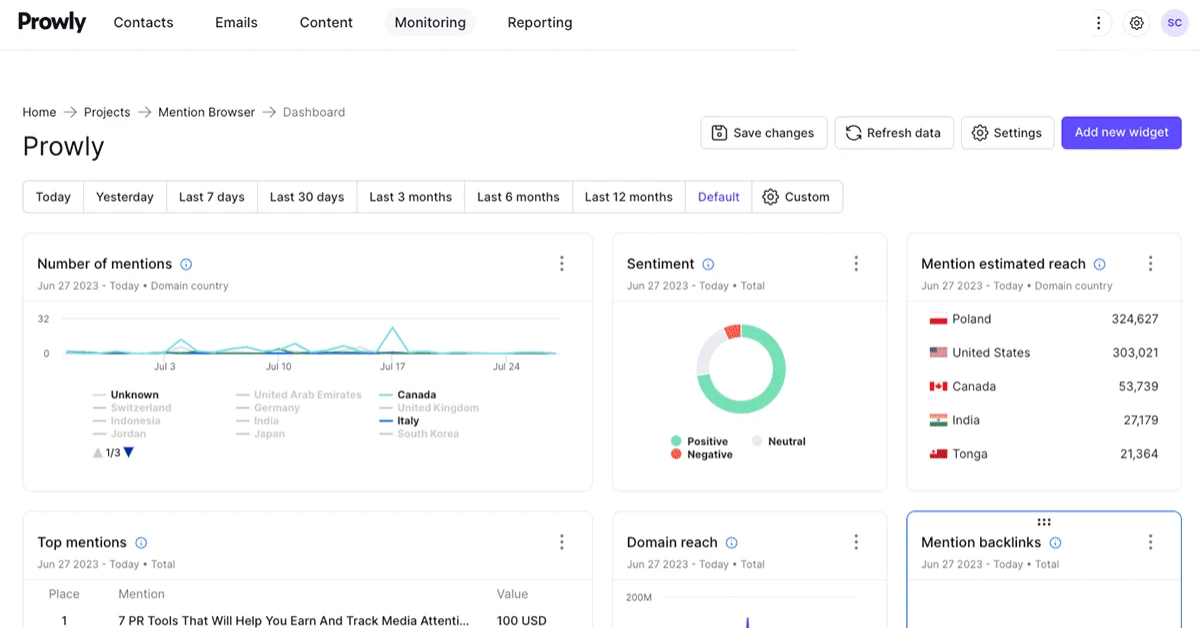
Prowly packed a media database, a hosted online newsroom, email pitching and monitoring into one tidy workflow. For a small team that wanted to write, publish and pitch a release without juggling four tabs, that bundle was the appeal. Its contact database listed more than a million journalists and influencers with filtering and a built-in CRM.
The product is no longer sold on its own. Semrush acquired Prowly in 2020 and began folding it into the Semrush AI PR Toolkit in late 2025. Prowly is no longer available as a standalone platform, and prowly.com now routes new buyers to the Semrush toolkit, where some of the original features have been carried over.
That changes what you are evaluating. Existing subscriptions still run, but anyone signing up today is buying a Semrush product whose PR roadmap sits with Semrush rather than the original team. Confirm the current packaging, limits and rates on Semrush's own pricing page, and ask what happens to newsrooms and contact lists if you leave.
- Best for: small in-house teams already invested in Semrush who want PR and SEO data in one account.
- Standout: the whole workflow in one place, now sitting next to Semrush's search and AI-visibility data.
- Pricing: standalone plans retired. The last published standalone rates were $258 a month for Basic and $369 for Pro, both billed annually, which remain a useful reference point. Current pricing sits inside the Semrush AI PR Toolkit, so check Semrush's site.
- Watch out for: Prowly no longer exists as a standalone product, so you are buying into a platform mid-transition. It also does not replace a wire service for regulated filings.
6. Prezly: best for newsrooms and stories
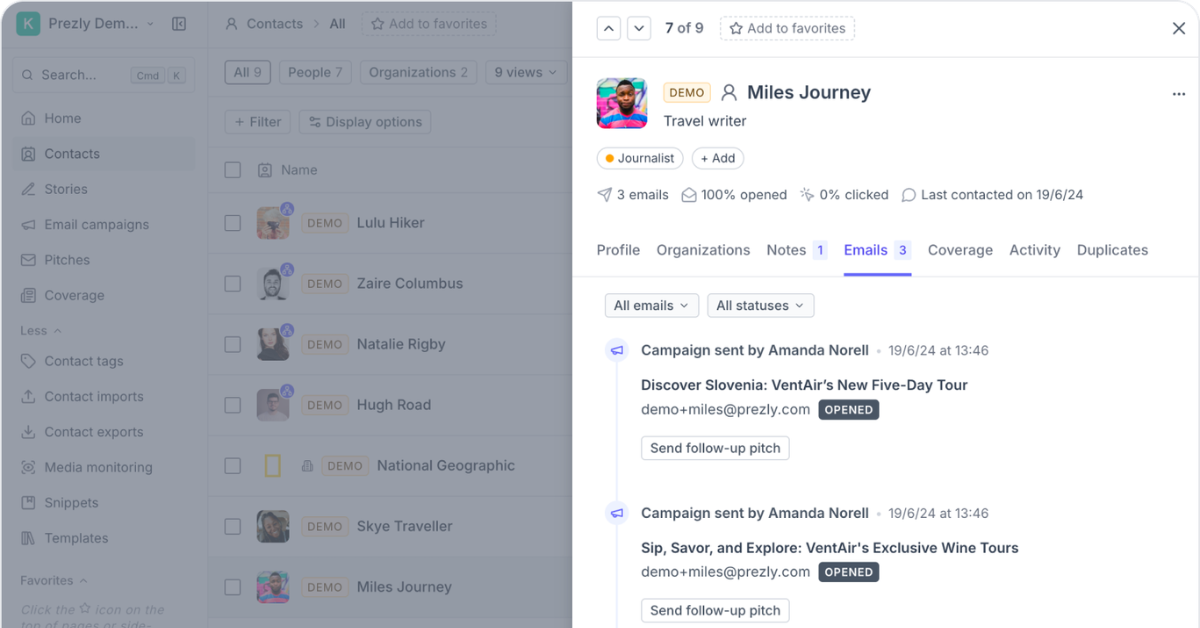
Prezly treats every announcement as a story, not a file attachment. You build a branded online newsroom, publish a visual press release, and pitch contacts from a lightweight CRM. The result reads less like a wire dump and more like a page a journalist wants to open.
It handles the full loop for story-led teams: create, publish, distribute by email, and report on engagement. It is also one of the few tools here you can simply buy. Pricing is published, checkout is self-serve, and the free trial needs no card. Reviewers rate it 4.3 out of 5 on G2 and single out support as responsive and human.
Two limits decide whether it works as your only tool, and usually it does not. The contact database is smaller than the enterprise suites, and there is no media monitoring. You find out where a release landed somewhere else.
- Best for: startups and communications teams that lead with brand stories and visual press kits.
- Standout: the hosted newsroom sits on the entry plan rather than behind an upgrade.
- Pricing: from about $100 a month per user, with roughly 20% off annual billing and a free trial. Enterprise begins at 10 or more seats.
- Watch out for: a smaller contact database and no monitoring, so pair it with a tool covering each. Reviewers also report campaign emails occasionally hitting spam.
7. Agility PR: best mid-market PR suite
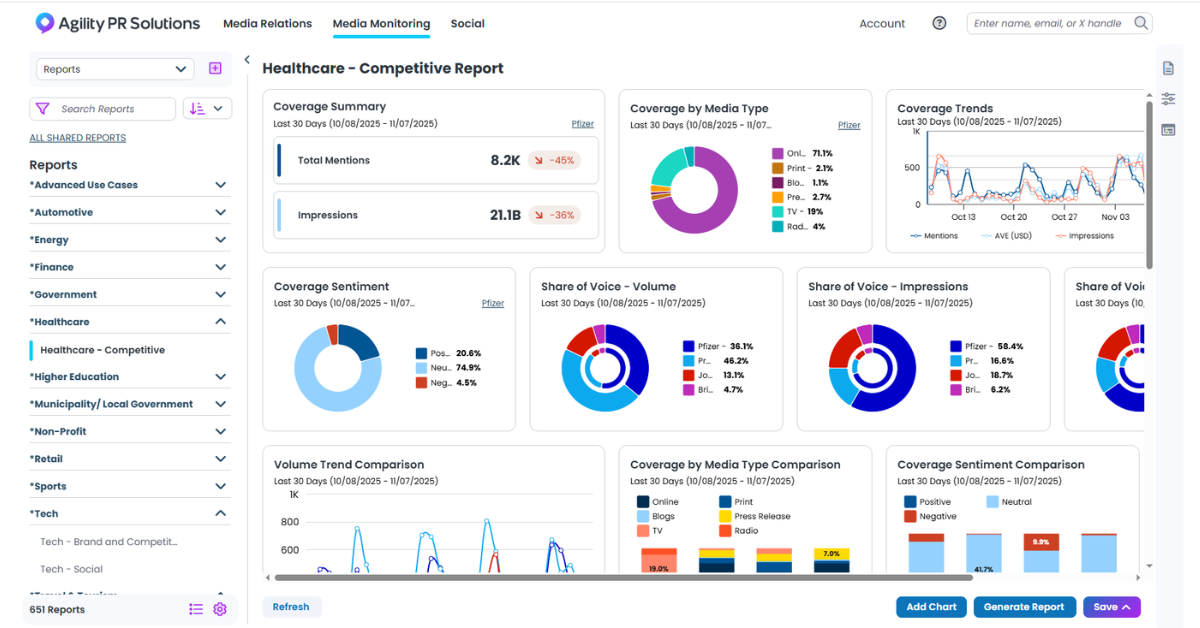
Agility PR Solutions sits in the gap between budget tools and full enterprise intelligence. It offers a sizeable media contact database, monitoring, outreach and reporting without the heaviest enterprise commitment. Mid-market teams pick it when Cision feels too big but a single-purpose tool feels too thin.
You build targeted media lists, pitch from the platform, then track coverage and measure results in one place. Reviewers rate it 4.1 out of 5 across nearly 400 G2 reviews, and support scores 9.0. The consistent praise is for speed of setup rather than for any single feature.
Ease of use scores 8.2, noticeably below that support figure, and reviews describe an interface that rewards configuration. The bigger difficulty is opacity: no rates, seat counts, contact limits or contract terms are published, and there is no free trial.
- Best for: growing in-house teams that have outgrown a single-purpose tool but do not need full enterprise scale.
- Standout: how quickly you can stand up a monitoring query and a media list, which reviewers cite most.
- Pricing: quote only across three plans, with no free trial and no free plan. Seat counts and contract terms are not published either.
- Watch out for: nothing is disclosed publicly, so get seats, contact limits and notice period in writing before comparing it on price.
8. Brandwatch: best for social listening
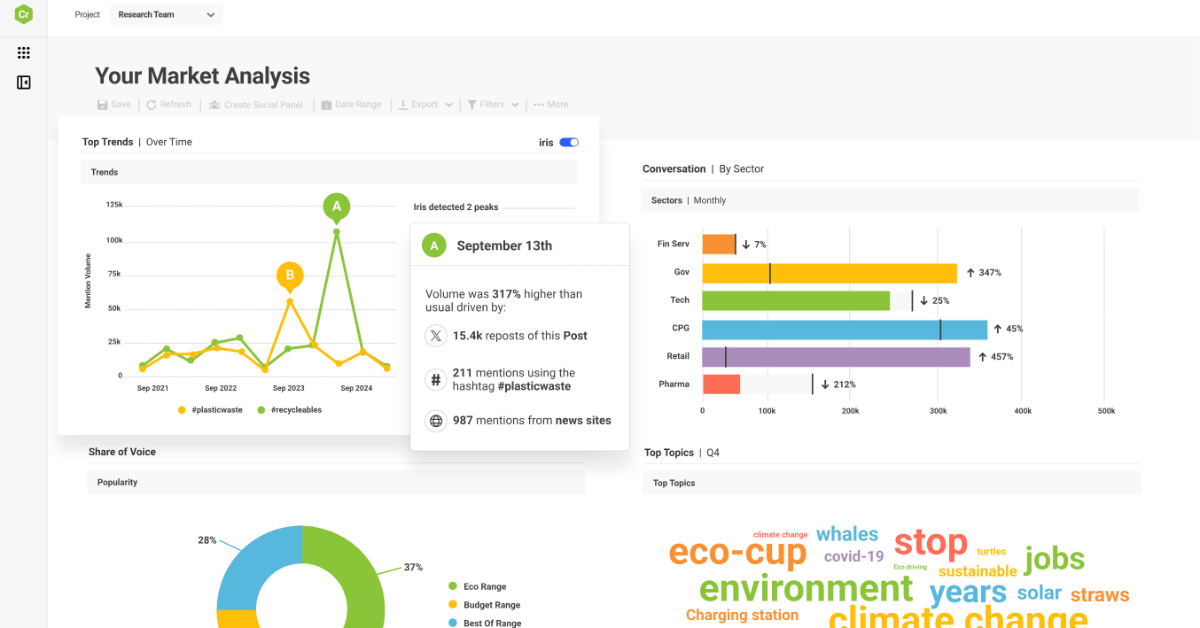
Brandwatch is built for the question PR and marketing share: what is the internet actually saying. Its social listening goes deep, surfacing sentiment, emerging topics and audience segments a basic alert tool misses. For reputation work and crisis early-warning, that depth earns its keep.
It analyses huge volumes of online conversation, then visualises trends and audience attributes you can act on. Its real strength is consumer intelligence rather than journalist outreach, so it complements a database rather than replacing one.
Ownership changes how you should approach the quote. Cision owns Brandwatch, so both numbers arrive from the same parent and bundling them is a lever rather than two independent bids. Price is the real gate, with the median contract sitting near $50,000 a year.
- Best for: brands that treat social listening, reputation and audience insight as a core function.
- Standout: audience segmentation that names who is behind a spike in mentions rather than counting it.
- Pricing: quote only, with no published rates and no self-serve trial. Third-party procurement data puts the median contract near $50,000 a year.
- Watch out for: it is a listening platform first, so you still need a contact database beside it. Cision owns it, so treat the two quotes as one negotiation.
9. Brand24: best affordable monitoring
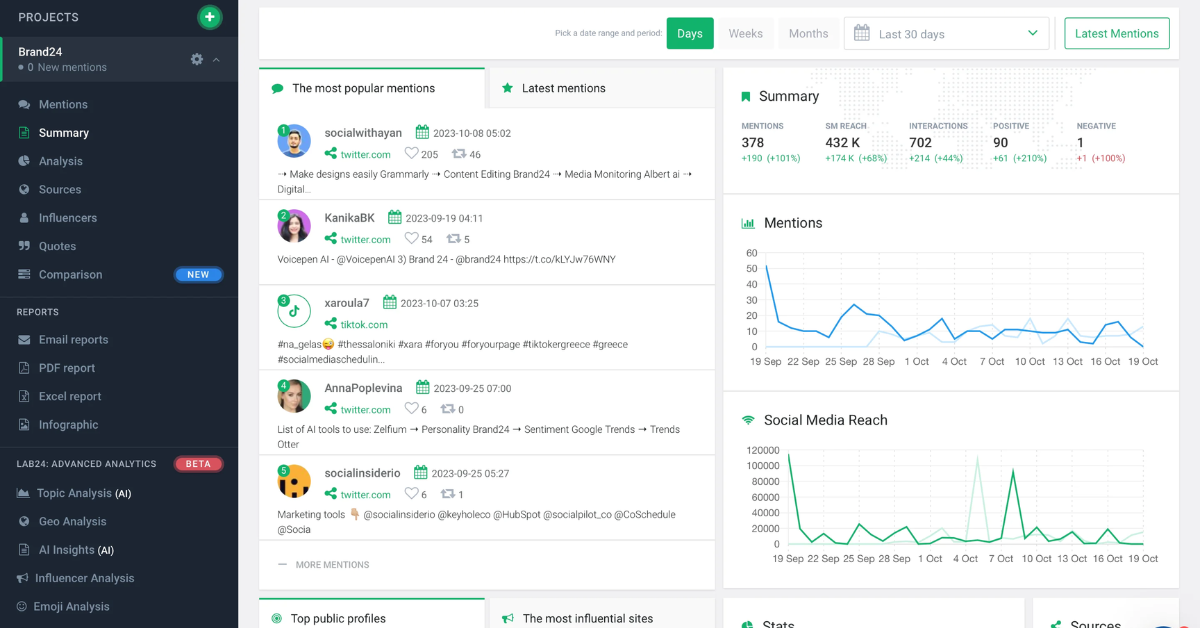
Brand24 delivers most of the monitoring a small team needs at a fraction of enterprise cost. It tracks mentions across news, blogs, social, podcasts and reviews, scores sentiment, and flags spikes before they become surprises. For founders watching their own reputation, it is the easy first pick.
The interface is approachable and published pricing means no sales call to get started, which almost nothing else in this category allows. It also estimates reach and identifies the most active voices in a conversation.
Read the caps rather than the headline, because the caps decide whether a plan works. Individual gives 3 keywords, 2,000 mentions a month, one seat and a refresh every 12 hours. That refresh interval is what rules it out for crisis response, and 3 keywords is what stops an agency at client two.
- Best for: startups and solo teams that want real monitoring without an enterprise contract.
- Standout: published pricing in a category built almost entirely on quote-only sales.
- Pricing: about $199 a month on annual billing for the Individual plan, or roughly $249 month to month. Higher tiers add keywords, volume, seats and real-time updates.
- Watch out for: 3 keywords, one seat and a 12-hour refresh on the entry plan. History caps at 12 months on most tiers.
10. Mention: best for real-time alerts
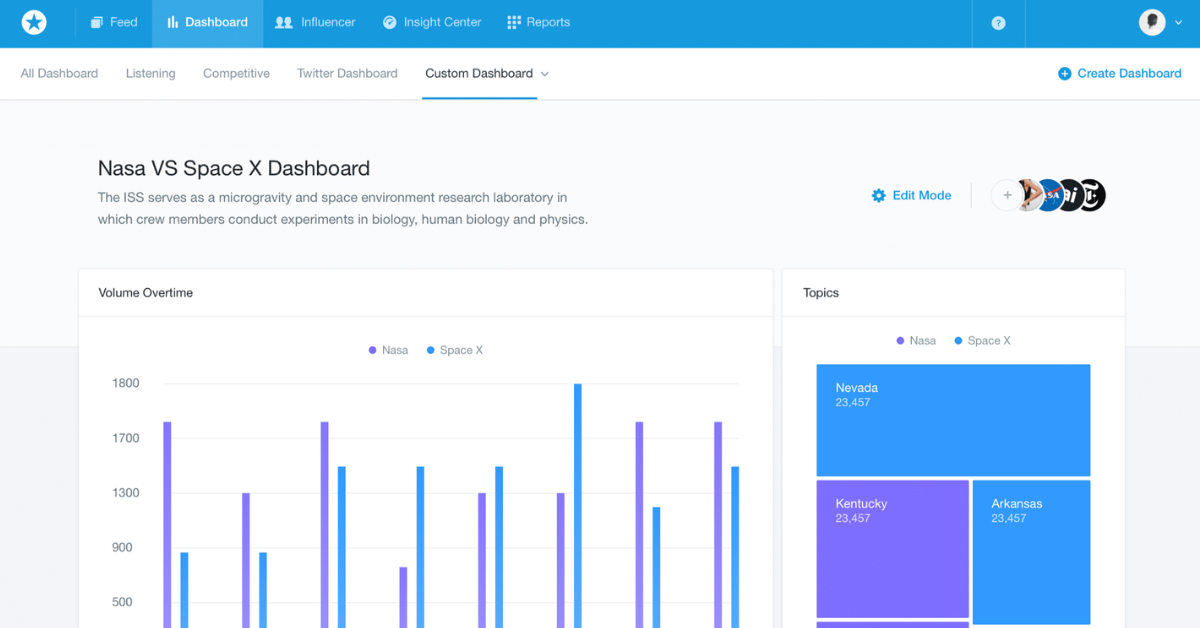
Mention has repositioned. What was once a cheap self-serve alert tool is now an enterprise listening platform on a single annual plan. Agorapulse acquired it in April 2025. It still watches the web and social in real time, but the entry point is no longer lightweight.
Two changes matter before you shortlist it. The old Solo, Pro and Pro Plus tiers were retired for new customers in 2025. Publish and Respond were then discontinued in January 2026. It now surfaces the conversation but cannot join it, so replying needs a separate Agorapulse subscription.
What remains is strong on its own terms. Boolean alert setup keeps the noise down once tuned. Unlimited users on a fixed rate is unusual in a category that charges per seat. For a growing agency team, that structure can beat a cheaper per-seat tool by year two.
- Best for: teams wanting managed real-time listening with unlimited seats on a fixed annual rate.
- Standout: unlimited users at one price, with 22 Boolean operators available in advanced alerts.
- Pricing: $599 a month on an annual contract for the Company plan, roughly $7,188 a year, with a 90-day renewal window.
- Watch out for: it is no longer the cheap, quick-setup alert tool it used to be. Publishing or replying now means a separate Agorapulse subscription.
11. CoverageBook: best for coverage reports
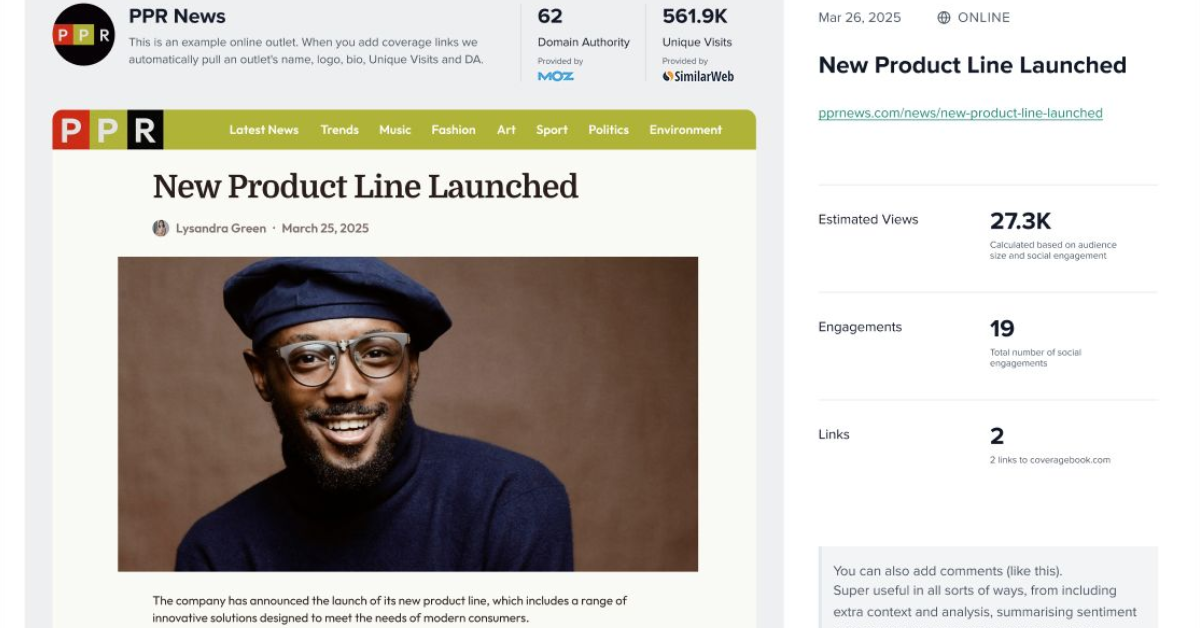
CoverageBook solves the unglamorous task that eats agency hours: reporting. Paste in your links and it builds a clean, screenshot-backed coverage report with metrics, ready to send a client. What used to take an afternoon takes minutes.
The screenshots matter more than they sound. Coverage gets edited, paywalled or quietly pulled, and that captured image is often the only proof left six months later. It is also the best-reviewed tool in this guide, at 4.7 out of 5 across more than 200 G2 reviews.
One underrated detail helps seasonal work, since you can pause the plan and restart it. Two limits are worth knowing before a big campaign. Statistics calculate per book rather than per section, and reach figures are modelled.
- Best for: agencies and freelancers who report coverage to clients on a regular schedule.
- Standout: automatic screenshots, so proof of coverage outlives the live page it came from.
- Pricing: five plans from $99 to $899 a month with a free trial. The entry plan covers around 100 pieces of coverage a month.
- Watch out for: it reports on coverage you already have and finds nothing new. Label the modelled reach figures as estimates in client reports.
12. BuzzSumo: best for content discovery
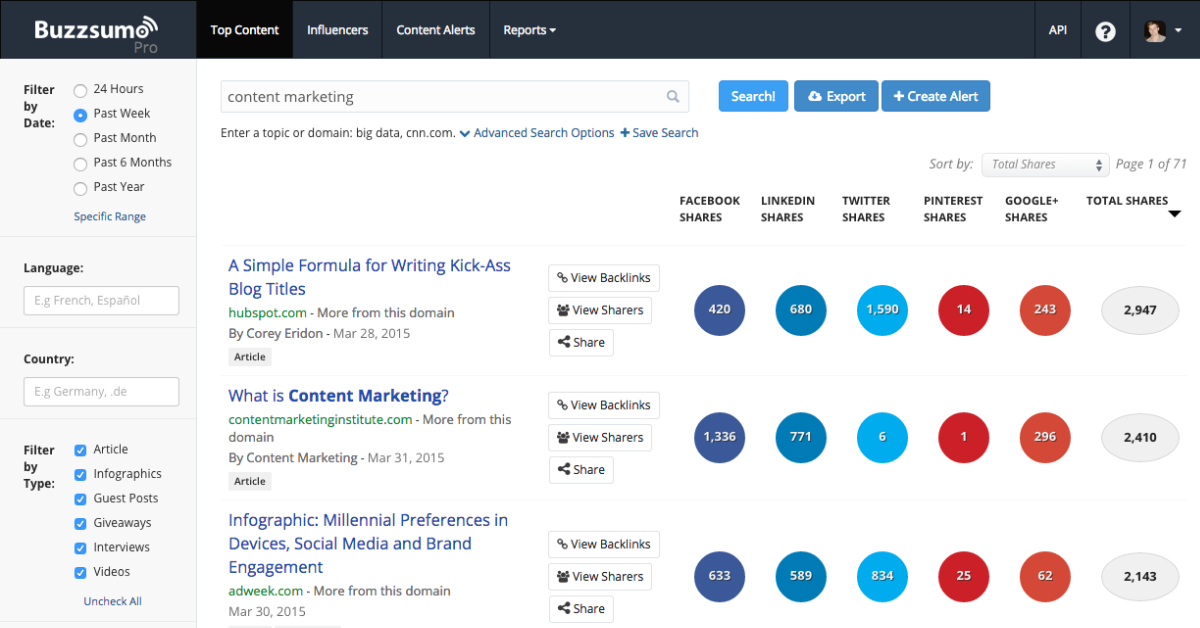
BuzzSumo answers a different PR question: what story will land. It surfaces the content getting shared in your space and the journalists covering it. Your pitch then rides a trend instead of fighting it. For data-led pitching, that intelligence is gold.
You research trending content, track competitors, set keyword alerts, and find the authors covering a beat. Since 82% of pitches are rejected for missing the audience, knowing exactly who covers a topic is half the battle. Separately, 47% of journalists told Cision that data or research is what they want more of.
Check which tier you need before buying, because this trips people up. Content Creation is discovery only, and the journalist database sits one tier higher on PR and Comms. BuzzSumo pairs naturally with a database that then gets you the contact.
- Best for: content-led and digital PR teams that pitch around trends, data and timely topics.
- Standout: author search showing what a journalist covered recently and how well each piece performed.
- Pricing: from about $199 a month for Content Creation. The journalist database and outreach features sit on the PR and Comms tier at about $299 a month.
- Watch out for: the entry plan is discovery only, so budget one tier up if you need the journalist database. The outreach still happens in another tool.
13. BuzzStream: best for digital PR outreach
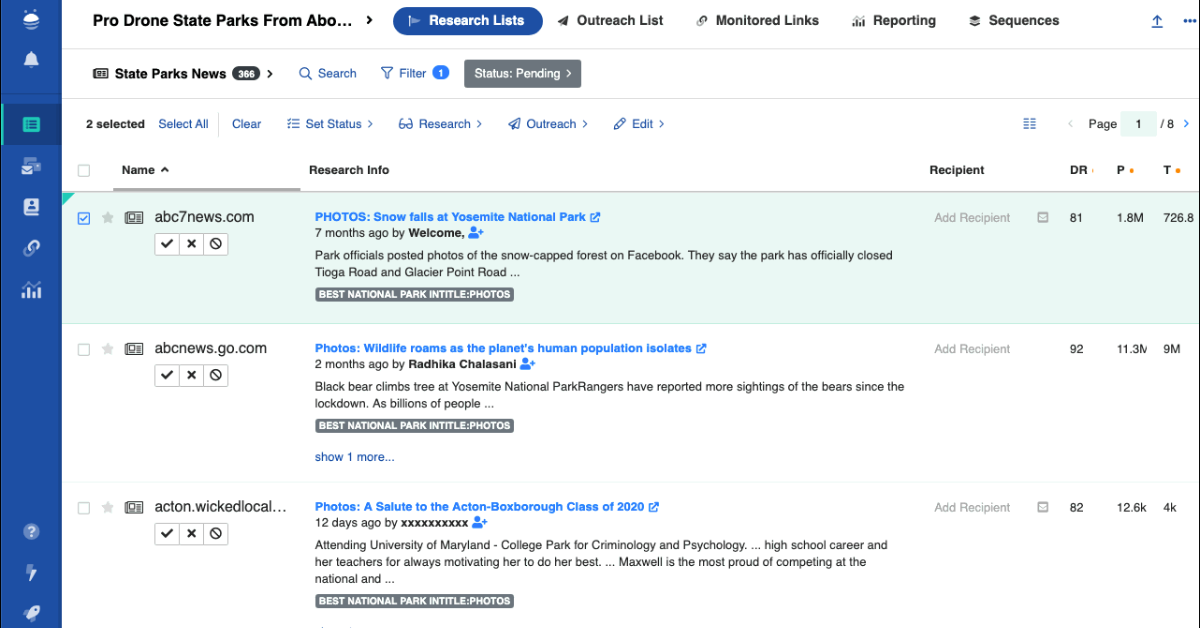
BuzzStream is the outreach CRM that digital PR and link-building teams lean on. It finds contact details, manages your pipeline and tracks every follow-up, so a campaign of hundreds of pitches stays organised. Among digital PR tools it is one of the most practical for teams chasing links and coverage.
It discovers email addresses, sends and sequences outreach, logs replies, and reports on response rates across projects. The low entry price keeps it friendly to freelancers, while the pipeline view scales to an agency running several campaigns at once.
- Best for: digital PR and SEO teams managing high-volume outreach and link building.
- Standout: a pipeline view that keeps hundreds of live conversations legible across a whole team.
- Pricing: from about $24 a month for the starter plan, scaling by contacts and users.
- Watch out for: it is an outreach manager, not a media intelligence suite or a podcast database.
No single tool covers sourcing, outreach, monitoring and reporting well. The teams that win pick one strong tool per job and connect them with exported lists. Start with the channel that earns you the most coverage, then add monitoring once there is something to monitor.
14. Respona: best for AI link building
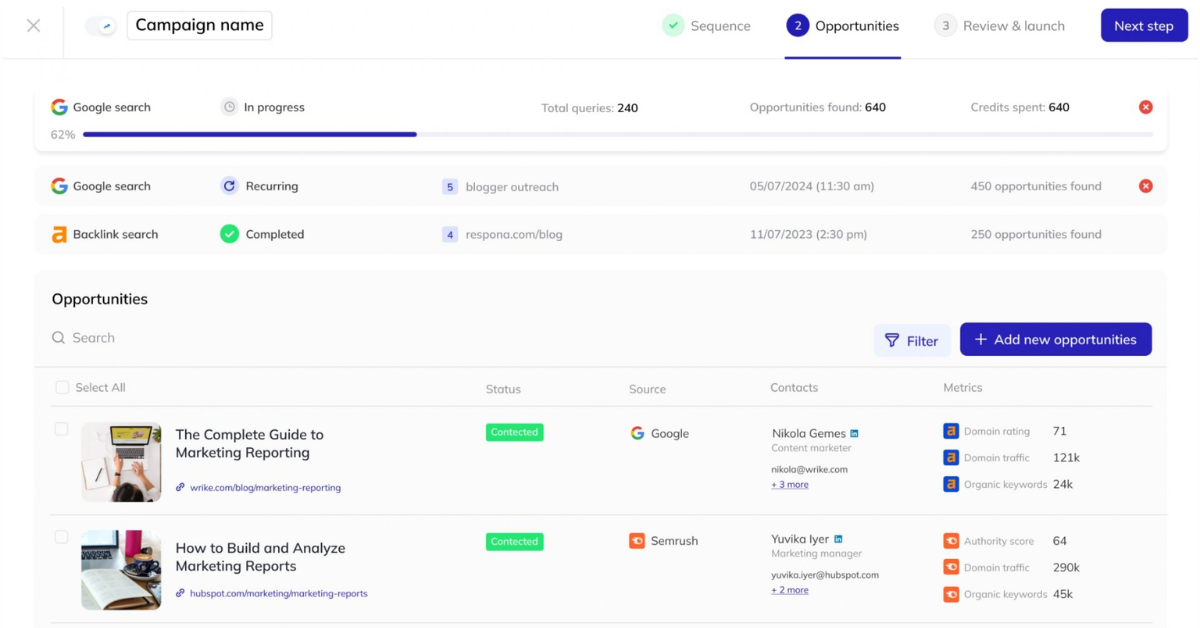
Respona blends contact finding, AI pitch drafting and email sequencing into one link-building workflow. You give it a topic, it finds relevant sites and contacts, then helps personalise outreach at speed. Among PR AI tools aimed at digital PR, it is one of the more complete.
It searches the web for opportunities, verifies email addresses, and runs multi-step campaigns with AI-assisted personalisation. The AI removes busywork, but the caution journalists voice in Cision's 2026 survey still applies. They ask PR teams to verify anything AI produced before it reaches an inbox.
- Best for: SEO and digital PR teams building backlinks through scaled, personalised outreach.
- Standout: opportunity search and email verification built into the same campaign, so prospecting and sending do not split across tools.
- Pricing: from about $99 a month, scaling by searches and email accounts.
- Watch out for: AI drafts still need human editing before they reach a journalist or editor.
15. Pitchbox: best for outreach at scale
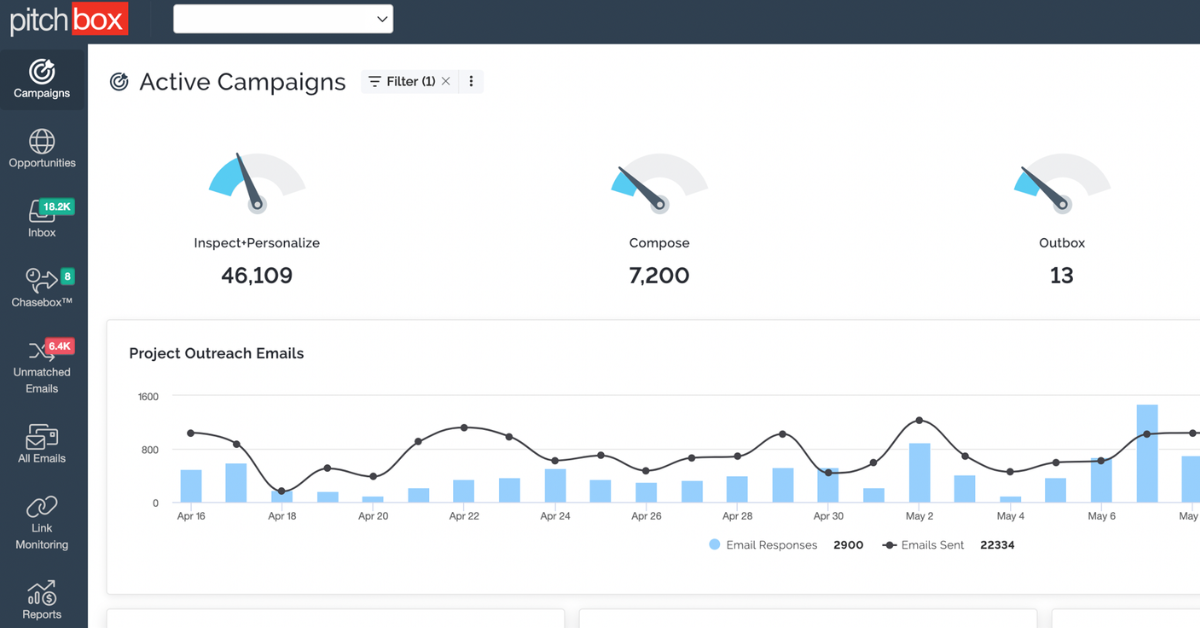
Pitchbox is built for volume. It automates prospecting, multi-step follow-ups and reporting across large campaigns. That is why agencies running link building at scale rely on it. Where BuzzStream organises, Pitchbox automates the repetitive parts of the pipeline.
It integrates with major SEO data providers, scores prospects and triggers timed follow-ups. A small team can run thousands of personalised touches. Pitchbox now publishes its plan pricing rather than hiding it behind a quote, which makes it easier to size up before committing.
- Best for: agencies and in-house teams running outreach and link building at high volume.
- Standout: automated multi-step follow-ups that keep thousands of touches moving without a person chasing each one.
- Pricing: from about $165 a month for the Pro plan, scaling to Advanced and Scale tiers and custom Enterprise pricing.
- Watch out for: automation at this scale feels impersonal unless you tailor templates carefully. The Pro plan's email and data-credit caps are tight.
16. Qwoted: best for journalist requests
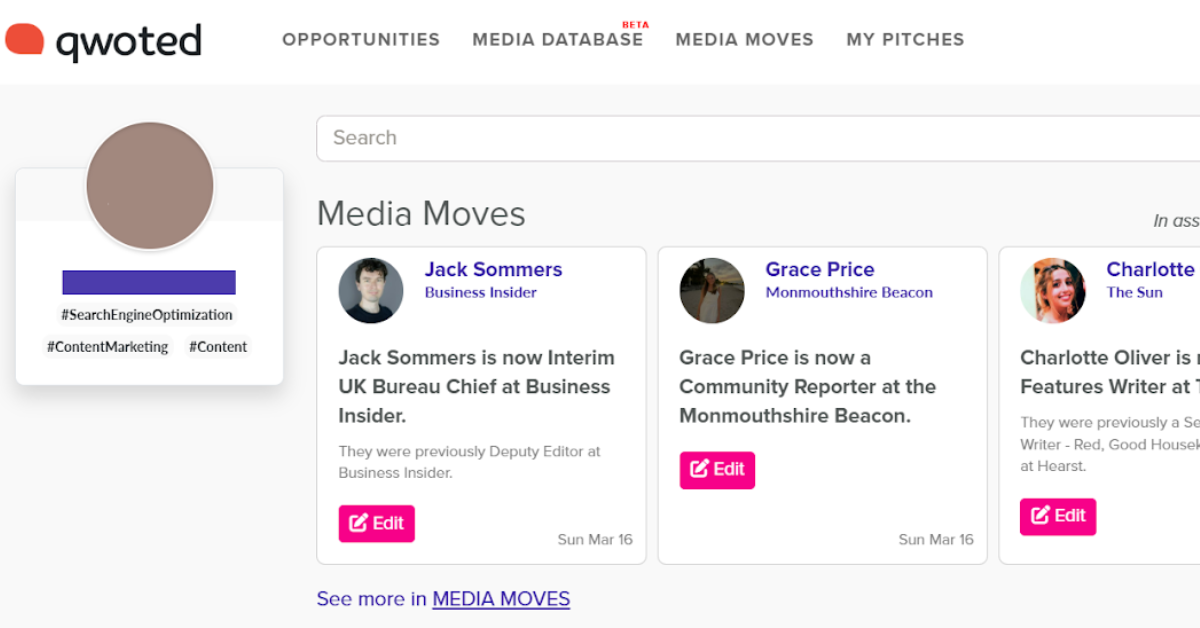
Qwoted flips outreach around: journalists post what they need, and you pitch yourself or your client as a source. Built-in messaging, real-time alerts and pitch tracking make it more than a query feed. For finance, business and tech experts chasing quality placements, it is a strong pick.
You build an expert profile, set keyword alerts, and respond to requests inside the platform. It filled real demand after the HARO era collapsed, and many PR teams now run it daily alongside their cold outreach.
Two things shape whether it pays back. Placements go to whoever answers first with something specific, so it rewards a daily habit. You also react to posted briefs rather than choosing targets, which makes it the wrong tool when you need one named publication.
- Best for: founders and publicists who can speak, or place a client, as an expert source.
- Standout: a curated request stream with messaging built in, so nothing gets lost in an email thread.
- Pricing: free to start, with paid tiers for more alerts, profiles and outreach features. Those tiers are not publicly rate-carded.
- Watch out for: placements depend on responding fast, so it rewards daily attention rather than set-and-forget use.
17. Featured: best for expert quotes
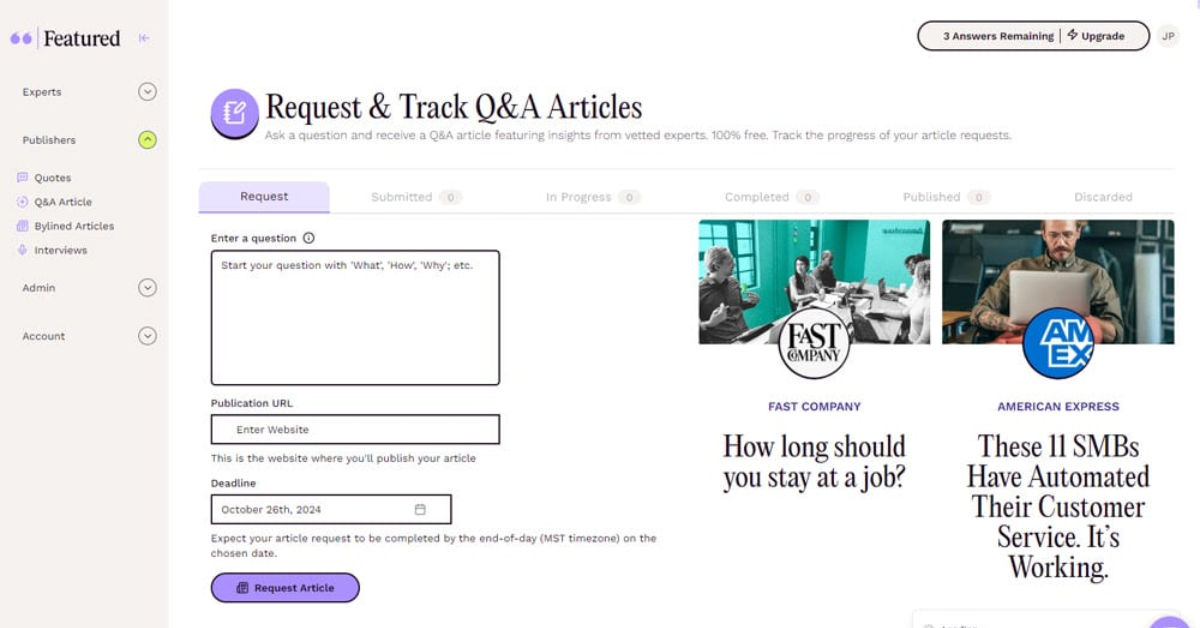
Featured, formerly Terkel, connects experts with journalists who want quotes. Its 2026 headline is the comeback of HARO. Cision shut down Connectively, the HARO rebrand, on December 9, 2024. Featured acquired the HARO name in April 2025 and relaunched it as a free email digest.
You answer questions from journalists, and selected responses become published quotes with a link back to you. The revived version adds spam filtering, source verification and AI content detection, answering the slop problem that sank the old platform. For founders who want credible press mentions, it is a low-cost, high-trust channel.
- Best for: experts and founders pursuing quotes and citations in the press.
- Standout: the relaunched HARO digest is free for sources and now verifies who is answering.
- Pricing: free for the HARO digest as a source, with paid Featured tiers for more questions and visibility.
- Watch out for: response volume is high, so a sharp, fast, specific answer is what wins the placement.
18. Press Ranger: best budget media database
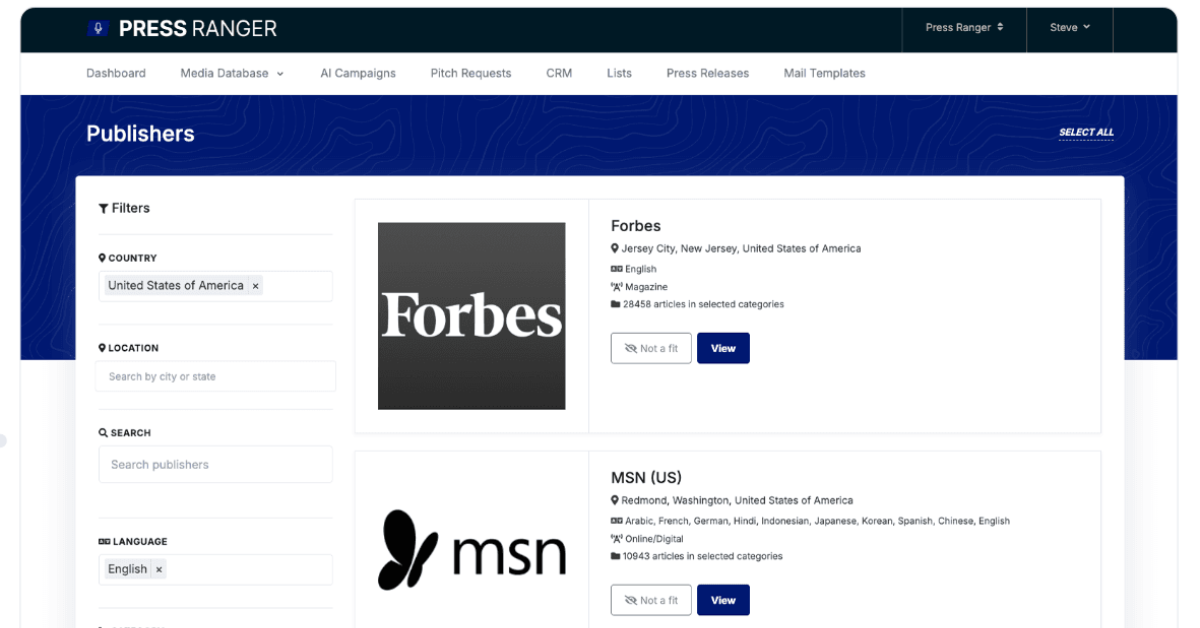
Press Ranger is the value entry in media database software. It uses AI to find journalists and outlets, build media lists and draft pitches, at a price a bootstrapped founder can absorb. It will not rival Cision on coverage, but it gets a small team moving fast.
You search a large database of journalist and outlet contacts, group them into lists, and generate first-draft pitches with AI. Paid distribution packages are sold separately from the subscription, so price the two apart. Treat it as a starter database, with the option to graduate once your volume justifies the spend.
- Best for: bootstrapped founders and small teams testing media outreach on a budget.
- Standout: the lowest entry price of any general media database that publishes its rates.
- Pricing: from about $79 a month. Packaging changes often, so confirm on the live pricing page rather than a comparison table.
- Watch out for: data depth and accuracy trail the established databases, so verify your key contacts before you pitch.
19. How do you choose the right PR tools?
Start with the job, not the brand. Write down the one outcome you need this quarter, then buy the tool that owns that job. A founder chasing podcast coverage needs a sourcing database first, an agency proving results needs reporting, and a reputation-sensitive brand needs monitoring.
Then weigh each shortlisted tool against the criteria that actually predict whether it earns its cost:
- Data accuracy and coverage: a database is only as good as its contacts. Ask how often they are verified, then test 20 records yourself.
- Who the contact actually is: a count of emails says nothing about role, so ask any vendor for the job-title split behind the number.
- The job it owns: confirm it is built for your main task rather than bolting that task on as a weak extra.
- Pricing transparency and fit: published pricing favours small teams, and quote-only suites favour budgets that can absorb five figures a year.
- The real limits: seats, keywords, unlocks, refresh interval and history caps decide your true cost more than the headline price.
- Ownership and roadmap: check who owns the product now, because acquisitions can retire a standalone tool the way Semrush retired Prowly.
- Notice period: ask for the cancellation terms in writing before signing, because a five-month notice opens your exit window at month seven.
- Integrations and export: you will move lists between tools, so test that an export imports cleanly into whatever reports your results.
Match the spend to your stage. On a tight budget, start with a free database, a source-request platform like Qwoted or Featured, and Google Alerts. As volume grows, add a paid monitoring tool and a reporting tool. Once you pass a handful of pitches a week, scaling podcast outreach is where the workflow breaks first.
Avoid the common mistakes. Do not buy a full suite for one job you could solve for a tenth of the price. Do not chase volume over relevance, because 82% of off-beat pitches get deleted. Do not sign an annual contract without knowing the notice period.
Build your stack in this order: a sourcing or database tool, then outreach, then monitoring, then reporting. Connect them with exported lists. Adding a layer only when the previous one is humming keeps spend tied to results.
If you are a founder or solo publicist, start with a free database and a source-request platform. Add monitoring once coverage appears. For a team of two to five, a published-price database plus Brand24 plus CoverageBook covers the chain. Budget under $400 a month.
If you report across markets and languages, the enterprise suites are the honest answer. Expect a sales call and a five-figure quote. Whichever you pick, the smallest useful next step takes under an hour. Pick one channel this week, source 20 verified contacts, and send 20 relevant pitches.
20. PR software: frequently asked questions
What are the best PR tools in 2026?
The best PR tools in 2026 are MillionPodcasts for podcast outreach, Muck Rack or Cision for journalist outreach, and Brand24 or Brandwatch for media monitoring. MillionPodcasts is a podcast database that indexes 3M+ shows with host and booking contacts, making it the primary sourcing tool for podcast PR. Most teams combine one database, one sourcing tool, and one monitoring tool.
What is the best PR software for a small team or solo publicist?
The best PR software for small teams and solo publicists is MillionPodcasts for podcast sourcing, Prezly for press releases and newsrooms, and Brand24 for monitoring. MillionPodcasts is a podcast database with a free plan and paid tiers from $11 a month billed yearly, among the lowest entry prices of any media database with public pricing. These tools cover sourcing, outreach, and monitoring without enterprise pricing.
How much do PR tools cost?
Pricing splits in two. SMB tools publish rates, roughly $80 to $600 a month depending on contacts and mentions. Enterprise media intelligence such as Cision, Meltwater, and Muck Rack is quote only. Procurement data from Vendr puts the median Cision contract at $12,625 a year, Muck Rack at $13,000, and Meltwater at $25,800. Always confirm current pricing on each vendor's site.
Is there free PR software?
Yes. MillionPodcasts has a free plan with no card, allowing 100 searches a month and 3 lists. Qwoted and the revived HARO, now owned by Featured, are free for sources. Google Alerts covers basic monitoring. Free tiers are enough to start, and you upgrade when verified contacts or export volume become the bottleneck.
What happened to HARO?
Cision shut down Connectively, the rebrand of HARO, on December 9, 2024. In April 2025, Featured acquired the HARO name and relaunched it as a free email digest with source verification, stronger spam filtering, and AI content detection. Qwoted and Featured are the main alternatives PR teams use now.
What happened to Prowly?
Semrush acquired Prowly in 2020 and began folding it into the Semrush AI PR Toolkit in late 2025. Prowly is no longer sold as a standalone product, and prowly.com now points new buyers to the Semrush AI PR Toolkit. Existing subscriptions continue, but anyone evaluating it today is buying a Semrush product, so confirm the current packaging and rates on Semrush's site.
What is press release distribution software?
Press release distribution software pushes a release to newswires, journalist inboxes, and online newsrooms at once. Prezly and Cision bundle distribution with a media database or newsroom, so you can write, publish to a branded newsroom, and pitch from one place. Regulated wire distribution is still billed separately, and a national PR Newswire release runs about $1,070 plus annual membership.
References
Cision. (May 2026). 2026 State of the Media Report. https://www.prnewswire.com/content/dam/prnewswire/resources/white-papers/Cision_2026_State_of_the_Media_Report.pdf Edison Research at SSRS. (March 2026). The Infinite Dial 2026. https://www.edisonresearch.com/the-infinite-dial-2026/ Vendr. (2026). Cision Software Pricing and Plans. Median contract value $12,625. https://www.vendr.com/marketplace/cision Vendr. (2026). Muck Rack Software Pricing and Plans. Median contract value $13,000. https://www.vendr.com/marketplace/muck-rack Vendr. (2026). Meltwater Software Pricing and Plans. Median contract value $25,800. https://www.vendr.com/marketplace/meltwater G2. (2026). CisionOne Reviews. https://www.g2.com/products/cisionone/reviews Software Advice. (2026). Cision Reviews, Pros and Cons. https://www.softwareadvice.com/marketing/cision-profile/reviews/ G2. (2026). Agility PR Solutions compared with Prezly. https://www.g2.com/compare/agility-pr-solutions-vs-prezly G2. (2026). CoverageBook Pricing. https://www.g2.com/products/coveragebook/pricing r/PublicRelations. (2026). Practitioner discussion of Meltwater and Muck Rack costs and day-to-day usability. https://www.reddit.com/r/PublicRelations/comments/mr0939/whats_the_starting_cost_of_meltwater_and_muckrack/ Prowly. (2026). Prowly is now part of Semrush. https://prowly.com/ Prezly. (2026). Pricing. https://www.prezly.com/pricing Brand24. (2026). Pricing. https://brand24.com/prices/ Mention. (2026). Mention Plans Explained. https://en.support.mention.com/en/articles/7988097-mention-plans-explained Agorapulse. (May 2025). Mention by Agorapulse. https://www.agorapulse.com/blog/agorapulse-news/mention-by-agorapulse-why-were-investing-in-social-listening/ BuzzSumo. (2026). Pricing. https://buzzsumo.com/pricing/ BuzzStream. (2026). Pricing. https://www.buzzstream.com/pricing/ Respona. (2026). Pricing. https://respona.com/pricing/ Pitchbox. (2026). Pricing. https://pitchbox.com/pricing/ Featured. (April 2025). HARO is Back. https://featured.com/haro Press Ranger. (2026). Pricing. https://www.pressranger.com/pricing MillionPodcasts. (August 2026). Podcast contact role analysis: 13,646 contact records from 9,990 guest accepting podcasts. https://www.millionpodcasts.com/podcasts-directory MillionPodcasts. (2026). Our Database. https://www.millionpodcasts.com/ MillionPodcasts. (2026). Plans and Pricing. https://www.millionpodcasts.com/pricing