
43,100 podcasts in our database currently carry a sponsor. Most of them are not big shows. They are shows with a few hundred listeners who sell something other than download volume, and that is the whole trick to getting podcast sponsors with low downloads.
The advice that says you need 5,000 downloads is describing one buying model, not a law. This guide gives you the deal types that ignore your download count, real starting rates, the pitch, and the exact words for the moment a brand says you are too small. If you want the asset that goes with the pitch, start with our guide to the podcast media kit sponsors trust.
How many downloads do you need to get podcast sponsors? There is no fixed minimum. CPM ad networks usually want 5,000 to 10,000 downloads per episode, but flat rate, affiliate and lead based deals have no floor. Shows at 200 to 1,000 downloads sign paying sponsors when the audience is specific and results are trackable.
1. Why Brands Sponsor Shows This Small
Sponsorship is not a prize you unlock at a download threshold. It is a trade. A brand gives you money, and you give them access to people who trust you.
Big networks set high minimums because they resell audiences in bulk. A brand buying directly from you has a different problem. They need the right people, not more people, and that is where your show can beat a much larger one.
The four things a sponsor is really buying
Read this list before you write a single pitch. Everything you sell later is one of these four outcomes, and every one of them works at 300 downloads.
- Visibility inside a niche community that already cares about the topic
- Your credibility doing the recommending instead of their ad copy
- Warm leads who already understand the problem the product solves
- Trackable sales through a promo code or a tagged link
Why a narrow niche beats a big number
The tighter your topic, the fewer shows a brand can choose from. A company selling scheduling software to dental practices has maybe a dozen relevant podcasts on earth. Being one of the twelve matters more than being one of the big ones.
Your listeners also behave differently. Someone who chose a small show about their exact problem is paying closer attention than someone half listening to a chart hit. Edison Research found that 44% of weekly podcast listeners bought something after hearing a podcast ad, and 68% say they do not mind hearing ads at all.
Write one sentence naming who your show is for and what it gets them. If you cannot do that in fifteen words, no brand can picture your listener, and no amount of downloads will fix it.
2. How Many Downloads Do You Need?
The honest answer depends on who is paying and how. Download minimums come from the buying model, not from your worth as a show.
| Route to a sponsor | Typical download expectation | What it means for you |
|---|---|---|
| CPM ad network | 5,000 to 10,000 per episode | Realistic later, not now. Below that the payout is a few dollars per episode. |
| Hosting platform marketplace | Varies, some accept any size | Easy to list, low control, low rates. Treat it as pocket money, not a plan. |
| Affiliate or per sale | None | You can start today. You carry the risk, so your conversion rate decides the pay. |
| Direct flat rate deal | None, fit matters instead | The best paying route under 1,000 downloads, and the rest of this guide is built on it. |
Our own index says the same thing in one line. Of the 524.2K podcasts that published in the last 12 months and sit in the smallest audience band, up to 1K estimated monthly listeners, 22.2K are flagged as carrying a sponsor. That is a floor rather than a ceiling, since a sponsor only lands in the data once it appears in an episode.
Those sponsored shows are not spread evenly across topics:
| Beat | Sponsored shows with up to 1K monthly listeners |
|---|---|
| Business | 1.8K |
| Technology | 1K |
| Health and Fitness | 982 |
| Society & Culture | 924 |
| Education | 681 |
| Comedy | 375 |
| Science | 279 |
| Leisure | 240 |
| Games | 185 |
| Fiction | 51 |
Read that as a map of buyer appetite rather than a verdict on your show, because a lower beat means fewer in-category advertisers, not a closed door. Figures are from the MillionPodcasts index, August 2026.
One number does matter, though. Advertisers judge a show on downloads in the first 30 days after an episode goes live, so quote that figure and keep it consistent. Report the same window every time and your numbers start to look like a business.
Marketplace terms and platform names in this space change often. Check any network's current requirements on its own site before you spend an afternoon on a listing, and read our breakdown of the biggest podcast networks if you want to know who owns what.
3. Stop Selling CPM. Sell This Instead
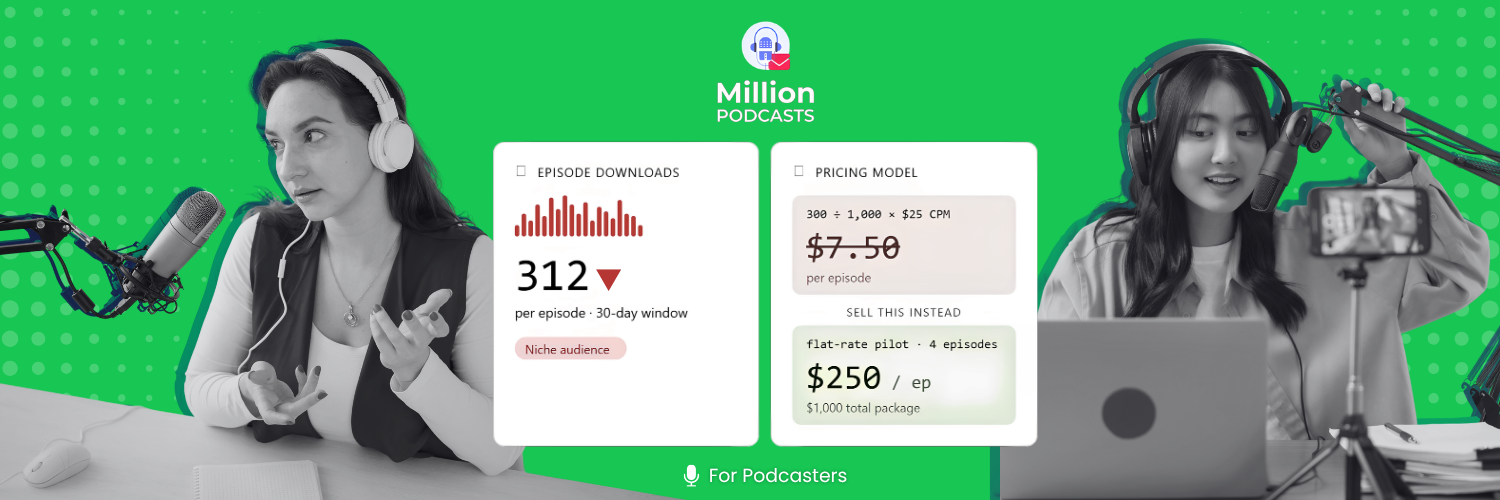
CPM means cost per mille, or price per thousand downloads. It is the model that traps small shows, and the math shows why in one line.
Buzzsprout puts common benchmarks around $18 per 1,000 listens for a 30 second pre roll and $25 per 1,000 for a 60 second mid roll. Now run your own numbers.
At 300 downloads an episode, a $25 mid roll pays:
Nobody builds a business on that. The fix is not to grow first. The fix is to change what you are selling.
I sell 1,000 impressions at a time. I need volume before this pays.
I sell a trusted recommendation to a specific group. I need relevance, not volume.
This is why the same brand that ignores a CPM email will approve a flat fee. You stop competing on price per thousand, where you will always lose. You start selling the one thing they cannot buy anywhere else, which is you talking to your people.
4. Deal Types That Work With Low Downloads
Three structures do almost all the work below 1,000 downloads. Pick one to lead with, based on what your sponsor is actually chasing.
| Deal type | How you get paid | Fits which sponsor | Your main risk |
|---|---|---|---|
| Flat rate | A fixed fee per episode or per package, whatever the download count | Local services and niche brands who want a simple line in the budget | You have to prove the value, because there is no volume to hide behind |
| Affiliate or CPA | A cut of each sale or signup through your link or code | Products and digital tools with an existing checkout | Income swings, and a weak offer can pay you nothing |
| Lead based | A set price per qualified lead from a giveaway, webinar or waitlist | B2B brands and services with high customer value | More moving parts to run, and you must agree what qualified means |
| Bundled placement | One fee covering the episode plus your newsletter or social post | Creators with a second channel worth naming | More to deliver and more to report on |
| Category exclusivity | A premium on top of your rate to lock competitors out | Brands in crowded categories who want the space to themselves | You block other income, so only sell it once you have a waiting list |
Lead with flat rate if your niche is obvious and your listener is easy to describe. Lead with affiliate when the brand hesitates, because it moves the risk onto you and removes their reason to say no. Keep bundling and exclusivity in your pocket for the renewal.
Sell a four episode pilot instead of a single spot. One episode is too small a sample to prove anything, and a year is too big an ask from a brand that has never worked with you.
5. What To Charge For A Small Podcast
Pricing is where most small shows freeze. Base your rate on the work you do and the outcome you deliver, then hold it.
A starter rate card you can use today
| Package | What the sponsor gets | Starting rate |
|---|---|---|
| Single episode | One host read mention plus a show notes link | $150 |
| Four episode pilot | Four host read mentions, show notes links, one pinned resource link | $500 |
| Bundled placement | Episode mention plus newsletter feature plus one social post | $400 |
| Lead based | A giveaway or webinar that delivers qualified email leads | $25 to $50 per lead |
| Affiliate only | Commission on tracked sales you drive | 10 to 20% per sale |
| Category exclusivity | Sole sponsor in their category for a set month | Your rate plus 40 to 60% |
Lead with the pilot. It is small enough that one person can approve it without a meeting, and long enough to produce numbers worth reporting.
Three rules that protect your rate
Discounting feels like closing. It is usually the opposite, because it tells the brand your first number was invented.
- Never quote a price without naming the proof. Say the fee, then say how you will measure it. A rate with tracking attached invites a yes, not a haggle.
- Cut scope, not price. If the budget is short, drop from four episodes to two. Your per episode value stays intact for the next negotiation.
- Raise the rate only with evidence. After a pilot that converted, quote the new number alongside the result that justifies it.
6. Get Sponsor Ready Before You Email
Sponsors judge your process as much as your show. Every question you answer instantly is a reason for them to keep going.
The 10 things to have ready
- A one sentence show promise. Name the listener and the outcome. A weekly show that helps first generation students land paid internships tells a brand more than any mission statement.
- An audience snapshot. Who they are, why they listen, what problem you solve. Use what you genuinely know and never invent demographics.
- Your 30 day download average. One consistent number, measured the same way every episode.
- A one page media kit. Show description, listener profile, average downloads, top episodes, sponsor options with starting rates, contact details.
- Two named ad slots. A 20 to 30 second read near the top and a 45 to 60 second mid episode slot. Predictable inventory is easier to buy.
- A sample host read. Sixty seconds in your real voice so a brand can hear what they are buying.
- A tracking plan you can explain in 20 seconds. One tagged link and one promo code is enough.
- A short sponsor policy. What you will promote, what you will not, and that you always disclose.
- A sponsor page on your site. Overview, options, and a form that reaches you.
- A real business email. Something like partnerships@yourdomain.com beats a personal address every time.
Do a six question listener survey before anything else. Ask what they do for work, what they are stuck on, and what they already pay for. The answers become your audience snapshot, your target brand list and your pitch language at once.
7. How Do You Find The Right Sponsors?
Your best sponsor is rarely a national brand. It is a company that already wants your exact listener and has never been pitched by a show like yours.
Categories that work well with small shows
- Local services such as clinics, gyms, studios, legal and accounting practices
- Education brands including tutoring, test prep and online course platforms
- Career tools like resume services, portfolio builders and niche job boards
- Niche ecommerce with healthy margins and one clear buyer
- B2B software aimed at the exact job title your listeners hold
- Events such as conferences, meetups and workshops in your topic
Method 1: ask your own listeners
Ask one question on air. What do you already pay for? Put a short form in the show notes and let the answers build your list for you.
Method 2: copy the brands already spending
List ten shows your audience also listens to, scan their recent episodes, and note every sponsor. Those brands have already decided podcasts work, so you are selling a better fit rather than a new idea.
This is faster with a database than by ear. Of the 3M+ shows indexed on MillionPodcasts, 43.1K are flagged as carrying a sponsor, and you can filter them by beat, location and estimated listeners to see who backs shows your size.
Method 3: work your local and niche ground
Chamber of commerce listings and city directories are unglamorous and they work. Local brands like flat rates with clear deliverables. Event sponsor pages in your niche are the same idea at national scale, since those lists are budgets made public.
Stop at five to ten names. A short list you research properly beats a long list you blast, every time.
Build the sponsor list this guide runs on
Filter 3M+ podcasts by beat, location, episode length and listener demographics, including the 43.1K shows flagged as having a sponsor. Unlock verified host, producer and booker emails, then export the shortlist to CSV or Excel and pitch from your own tool.
Start free, no card →8. How To Pitch Without Sounding Salesy
A good pitch is short, specific and easy to say yes to. It reads like a person who did their homework, not a media pack.
The five part structure
- Why this brand. One real reason, based on their product or their audience.
- Who listens. One or two sentences describing your people.
- The offer. The placement, the episode count and the price.
- The tracking. How they will see whether it worked.
- The next step. One small ask, not a decision.
For the subject line, name the brand and the fit. Something like "Thought of Acme when my listeners asked about scheduling" outperforms anything with the word partnership in it.
Hi [Name],
I run [Podcast Name], a show for [who your audience is] who want [the outcome your show helps them reach].
I think your brand fits because [one specific reason based on their product or audience].
We average [your 30 day download number] per episode, plus [any newsletter, community or social reach].
I can offer a four episode pilot with a host read mention and a tracked link, so we can both see exactly what moves.
If that sounds useful, want me to send a one page overview?
Thanks,
[Your name]
What to attach, and what to skip
Send three things only. Your one page media kit, two episode links that show your style, and a short options menu with two or three prices. A twelve page deck gets saved for later, which means never.
A follow up plan that stays polite
Most deals die from silence, not rejection. Send a one line check in on day 4, a new angle on day 10, and a friendly close on day 17 offering to revisit next quarter. Then stop, because you can always come back.
The four objections you will actually hear
This is where small show deals are won. Each objection has a good answer that does not involve dropping your price.
Too small: Fair, if you are buying reach. What I am selling is fit. My listeners are [specific role or situation], which is exactly who buys [product]. A four episode pilot with a tracked link is $500, so if it does not move we both find out cheaply.
Free product instead: Happy to feature it. Two options: a one off product mention, or the product plus an affiliate link so you only pay on results. If it converts, I would want to move to a paid rate after that. Which suits you?
Over budget: Understood. I can bring it to $250 by running two episodes instead of four, or keep all four on an affiliate basis so your cost tracks results. I would rather resize the deal than discount the work.
Send your CPM: Sending the one pager now. One note: at my size CPM undersells what actually happens on the show, so the pilot is priced flat with tracking built in. I can send a past results report if that helps.
Two rules sit under all four answers. Never apologise for your size, and never answer an objection with a discount. Resize the scope or move the risk instead.
9. Deliver Results And Earn The Renewal
The money is in the second and third deal. Your job during the pilot is to make renewing the easiest decision your sponsor makes that month.
Make the ad sound like the show
- Use your normal voice instead of an announcer voice
- Say who the product is for before you say what it does
- Give one honest reason you find it useful
- Repeat the code and link once and say them slowly
If a sponsor sends a word for word script, ask for talking points instead. You know how your audience listens, and a stiff read costs them conversions.
Put the deal in writing first
You do not need a lawyer for a $500 pilot. You do need a paper trail, so send this as a plain email and ask them to reply with the word confirmed.
Sponsorship confirmation: [Podcast Name] and [Brand]
Term: Four episodes, published between [date] and [date].
Deliverables: One 60 second host read mid roll per episode, one show notes link, one pinned resource link.
Fee: $500 total. Half on confirmation, half within 14 days of the final episode.
Approvals: Brand supplies talking points, host writes the read, one round of feedback before episode one.
Exclusivity: None, or brand is the only [category] sponsor for the term.
Tracking: Tagged link plus promo code [CODE]. Every episode carries a clear paid promotion disclosure.
Disclose it plainly
In the US the Federal Trade Commission requires you to disclose a material connection with a brand clearly and conspicuously, and gifted product counts too. One line near the ad does the job. Say the episode is sponsored, in your own words, and move on.
Track three numbers, not thirty
Link clicks, promo code uses and confirmed conversions are enough to prove a pilot worked. Your host gives you downloads, your analytics give you clicks, and the sponsor reports the codes.
A small show that reports its results honestly renews more often than a bigger show that goes quiet. The report is not admin. It is the asset you show the next brand you pitch.
Send a one page results report
Pilot results: [Sponsor Name], [start date] to [end date]
Delivered: Four episodes, 60 second mid roll, promo code, show notes link
Numbers:
1,240 total downloads
87 link clicks, a 7% click through rate
14 promo code uses, a 1.1% conversion rate
What worked: Episode 3 drove 6 of the 14 conversions, and five listeners asked about you directly.
Next step: Same package, four more episodes next month at $500. Want to run it back?
Conclusion
Low downloads are not what stops sponsorship. Vague positioning is. The shows that get paid at a few hundred listeners stopped selling impressions and started selling a specific audience at a fixed price, with proof attached.
If your niche is clear, pitch a flat rate pilot this week. If your niche is broad, run the listener survey first and pitch next week, because the survey is what makes your audience describable.
So write down one brand your listeners already buy from. That name is your first pitch, and everything above exists to help you send it.
10. Frequently Asked Questions
How many downloads do you need to get podcast sponsors?
There is no fixed minimum. Ad networks that sell on CPM usually want 5,000 to 10,000 downloads per episode. Flat rate, affiliate and lead based deals have no download floor at all, so shows averaging 200 to 1,000 downloads sign paying sponsors when the audience is specific and the results are trackable.
How much should a small podcast charge a sponsor?
Under 1,000 downloads per episode, start at $150 to $250 for a single host read placement, or around $500 for a four episode pilot with show notes links. Price the work and the outcome you deliver. CPM math pays under $10 an episode at that size, so it is the wrong basis for your rate.
A brand said my podcast is too small. What do I say?
Move the conversation from reach to fit. Tell them who your listeners are, why that group matches their buyer, and offer a structure that carries their risk. A four episode pilot with a tracked link, or an affiliate deal where they pay only on conversions, answers the size objection without dropping your rate.
Should I accept free products instead of payment?
Accept product only when you would have bought the product anyway, or when the brand agrees in writing that a paid rate follows a successful pilot. Free product is not payment. Pairing the product with affiliate commission is a fair middle ground, and gifted product still has to be disclosed.
Do I have to tell listeners an episode is sponsored?
Yes. In the US the Federal Trade Commission requires you to disclose any material connection with a brand clearly and conspicuously, and that covers paid reads and gifted products. One plain line close to the ad is enough. Say that the episode is sponsored by the brand, in your own voice.
When should a small podcast turn a sponsor down?
Turn down any product you would not recommend to a friend, any brand that will not let you disclose the deal, and any script you do not believe. Your listeners' trust is the asset you are selling. One read that feels bought costs more attention than a single fee replaces.
References
Edison Research. (July 2025). The Podcast Consumer 2025. https://www.edisonresearch.com/the-podcast-consumer-2025/ Buzzsprout. (January 2026). How to Get Podcast Sponsors. https://www.buzzsprout.com/blog/get-podcast-sponsors Federal Trade Commission. Disclosures 101 for Social Media Influencers. https://www.ftc.gov/business-guidance/resources/disclosures-101-social-media-influencers MillionPodcasts. (August 2026). Result counts from the podcast database, filtered on Latest Episode Date, Estimated Monthly Listeners, Has Sponsor and Beats. https://www.millionpodcasts.com/podcasts-directory MillionPodcasts. Podcast database and Our Database statistics panel. https://www.millionpodcasts.com/