
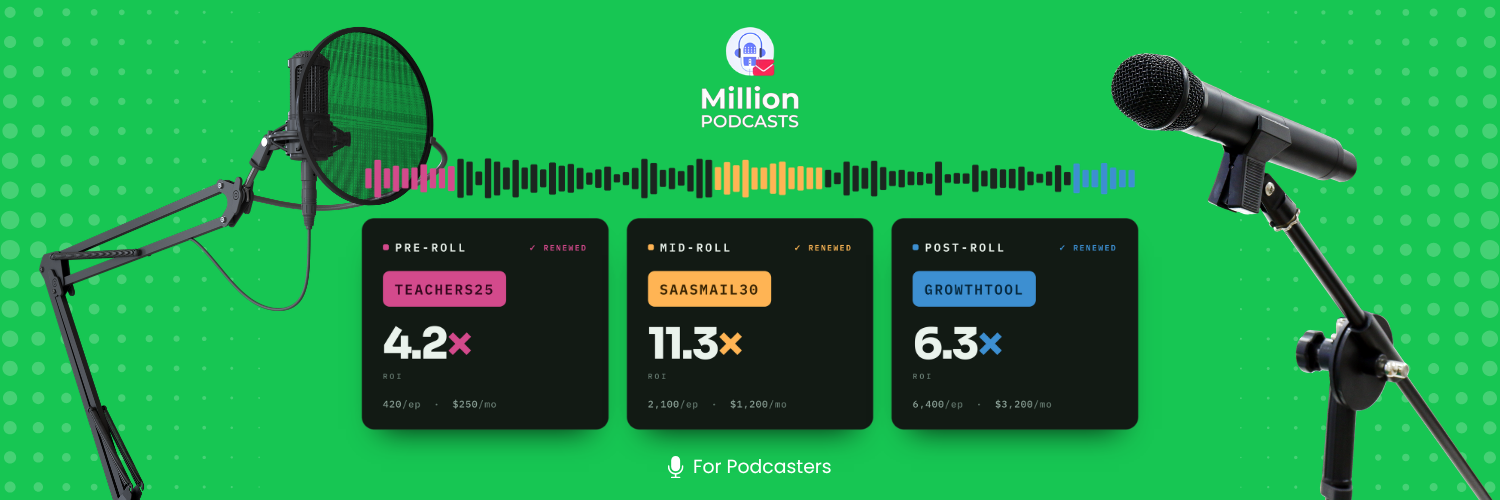
A show with 420 downloads an episode charged $250 a month, and renewed four times. A show with 9,100 downloads returned 1.18x in year one, and kept the same sponsor for three. Those are two of the nine podcast sponsorship examples below.
Each one is costed end to end. Who listened, which package the brand agreed to, what money moved, and whether the sponsor came back. Rates run from $250 a month to $4,400. For market rate benchmarks by genre, see our guide to podcast advertising cost and CPM rates.
One pattern runs through all nine. The rate tracked how precisely the host could describe the audience, not how large it was. A 420 download show and a 9,100 download show both landed deals that renewed.
What are podcast sponsorship examples? Each one shows the audience, the package, the rate, the tracking and the outcome together. The nine here run from $250 to $4,400 a month across seven package types, with effective CPMs from $28 to $417. Eight of the nine renewed. Our own index counts 16,000 shows under 1,000 monthly listeners already carrying a sponsor.
1. What a Sponsorship Example Shows You
Sponsors pay more for a host read than for any other audio placement. Your listener chose your voice. A banner ad arrives uninvited.
Examples come in two shapes, and each answers a different question.
Which companies buy, what placement they take, what offer they track. Use these to build a prospect list. See Section 2.
The full economics of one agreement, from downloads through to renewal. Use these to decide what to charge. See Section 4.
US podcast advertising reached $2.862 billion in 2025, up 17.6 percent year on year. That figure comes from the IAB and PwC revenue report published in April 2026. Plenty of it reaches small shows, through the categories in the next section.
Open every host read with a spoken sponsor disclosure. The Federal Trade Commission requires a material connection to be disclosed clearly and close to the endorsement. In audio, show notes do not count, because most listeners never open them.
2. Which Brands Sponsor Podcasts?
Most podcast sponsors examples stop at a list of brand names. Pitching a brand that already buys podcast ads cuts your sales cycle roughly in half. They know the format and hold a budget for it. Eight categories cover most repeat advertisers.
The brands below are not guesses. Two MillionPodcasts exports pulled on August 20, 2026 supply them. The larger covers 7,190 English language shows at 1,000 to 10,000 monthly listeners, all flagged Has Sponsor. The count beside each brand is how many of those shows carry it.
| Category | Brands seen on shows at 1K to 10K listeners | What they track | Smallest show they buy | Example |
|---|---|---|---|---|
| Software | Odoo on 120 shows, Shopify on 90, Squarespace on 27 | Free trial on a show specific URL | Any size with a defined job title | Affiliate SaaS |
| Health and wellness | BetterHelp on 120 shows, Hims on 76, AG1 on 39 | Promo code on a first order | 500 downloads, engaged audience | Three sponsors |
| Financial services | Monarch on 161 shows, Rocket Money on 134, Cash App on 65 | Consultation booked, tagged in CRM | Any size with verified income data | Premium CPM |
| Recruitment | Indeed on 122 shows, LinkedIn on 30, ZipRecruiter on 18 | Job post credit on a vanity URL | 500 downloads of owners or hirers | Lead gen B2B |
| Subscription and DTC | Factor on 151 shows, Aura Frames on 112, HelloFresh on 69 | Heavy first order promo code | 1,000 downloads, consumer audience | Bundle deal |
| Security and privacy | NordVPN on 68 shows, ExpressVPN on 36, 1Password on 24 | Discounted first term on a URL | 2,000 downloads, tech audience | Exclusivity |
| Education | Masterclass on 32 shows, Babbel on 11, Skillshare on 8 | Applications counted per cohort | 1,000 downloads in one profession | Performance bonus |
| Local services | Regional firms only, such as Campbell Accountants and Pascoe Jewellers | Promo code used at booking | 200 downloads in the right city | Local flat rate |
That last row is where small shows actually get paid. Its two names come from the second export, of 6,938 shows under 1,000 monthly listeners. National brands buy scale. A regional firm buys relevance, and will fund a 400 download show if those listeners live nearby.
One cluster sits outside all eight categories and buys hard at this size. Sports betting and ticketing brands appear more often than any software name in the same sample. FanDuel shows up on 192 of those shows, Gametime on 154, PrizePicks on 149 and DraftKings on 92. If your show touches sport, start your pitch list there.
How many brands one small show carries, from the same two exports:
- Seven sponsors, the median count on record for a show under 1,000 monthly listeners
- Nine sponsors, the median once a show reaches 1,000 to 10,000 monthly listeners
- 63.3 percent of sponsored shows under 1,000 listeners have carried five brands or more
- 13.2 percent have run only one, so a single logo is the exception, not the entry point
Read that as a pricing signal, not a boast. A show that has cycled through seven brands is a show whose sponsors keep leaving. Usually that means each read was sold cheap and reported thinly. Depth beats volume here, and the renewal conditions in Section 8 are what build it.
Names are a starting point, not a list. Search your beat in the MillionPodcasts podcast directory and apply the Has Sponsor filter across 43.1K shows already carrying deals. The brand categories on those profiles show you who is buying in your niche right now.
3. The 7 Podcast Sponsorship Packages
Your package decides who carries the risk. Flat rate puts it on the sponsor. Affiliate puts it on you. For a first deal the package matters more than the rate, because it anchors every renewal after it.
| Package | How it works | Who carries the risk | Best match | Worked example |
|---|---|---|---|---|
| Flat rate | Fixed fee each month, whatever the results | Sponsor | Any size, when your audience is provable | Local flat rate, $250 at 420 downloads |
| CPM | A set price per 1,000 downloads | Sponsor | Above 5,000 downloads, steady delivery | Premium CPM, $65 at 9,100 downloads |
| Affiliate | You earn a share of each verified sale | Podcaster | Audiences already shopping the category | Affiliate SaaS, 5 percent at 680 downloads |
| Cost per lead | A fixed amount per qualified prospect | Podcaster | B2B shows with one clear job title | Lead gen B2B, $40 at 540 downloads |
| Performance bonus | Guaranteed base plus milestone payments | Shared | New sponsors unsure about conversion | Performance bonus, $900 base plus bonuses |
| Category exclusivity | A premium to lock competitors out | Sponsor pays more, you forgo rivals | Niches where rivals are already buying | Exclusivity, $3,200 at 6,400 downloads |
| Multi channel bundle | Podcast sold with newsletter or social | Sponsor | Creators with two or more channels | Bundle deal, $1,200 bundled |
Open with flat rate even when affiliate could pay more. The first number you name becomes the anchor. Sponsors renewing a $500 deal think in multiples of $500. For the upgrade conversation, read how to negotiate podcast ad rates.
4. Podcast Sponsorship ROI Case Studies at a Glance
Nine podcast sponsorship examples, three size tiers, seven packages. Find the row nearest your show, then jump to it. Each one shows its inputs first, then the arithmetic that follows.
Effective CPM = fee ÷ (downloads per episode × episodes in the period) × 1,000
Eight columns sit in this table. On a phone, scroll it sideways to reach effective CPM, ROI and renewal.
| Example | Downloads | Audience | Package | Paid to host | Eff. CPM | Sponsor ROI | Renewed |
|---|---|---|---|---|---|---|---|
| Local flat rate | 420 | School teachers | Flat monthly | $250 a month | $137 | 14.0x | Yes, four times |
| Affiliate SaaS | 680 | HR managers | Affiliate, 5 percent | $1,008 over 90 days | $114 | 20.0x | Yes, as hybrid |
| Lead gen B2B | 540 | Small business owners | $40 per lead | $1,800 total | $257 | 43.3x | No, host declined |
| Bundle deal | 2,100 | DTC brand owners | Podcast plus newsletter | $1,200 a month | $28 | 8.7x | Yes, plus 16.7 percent |
| Precision B2B | 1,800 | Email marketers | Flat monthly | $1,500 a month | $417 | 9.0x | Yes |
| Performance bonus | 3,200 | New managers | Base plus milestones | $7,300 over 5 months | $105 | 18.2x | Yes, as flat |
| Exclusivity | 6,400 | Software teams | Flat plus exclusivity | $3,200 a month | $115 | 5.2x | Yes, plus 9.4 percent |
| Three sponsors | 8,200 | Women in perimenopause | Three flat rates | $4,400 a month | $124 | 4.8x average | All three |
| Premium CPM | 9,100 | Accredited investors | CPM at $65 | $1,183 a month | $65 | 1.18x year 1 | Yes, three years |
Two things jump out once every row uses the same formula. Effective CPM spans $28 to $417, and the highest rate per thousand belongs to one of the smallest shows. The biggest return sits on the only deal that did not renew.
5. Examples Under 1,000 Downloads
Three of the nine podcast sponsorship examples sit under 1,000 downloads an episode. None won on reach. In each, the sponsor could describe the audience better after one pilot than through any channel they bought.
Three deals could be luck, so here is the whole index behind them. Filter to English language shows with an episode in the last 12 months. On that filter, 16,000 podcasts under 1,000 estimated monthly listeners carry a sponsor. That is a larger sponsored population than every band above 10,000 listeners combined.
| Audience band | Shows in the index | Shows carrying a sponsor | Share sponsored |
|---|---|---|---|
| Up to 1K | 332.7K | 16K | 4.8 percent |
| 1K to 10K | 70K | 10.4K | 14.9 percent |
| 10K to 50K | 9.2K | 2.6K | 28.3 percent |
| 50K to 250K | 1.7K | 692 | 40.7 percent |
| 250K to 1M | 135 | 55 | 40.7 percent |
| 1M plus | 4 | 2 | 50.0 percent |
One caveat before you use those figures. The index counts estimated monthly listeners, while the nine examples below count downloads per episode. A weekly show at 420 downloads sits inside that first band, so treat the bands as wider than the example figures.
Two readings sit inside that table, and both matter to your pitch. The share sponsored climbs with size, from 4.8 percent to 40.7 percent. So a sponsor asking why your feed carries no logo yet is asking a fair question. The absolute count runs the other way, because small shows hold the money in volume rather than rate.
Local flat rate: a tax firm reaching teachers
$250 a monthThe firm's problem was precision, not volume. Local search ads on tax keywords cost $18 to $35 a click, and reached anyone who typed a tax term. The podcast reached one profession: teachers with self employment income.
| Metric | Result |
|---|---|
| Promo code redemptions | 19 |
| New clients won | 16, or 84 percent of redeemers |
| Average first year client value | $658 |
| Revenue attributed to the podcast | 16 × $658 = $10,528 |
| Sponsor ROI | $10,528 ÷ $750 = 14.0x |
Flat rate plus a code removes every barrier a small sponsor faces. No CPM maths, no impression estimates, just a redemption count they can check any day. The 420 figure never came up again.
Affiliate SaaS: 5 percent that underpaid the host
5% commissionThe sponsor was paying $190 to $340 per trial signup on paid search, and most of those trials churned inside a month. This audience was accountable for compliance decisions. They were not browsing for a tool. They needed one.
| Metric | Result |
|---|---|
| Trial signups from the podcast | 47 |
| Trial to paid rate, podcast | 29.5 percent, against 18 percent everywhere else |
| Paid subscribers won | 14, at $1,440 a year each |
| Revenue attributed to the podcast | 14 × $1,440 = $20,160 |
| Commission paid to the host | 5 percent of $20,160 = $1,008 |
| Sponsor ROI | $20,160 ÷ $1,008 = 20.0x |
Read the last two rows together. The campaign worked, and the host still earned about $336 a month. A 5 percent cut of a $1,440 product cannot pay a host at 680 downloads, however well it converts. At renewal the host moved to $600 guaranteed plus the same commission.
Affiliate suits audiences already shopping the category. Run the arithmetic before you sign. Multiply a realistic conversion count by the commission, then ask whether that covers the work.
Lead gen B2B: $40 for every qualified lead
$40 a leadA qualified lead meant a business owner who attended a free webinar and answered four screening questions. This is the highest return here, and the only deal that did not continue past the pilot.
| Metric | Result |
|---|---|
| Webinar registrations | 61 |
| Qualified leads | 45, or 73.8 percent |
| Paid to the podcaster | 45 × $40 = $1,800 |
| Leads closed by the sales team | 12, a 26 percent close rate |
| Revenue attributed to the podcast | 12 × $6,500 = $78,000 |
| Sponsor ROI | $78,000 ÷ $1,800 = 43.3x, or $150 per client won |
The sponsor offered to continue and the host declined. Cost per lead deals need you to price your own hours before episode one. If the brief includes co producing content or vetting leads, that labour has a rate. A 43.3x return is enormous leverage at renewal.
Never open a media kit with your download count at this size. Open with the sentence a marketing lead would forward to their boss. We reached 540 business owners and closed 12 clients at $150 each. For the groundwork, see how small podcasts attract sponsors.
6. Examples at 1,000 to 5,000 Downloads
At this size your conversion data steadies across a pilot. All three sponsors below already bought through networks. Each picked one show anyway.
Bundle deal: podcast and newsletter sold together
$1,200 a monthThe bundle put roughly 42,900 monthly impressions in front of one buyer persona for $1,200. That rate sat close to what the sponsor already paid a network for a general audience.
| Metric | Result |
|---|---|
| Trials from the podcast | 47, or 42.7 percent of the bundle |
| Trials from the newsletter | 35, or 31.8 percent |
| Trials from social | 28, or 25.5 percent |
| Blended trial to paid rate | 24 percent, against an 18 percent network benchmark |
| Customers won | 110 × 24 percent = 26, at $2,400 first year value |
| Sponsor ROI | $62,400 ÷ $7,200 = 8.7x over six months |
Bundle your channels before the sponsor asks. To a brand with one acquisition budget, your newsletter and your show are the same audience twice. Insist on separate UTM sources, or you cannot prove which channel earned the result.
Precision B2B: a niche priced far above CPM
$1,500 a monthThis example should change how you think about CPM. At 1,800 downloads twice a month, $1,500 works out to $417 per thousand. Priced off a rate card, this host would have asked $150 and left $1,350 a month behind.
The sponsor did not care. They were not buying impressions. Reaching a marketer who runs a 50,000 subscriber list cost them $120 to $280 per qualified click elsewhere.
| Metric | Result |
|---|---|
| Paid to the host | 4 × $1,500 = $6,000 |
| Enterprise trials from the podcast | 5, or $1,200 each |
| Sponsor's cost per acquisition elsewhere | $2,400 to $3,600 |
| Contracts closed | 3, at $18,000 a year |
| Sponsor ROI | $54,000 ÷ $6,000 = 9.0x |
The premium held because the host could prove the niche. A listener survey showed 68 percent managed lists above 50,000 subscribers. Price against what the sponsor pays per customer today, never against a CPM table.
Performance bonus: a base plus milestone payments
$900 base a monthA bonus structure solves a standoff on a first deal. The sponsor wants a cap on downside. You want income certainty. A base plus milestones gives both, and puts you on the same outcome.
| Metric | Result |
|---|---|
| Enrolments carrying the code | 74 |
| Base fees paid | 5 × $900 = $4,500 |
| Bonuses triggered | 14 × $200 = $2,800 |
| Total paid to the host | $4,500 + $2,800 = $7,300 |
| Revenue attributed to the podcast | 74 × $1,800 = $133,200 |
| Sponsor ROI | $133,200 ÷ $7,300 = 18.2x |
A bonus is a bridge, not a destination. It gets a nervous sponsor to yes and produces three months of data. Put the trigger and the reconciliation date in writing.
Both premium deals in this guide rested on one survey question asked on air. Ask your listeners for their job title or list size, then put the result in your media kit. Our guide on how to read a podcast media kit shows which fields sponsors actually check.
7. Examples Above 5,000 Downloads
Above 5,000 downloads, sponsors already know podcasts work. The question is which package captures the most value. In all three below, the host proposed the structure first.
Exclusivity: paying a premium to lock rivals out
$3,200 a monthExclusivity sells something impressions cannot: silence from competitors. This sponsor paid about 35 percent above the standard rate to keep rivals out of the feed for six months.
| Metric | Result |
|---|---|
| Paid to the host | 6 × $3,200 = $19,200 |
| Trial signups from the podcast | 203, converting at 27 percent |
| Customers won | 55, at $1,800 first year value |
| Sponsor ROI | $99,000 ÷ $19,200 = 5.2x |
| Rival sponsors turned away | 3 |
| Renewal | $3,501 a month, up 9.4 percent |
Propose exclusivity yourself, premium attached. Whoever raises it second negotiates down from someone else's number. Check first that rivals are actually buying in your niche. Exclusivity is only worth a premium when there is something to exclude.
Three sponsors: one show, no category overlap
$4,400 a monthThree sponsors at once needs category management, not just more selling. A supplement brand, a health device and a life insurer, all confirmed non overlapping in writing before signing.
| Sponsor | Slot | Rate | Monthly volume | Value per action | ROI |
|---|---|---|---|---|---|
| Supplement brand | Pre roll | $1,600 | 284 code redemptions | $29 order | 5.1x |
| Health device | Mid roll 1 | $1,800 | 67 units sold | $110 unit | 4.1x |
| Life insurer | Mid roll 2 | $1,000 | 31 qualified leads | $165 lead | 5.1x |
Define the category in writing when you sign the first sponsor, not when the second appears. Supplements and health devices sound distinct until a supplement brand launches a wearable.
Build the sponsor list this guide runs on
MillionPodcasts indexes 3M+ shows, 43.1K of them already carrying sponsors. Filter by beat, audience size, listener income and geography, unlock verified host and booker emails, then export the list to CSV or Excel for your own outreach tool.
Search the sponsor database →8. Why Eight Deals Renewed and One Ended
Eight of the nine renewed, four at a higher rate. The one that ended returned 43.3x, the biggest number here. That sponsor asked to carry on. The host was the one who said no.
So read the table below in two parts. The first four rows are reporting habits the eight renewals shared, and they are worth copying. Only the last row explains why the ninth stopped.
| Practice | The 8 that renewed | The 1 that ended |
|---|---|---|
| Sponsor could verify in their own systems | All eight | Yes, 43.3x confirmed in their CRM |
| Report sent within 5 days of the last episode | All eight | No, sent on day 14 |
| A quality metric reported, not just volume | Six of eight | Not measured |
| A listener quote in the report | Seven of eight | Not included |
| Scope matched what the host was paid for | All eight | No, webinar hours were never priced |
The last row is the one that decided it. The cost per lead deal ended on scope, not on results and not on reporting. Webinar hours and lead vetting were never priced, so the host walked away from a 43.3x campaign. The premium CPM deal renewed for three years on a 1.18x first year, because that sponsor tracked retention as well as volume.
The tracking methods that appeared across the nine:
- UTM tagged links, used in all nine, so show notes clicks land in the sponsor's own analytics
- Unique promo codes, used in seven, catching buyers who never click a link
- Dedicated landing pages, used in six, isolating podcast traffic from every other source
- CRM source tags, used in five, the only way to measure retention months later
- How did you hear fields, used in four, as a cross check on everything above
Build the tracking before you pitch, not after the campaign airs. A UTM link, a promo code and a five day results report are the minimum. End that report with a proposal, not an invitation: name a rate and a start date. Six of the eight renewals signed within 72 hours of a report that did exactly that.
9. How to Write a Podcast Sponsorship Proposal
Every deal here opened with a proposal under 200 words. None led with downloads. Under 1,000 downloads, ask for flat rate and lead with occupation and geography. Between 1,000 and 5,000, take affiliate or a bonus first, then convert to flat rate once you hold the data. Above 5,000, propose exclusivity yourself.
Subject: [Show Name] sponsorship for [Company Name]
Hi [First Name],
I host [Show Name], a [weekly or biweekly] podcast for [specific audience, for example "HR compliance managers at companies of 50 to 500 people"]. We average [X] downloads an episode. [One survey data point, for example "68 percent of listeners manage lists above 50,000 subscribers."]
I am proposing a [package] pilot: [terms, for example "$500 a month flat rate for two months"]. Before the first episode airs I will set up UTM tagged links, a unique promo code and a dedicated landing page on your side, so every result lands in your analytics rather than in a report from me.
Within five days of the final episode you will have one page: downloads delivered, code redemptions from your own system, conversions, cost per customer, and one listener quote about your product.
Would 15 minutes on [specific date] work?
[Your Name]
[Show Name]
[Link to your media kit]
The second paragraph does the work. It answers the objection every sponsor raises, before they raise it.
Nine examples, from 420 downloads to 9,100, and size is not the pattern. The smallest show renewed four times. The biggest return here ended after one pilot, because nobody priced the host's hours.
So start here, today. Write one sentence describing your listener that a sponsor could forward to their boss. Then pick the package that matches your size, not your ambition. Check what it will actually pay you before you sign.
10. Podcast Sponsorship Examples FAQ
What are podcast sponsorship examples?
A podcast sponsorship example shows five things together. Who listened, what structure the brand agreed to, and what rate was paid. Then what tracking proved it, and whether the sponsor renewed. The nine here run from $250 to $4,400 a month across seven package types, and eight of the nine renewed.
Which brands sponsor podcasts?
Recurring podcast advertisers sit in eight categories. Software such as Squarespace and ZipRecruiter. Health such as BetterHelp and AG1. Financial such as Rocket Money and Policygenius. Recruitment such as Indeed. Subscription such as HelloFresh. Security such as SimpliSafe and NordVPN. Education such as Masterclass. The eighth is local professional services, which sponsors most shows under 1,000 downloads. MillionPodcasts exported 7,190 English language shows at 1,000 to 10,000 monthly listeners on August 20, 2026. The five brands on the most shows were Monarch on 161 and Factor on 151. Then Indeed on 122, BetterHelp on 120 and Aura Frames on 112.
What are the types of podcast sponsorship?
There are seven. Flat rate pays a fixed monthly fee. CPM pays per thousand downloads. Affiliate pays a share of verified sales. Cost per lead pays per qualified prospect. Performance bonus adds milestones to a base. Category exclusivity charges a premium to lock competitors out. Bundles sell the podcast with a newsletter or social audience.
Do podcasts under 1,000 downloads get sponsors?
Yes. MillionPodcasts index counts pulled on August 20, 2026 found 16,000 English language podcasts under 1,000 estimated monthly listeners carrying a sponsor. That is 4.8 percent of the band. Three of the nine examples here are shows at 420, 540 and 680 downloads an episode. Deals that size close on audience precision, not reach. In the 420 download example, a $250 monthly flat rate returns 14.0x over a three month pilot.
How do sponsors track podcast ads?
With UTM tagged links, unique promo codes, dedicated landing pages, CRM source tags and a how did you hear field at checkout. Across the nine examples here, every one uses UTM tagged links and seven use a promo code. Six use a dedicated landing page, five use CRM source tags, and four use a how did you hear field. Each uses at least two methods.
What should a podcast sponsorship proposal include?
Five things, in under 200 words. One sentence on who listens, by job title and buying responsibility. Average downloads per episode. One verified audience data point, such as a survey result. A named structure with a rate and duration. And the tracking you will build before episode one.
References
IAB and PwC. (April 2026). Internet Advertising Revenue Report, Full Year 2025. https://www.iab.com/insights/podcast-advertising-revenue-report/ Federal Trade Commission. FTC's Endorsement Guides: What People Are Asking. https://www.ftc.gov/business-guidance/resources/ftc-endorsement-guides-what-people-are-asking MillionPodcasts. (August 2026). Sponsored podcast counts by estimated monthly listener band, English language, latest episode in the last 12 months. https://www.millionpodcasts.com/podcasts-directory/ MillionPodcasts. (August 2026). Sponsor name and sponsor count export, 6,938 shows under 1,000 monthly listeners and 7,190 shows at 1,000 to 10,000 monthly listeners. https://www.millionpodcasts.com/podcasts-directory/ MillionPodcasts. Our Database. Total podcasts indexed and podcasts with sponsors. https://www.millionpodcasts.com/