
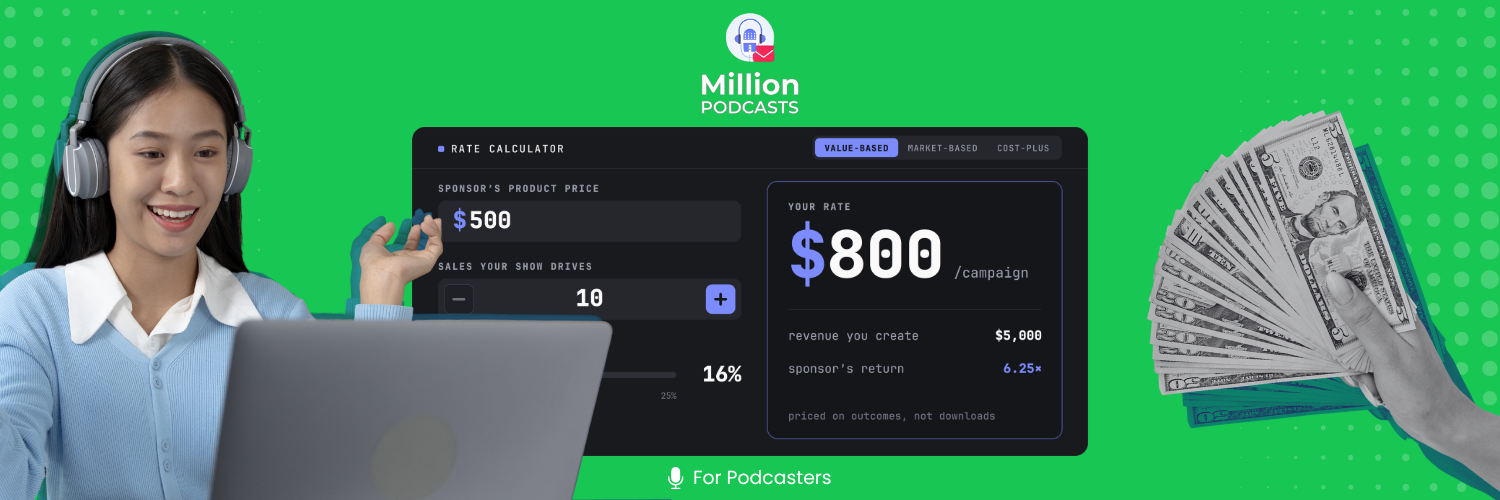
Multiply your 30 day download average by your category rate, then divide by 1,000. A 5,000 download business podcast gets $150 for a 60 second host read spot. That is the number, and the rest of this guide is about the two things it leaves out.
Those two: what a sponsor will actually agree to, and how to charge more than the average without losing the deal. Buying ad inventory rather than selling it? Our podcast advertising cost guide covers the buyer's side.
Podcast sponsorship rates in 2026 run $18 to $22 per thousand downloads for a 30 second host read spot. Sixty seconds pays $24 to $26. Business shows sit highest at $30.
What do podcast sponsors pay? Podcast sponsorship rates for host read spots run $18 to $22 per 1,000 downloads for 30 seconds and $24 to $26 for 60. A 5,000 download show earns $90 to $130 a spot. Business tops the table at $30.
1. What Do Podcast Sponsors Pay Per 1,000 Downloads?
Your rate starts with two numbers: how many people download an episode, and what your format is worth per thousand of them. That second number is your CPM, short for cost per mille.
These rates come from the Libsyn Ads card, retrieved August 2026.
| Ad format | Rate per 1,000 downloads | What you are selling |
|---|---|---|
| Host-read 60-sec, baked in | $24 to $26 | Your voice, permanently, mid-episode. The highest paying format you can offer. |
| Host-read 30-sec, baked in | $18 to $22 | Same permanence, half the airtime. What most first deals look like. |
| Dynamic on new episodes | $18 to $22 | Pre-recorded audio inserted at download. Expires when the campaign ends. |
| Dynamic on back catalogue | $14 to $16 | Your archive, sold by volume. Pure upside if you have episodes people still find. |
| Programmatic | $12 to $15 | Automated placement, no endorsement. Lowest rate, least work. |
The pattern is simple. The closer an ad sits to your actual voice on new episodes, the more it pays. A 60 second host read earns 60 to 100%+ more per thousand downloads than programmatic.
That premium is measured, not assumed. Magellan AI's Podcast Measurement Benchmark Report, published June 2026, covered campaigns run from January to March 2026. It found host read spots drove a 2.45% response, against 1.93% programmatic and 1.51% for produced spots.
Response rate there means the share of listeners reached who visited the advertiser's site within 30 days. Quote the definition alongside the number, because the definition is what makes it credible.
So how much do podcast sponsors pay?
Read across from your own download count. These are what a sponsor pays you for one host read spot, before any premium you argue for later.
- Under 1,000 downloads: $12 to $26 a spot on the maths, which is why almost nobody sells on CPM at this size. Quote a flat $300 to $500 an episode instead, then read how small podcasts get sponsors for the pitch that lands the first one.
- 1,000 to 5,000: $24 to $130 a spot, or roughly $100 to $520 for a four episode month. This is where a first paid deal usually lands.
- 5,000 to 25,000: $120 to $650 a spot. CPM starts working properly here, and premiums above the card become defensible.
- 25,000 and above: $600 to $1,200+ a spot. At this size sponsors negotiate the rate directly rather than accepting a card.
Two things change those numbers more than anything else. Category, which is worth up to $8 per thousand, and whatever proof you can put behind your audience.
Rates by category
Category moves your rate, but less than most guides suggest. The whole published table spans $8.
| Your category | Host-read rate | Why sponsors pay it |
|---|---|---|
| Business | $30 | Listeners buy at work. Highest per-listener spend of any category. |
| Health and Fitness | $27 | Supplement and wellness brands carry large consumer budgets. |
| Technology | $26 | SaaS and developer tools spend heavily against technical buyers. |
| Education | $26 | Career-focused listeners invest in courses, tools and software. |
| Fiction | $24 | Loyalty is unusually high, which sponsors value over raw spend. |
| Science | $23 | Educated audience, strong fit for health and subscription brands. |
| Comedy | $23 | Mass reach with real listener attachment. DTC brands budget here. |
| Society and Culture | $23 | Broad audience with community affinity. Lifestyle brands perform. |
| Games | $22 | Younger skew. Consumer electronics and gaming brands fit. |
| Leisure | $22 | Variable audience profile. Subscription brands find a fit here. |
Only 10 categories are published. True Crime, Sports, News and Kids and Family are among those missing. If yours is absent, use the format table above as your number, then check it against real shows in Section 4.
How many shows in your category carry a sponsor
A rate card assumes you already have a sponsor. Most shows never do. We counted every podcast in the MillionPodcasts database that published in the last 12 months, then counted how many of those carry a sponsor, in August 2026.
| Your category | Share of active shows carrying a sponsor |
|---|---|
| Technology | 18.3% (1.7K of 9.3K) |
| Business | 18% (3K of 16.7K) |
| Health and Fitness | 15.6% (2.1K of 13.5K) |
| Games | 12.4% (435 of 3.5K) |
| Comedy | 10.7% (1.1K of 10.3K) |
| Science | 10.7% (458 of 4.3K) |
| Leisure | 10% (381 of 3.8K) |
| Education | 9.6% (1.3K of 13.6K) |
| Society and Culture | 8.5% (1.7K of 20K) |
| Fiction | 7.5% (112 of 1.5K) |
The two categories with the highest published rates also have the most sponsored shows. That is demand, not coincidence. Society and Culture is the biggest category in the table at 20K active shows, yet fewer than one in ten carries a sponsor, so a crowded category is not an easy one.
How many shows your size have a sponsor
Sponsorship gets easier with audience, and the climb is steeper than any rate table suggests. Same database, same 12 month window, split by estimated monthly listeners.
| Estimated monthly listeners | Active shows | Shows with a sponsor | Share |
|---|---|---|---|
| Up to 1K | 523.3K | 22.2K | 4.2% |
| 1K to 10K | 92K | 12.7K | 13.8% |
| 10K to 50K | 11.9K | 3.1K | 26.1% |
| 50K to 250K | 2K | 787 | 39.4% |
| 250K to 1M | 144 | 56 | 38.9% |
| 1M and above | 5 | 3 | 3 of 5 shows |
Read that as a growth argument, not a rate argument. Crossing from under 1K listeners into the 1K to 10K band roughly triples your odds of carrying a sponsor at all. The top row rests on five shows, so treat it as a curiosity rather than a benchmark.
It also explains why the flat fee advice below matters. If you sit in the largest band, your competition is 523.3K other shows and only 22.2K of them have proved a sponsor will pay.
What that pays you, by download count
This is the table most hosts come here for. It uses the host read rates above, so read across from your own 30 day average.
| Downloads per episode | 30-sec spot | 60-sec spot | Four episodes, one month | What to quote instead |
|---|---|---|---|---|
| 500 | $9 to $11 | $12 to $13 | $48 to $52 | Flat $300 per episode |
| 1,000 | $18 to $22 | $24 to $26 | $96 to $104 | Flat $300 to $500 |
| 2,500 | $45 to $55 | $60 to $65 | $240 to $260 | Flat base plus a bonus |
| 5,000 | $90 to $110 | $120 to $130 | $480 to $520 | CPM works from here |
| 10,000 | $180 to $220 | $240 to $260 | $960 to $1,040 | CPM, with a floor |
| 25,000 | $450 to $550 | $600 to $650 | $2,400 to $2,600 | CPM, plus exclusivity |
| 50,000+ | $900+ | $1,200+ | Negotiate directly | CPM, plus add-ons |
Two things jump out of that table. A 500 download show earns $12 a spot on CPM maths, which is not a business for either side. And the monthly column is always the number worth quoting, because a sponsor buying one episode learns nothing.
Which podcast sponsorship pricing model fits your show
The model matters as much as the rate. Pick the wrong one and you either price yourself out or leave money behind.
| Your situation | Use this | What to say |
|---|---|---|
| Under 1,000 downloads | Flat rate | Quote $300 to $500 an episode. Justify it on who listens, not how many. See the 600 download example. |
| No conversion data yet | Affiliate or CPA | Zero risk gets a yes faster. Collect the numbers, then charge for the next campaign. |
| 1,000 to 3,000 downloads | Hybrid | A flat base covers production. A bonus per signup gives the sponsor a ROI line. |
| 3,000+ downloads | CPM with a floor | CPM scales as you grow. The floor stops a bad month costing you the deal. |
| Small but very specific | Value-based flat rate | 800 CFOs beat 8,000 casual listeners. Price on what one customer is worth. |
Most working hosts layer two. A CPM or flat base for the spot, with an affiliate link alongside, gives the sponsor a conversion metric. It also gives you upside above the guarantee.
Which downloads you can actually bill for
Your rate is a price per thousand downloads, so the definition of a download carries every figure above. Two shows with identical audiences can report different numbers if their hosts filter traffic differently.
The standard is the IAB Tech Lab Podcast Technical Measurement Guidelines. Version 2.2 dates from May 2024, and version 2.3 is out for public comment until 19 August 2026.
Settle three things in writing before the first invoice. Which window your figure uses, whether your host is IAB certified, and whether YouTube views are counted separately. Libsyn measures a show on the downloads a new episode gets in its first 30 days. Every table above assumes that window.
About the named rates you will find elsewhere
Search for what specific podcasts charge and you will meet the same handful of figures. A real estate show at a $5,000 minimum. A tech show at $25,000 a quarter. A business show at $150 to $600.
Trace them and they all lead back to one undated list, republished across dozens of sites for years. Some of the shows named have not published a rate card since. At least one has not published a new episode in years.
Do not price against them. A named rate with no date and no source is worth less than the formula at the top of this section. A sponsor who checks will know.
If you want real comparables, gather them yourself from shows your own size. Section 4 is the two week version of that.
What sponsors have actually been paying
One caveat before you quote any of this. These are published rates, and Libsyn also used to publish what its marketplace actually transacted at.
That series ended in September 2024 at $21.37 for a 60 second spot, down from $22.84 a year earlier. Podnews reported in June 2026 that rates have stagnated and in many cases compressed, as more shows compete for the same budgets.
So an experienced buyer knows the going rate is nearer $21 than $26. Quote the higher number anyway, then give them a reason it is worth it. Building that reason is the next section.
Podcast Sponsorship Rate Calculator (2026)
Host-read uses the Libsyn category rate. Thirty second host-read applies 75% of it, matching the published 60s to 30s ratio. Formula: downloads x rate / 1,000 = your per-spot price.
Name the softer number before the buyer does. "The card says $30 for business. The market has cleared nearer $21. We charge $34 because 72% of our listeners are founders." Conceding the low figure first makes your high figure believable.
2. How Much to Charge for Podcast Sponsorship
The tables in Section 1 give you a floor. Every dollar above it has to be paid for with a specific fact, not an adjective.
Sponsors do not think in rates. They think in cost per customer. The host who quotes that number closes higher and faster.
Work out what your listener is worth to them
Run this before any pitch above the category rate. Use your own affiliate conversion data where you have it. Where you do not, use 1 to 1.5% and say so, because sponsors often correct you upward with their own figures.
Illustrative numbers. Substitute your own downloads, conversion rate and price.
Your show: SaaS podcast, 2,200 downloads per episode
Their product: CRM at $2,400 a year
Step 1: 2,200 x 1.5% = 33 trial signups per episode
Step 2: Their trial-to-paid rate is 20%, so 33 x 20% = 6.6 customers
Step 3: 6.6 x $2,400 = $15,840 of customer revenue per episode
Step 4: Your rate of $800 divided by 6.6 customers = $121 each
Say this: "At $800 an episode you are paying about $121 per new customer on a $2,400 annual product. That is a 19.8x return before any renewal."
Three facts that justify a premium
Any rate above the category number needs at least one of these. All three together support pricing 40 to 60% higher.
| The fact | Where to get it | What it proves to a sponsor |
|---|---|---|
| Completion rate | Your hosting analytics, episode level. No public benchmark exists, so your own figure is the evidence. | Your mid-roll reaches people still listening. Attention is what they are buying. |
| A past result with a number | Promo redemptions or affiliate conversions from any previous campaign | Removes guesswork. "23 redemptions from four episodes" beats any rate comparison. |
| Audience specificity | Listener survey, or your platform's demographic data | Scarcity raises price. A DevOps-for-healthcare show has almost no substitutes. |
Turning a fact into a sentence a sponsor accepts
A fact on its own does not raise a rate. It has to be tied to something the sponsor is buying.
Completion rate becomes: your mid-roll reaches 74% of everyone who starts. Specificity becomes: 68% of our listeners hold the job title you sell to. A past result becomes: the last campaign in your category converted at 0.74%.
Each one answers the same silent question: why is this worth more than the next show on their list? Pick the strongest fact you have and lead with it before you name a number.
Price your video separately
If you publish to YouTube, charge for it. Magellan AI's Q1 2026 data found video podcasts drove a 2.49% response against 1.39% for audio-only shows. Lead conversion ran 11.27% against 6.42%.
That is a documented performance gap. It belongs in your rate rather than thrown in as a bonus deliverable.
How much a premium is worth defending
All three facts together support 40 to 60% above the category rate. One strong fact supports 15 to 25%.
Below that, do not bother. A $2 premium is not worth the credibility you spend arguing for it. It also anchors the sponsor on price rather than fit.
Where you have none of the three yet, the fastest route is an affiliate deal. Run one campaign, record the conversion rate, then use that single number as your premium argument at the next negotiation.
Under-pricing costs more than the money. Sponsors read price as quality, and a $200 rate signals a show that doubts itself. Your first rate anchors every renewal that follows, so use the podcast metrics that reveal growth to build proof before you quote.
3. Real Rate Examples by Show Size
Two shows at opposite ends of the range, with the exact argument each one makes. Every figure is a sample input, so swap in your own before you use them.
600 downloads: sell the audience, not the number
Show: Retirement planning for nurses, 600 downloads per episode
Sponsor: Fee-only financial planning firm for healthcare professionals
Rate: $500 flat per episode, two episodes a month, $1,000 total
The pitch: "Reaching 600 nurses with a retirement question is not the same as reaching 6,000 general finance listeners. You specialise in healthcare professionals and we are the only retirement podcast in that space. At $0.83 per targeted listener you are buying category ownership, against $4 to $8 per click on LinkedIn with no host endorsement."
Notice what is missing. There is no CPM in that pitch, because CPM maths at 600 downloads produces $14 and kills the conversation.
1,800 downloads: use a hybrid to land the first deal
Show: SaaS marketing strategy, 1,800 downloads per episode
Sponsor: Email marketing platform at $99 a month
Rate: $600 flat base covering four episodes, plus $15 per paid trial signup
The pitch: "The $600 base covers production and guarantees four episodes. The $15 per trial gives you a direct ROI line. At a conservative 1.5% conversion from 1,800 downloads, expect roughly 27 signups an episode, or 108 across the run. At $15 each that is $1,620 variable, so $2,220 total. At a 20% trial-to-paid rate you get about 22 customers at roughly $100 each."
The hybrid works here because you have no conversion history. The sponsor carries less risk and you keep a floor. The campaign also generates the data you need to charge a straight rate next time.
4,800 downloads: charge above the category rate
Show: Cybersecurity for healthcare IT teams, 4,800 downloads per episode
Sponsor: Compliance software vendor
Rate: $42 per thousand for a 60 second host read, $202 an episode
The pitch: "Healthcare IT is one of the hardest audiences to reach on any channel. Our $42 is $12 above the published business rate because our listeners are compliance and security decision-makers, not general IT. Equivalent attention on LinkedIn Sponsored Content costs $8 to $12 per click before any conversion, with no host endorsement."
Notice the premium is never asserted. It is priced against a named alternative the sponsor already buys. That is what makes $12 above the card survive procurement.
14,000 downloads: use the rate, then beat it
Show: Entrepreneurship and early-stage growth, 14,000 downloads per episode
Sponsor: Business banking for startups
Rate: $45 per thousand for a 60 second mid-roll, $630 an episode, $2,520 for four
The pitch: "The published business rate is $30. We charge $45 because our completion rate is 76% and 72% of our audience are founders at companies under $5M. At $2,520 for four episodes you reach roughly 10,080 founders per episode. That is $0.06 per targeted impression with no algorithmic waste."
The structure is identical at both sizes. Name the published rate, name your number, then give one audience fact that explains the gap.
Write the cost-per-customer maths for your top two sponsor categories before your next call. Thirty minutes of prep means you state the return calmly when asked, instead of reaching for it under pressure.
4. What Shows in Your Niche Charge
Published podcast sponsorship rates give you an anchor. What sponsors actually pay in your niche, at your size, can run 30 to 50% either side of it. Two weeks of emails produces better data than any report.
Find 10 podcasts in your category that carry sponsors and email the hosts directly. Most will share; they remember being where you are. Track what you collect in a spreadsheet with columns for show, downloads, 30-sec rate, 60-sec rate, model and category.
Aim for eight rows before you set a price. Five or fewer is too small a sample to trust.
Subject: Fellow host benchmarking sponsorship rates
Hi [Name],
I host [Podcast Name] in the same space as yours. I am setting our 2026 sponsorship rates and want to price accurately for our category rather than working off generic averages.
Would you be open to sharing your rate card or rough figures? Happy to return the favour when ours is updated, and to compare notes on which sponsor categories are converting well right now.
[Your name]
Brands are the second source, and the more useful one. They see rates across a dozen shows in your category and have no reason to inflate them.
Identify three to five brands sponsoring shows similar to yours, then email them directly as yourself. A host who researches rates reads as professional, not needy.
Subject: Quick rate question about podcasts in [category]
Hi [Name],
I host [Podcast Name] in the same space as [Competitor Podcast], which I noticed you sponsor. I am building our 2026 sponsorship offering and want to price in line with what brands in this category actually invest.
Would you share roughly what ranges you see in this niche? Even a ballpark helps me price fairly for both sides. Happy to share our audience data in return.
[Your name] | [Show name] | [Weekly downloads, rounded]
What to record, and what the numbers tell you
Once you have eight rows, three things fall out of the spreadsheet immediately.
- Your category's real midpoint, which is usually below the published rate and above what a first-time sponsor will offer you.
- Which model dominates your niche. If seven of eight shows quote flat rates, quoting CPM makes you the awkward one to buy from.
- The deliverables everyone includes, so you know what is table stakes and what you can charge for as an add-on.
- Who is under-charging, which tells you where a sponsor's expectations were set before they reached you.
Rerun this once a year. Rates move, and a benchmark you gathered two years ago is worse than no benchmark, because you will defend it with confidence.
Finding the shows to ask
The MillionPodcasts podcast directory covers 11.4K beats. Filter to shows that already carry sponsors, then narrow to your own audience band so the rates are actually comparable.
Email the hosts ranked in your tier rather than the biggest names. Your response rate will be higher because you are peers, and their numbers are the ones that apply to you. Our podcast sponsorship email templates cover the full sequence.
Lead with what you will give, not what you want. Offering to swap your own rate card or audience data turns a one-sided ask into a trade. It roughly doubles your reply rate.
Find the shows to benchmark against
Before you can email comparable hosts, you need to find them. MillionPodcasts lets you filter 3M+ podcasts by category, audience size and listener demographics, narrow to the shows that already carry sponsors, and unlock verified host emails to contact directly.
Start free, no card required →5. What to Put in Your Rate Card
A rate card exists to remove every question a sponsor would otherwise have to ask. Each remaining question is a reason to move on to the next show.
Six fields do the whole job.
- Downloads with a trend: "3,420 per episode, 30 day average, up 22% from Q4 2025." Sponsors buy future audience as well as current.
- Your measurement basis: one line naming the standard, the window and your host, as covered in Section 1. Almost nobody includes this, and it pre-empts the most common mid-campaign dispute.
- Audience in job titles: "Marketing leaders at US SaaS companies, 10 to 200 employees, skewing 25 to 44." Not "passionate listeners."
- One past result with a number: "Our [Brand] campaign drove 31 promo redemptions across four episodes, a 0.74% conversion. They renewed." One figure beats ten testimonials.
- Three tiers with exact deliverables: spot length, format, approval window and each extra asset. Vague deliverables invite negotiation, as Section 6 sets out.
- Your rate and your availability: state the number and how many slots are open. Sponsors who have to ask for a rate usually do not.
Two things kill a rate card faster than a high price. Replacing downloads with "potential reach of 50,000+" tells a sponsor the real number is smaller than you want to show. And a forwarded PDF with no direct email address ends the conversation wherever it lands.
Send it with a one-paragraph note naming your show, your audience and one reason this sponsor fits. Your full podcast media kit is what they ask for next.
The past result with a number is the single most valuable field. If you have never run a paid deal, use your affiliate conversion rate and label it as such. Build that line before you worry about the design.
6. Packages and How Many Slots to Sell
One rate is an invitation to negotiate. Three tiers is an invitation to choose. Buyers shown three options usually take the middle, so build Tier 2 as the deal you actually want.
| Tier | What is in it | Price it at | Its job |
|---|---|---|---|
| 1: Entry | One episode, 60-second mid-roll, tracked show notes link, basic report | 50 to 60% of target | Gets cautious first-timers in. Price it at something you are happy to sell. |
| 2: Standard | Four episodes, mid-rolls in each, one social post, conversion tracking | Your target rate | The deal you want. Most sponsors pick it because one episode proves nothing. |
| 3: Premium | Eight episodes over two months, category exclusivity, monthly calls | 180 to 220% of target | Anchors the top. Makes Tier 2 the sensible middle. Some sponsors take it. |
Category exclusivity is your highest-value add-on
Exclusivity means no competing brand in that category runs on your show during the campaign. Price it at 40 to 60% above your base rate. Never include it in Tier 1 or Tier 2 without charging. You are agreeing to turn away every other sponsor in that category.
How many slots you can actually sell
Listener tolerance sets your ceiling, not your calendar. Magellan AI measured average ad load at 8.24% of episode runtime in Q1 2026, down from 8.79% the previous quarter.
On a 40 minute episode, 8% is about three minutes. That is one 60 second spot plus one 30 second spot with room to spare. Selling a fourth costs you more in listener tolerance than it earns.
Ad load is shrinking while spend rises, which is the strongest argument you have for holding your rate. Inventory is getting scarcer, not more abundant.
Add-ons that raise the deal without cutting the rate
- Newsletter mention: a dedicated section in your email. Worth $150 to $400 by list size and open rate.
- Social post: one dedicated post on your strongest channel. Worth $100 to $250.
- Bonus interview episode: their founder as a guest on a topic-led episode. Sponsors pay $500 to $1,000 because it reads editorial.
- First mid-roll position: the earliest slot reaches the largest share of listeners. Worth a 10 to 15% premium.
An $800 base with a $250 newsletter mention and a $150 social post becomes a $1,200 deal. You held your rate, the sponsor got customisation, and revenue rose by half.
Price each add-on separately on the rate card rather than bundling. A sponsor who sees three line items negotiates one of them. A sponsor who sees one number negotiates the number.
What to put in writing before the first episode
Most disputes come from things nobody wrote down. Six lines in the agreement prevent almost all of them.
- Spot length and position, stated exactly. "One 60 second mid-roll, first ad position" leaves no room for a later argument.
- Script approval window, usually seven days before recording, with a default to your draft if they miss it.
- Download reporting basis, naming the standard, window and platform from Section 1.
- Campaign dates, tied to publish dates rather than months, because a delayed episode should not shorten a flight.
- Exclusivity scope, defining the category in words both sides agree on. "Fintech" means different things to you and to them.
- Payment terms, which decide when this deal becomes money rather than revenue.
Build Tier 1 as something you would genuinely be pleased to sell, not as a decoy. Sponsors who start there and see results move to Tier 2 at renewal. That is where most of your revenue growth comes from.
7. How Do You Hold Your Price?
Price objections are not rejections. They are requests for a better way to evaluate your number. The answer is always more information, never a lower rate.
Four moves handle almost every pushback, in this order.
- Ask what they are comparing to. "Is that against other podcast rates, or against other channels?" Podcasts need market data. Channels need a cost-per-customer answer.
- Give the market context. "The published business rate is $30 and the market has cleared nearer $21. We charge $38 because of completion rate and audience fit. Three comparable shows in our niche charge $34 to $42." Use the figures you gathered in Section 4.
- Give the outcome context. "At our rate your estimated cost per customer is about $13. If your current figure from other channels is higher, we are the cheaper option before the endorsement effect." The maths is in Section 2.
- Offer a smaller commitment, never a smaller rate. "If four episodes feels like a lot, run two at Tier 1. I will track every metric, then we scale."
If you do discount, trade for something specific: a longer commitment, a written case study, or a public mention. Any other discount tells the sponsor your opening number was inflated.
Frame the number against something
Never present a rate as a bare figure. Anchor it to a comparison the sponsor already understands, and the comparison does not have to come from podcasting.
Sample figures. Swap in your own before you use them.
Against the market: "The published business rate is $30 and the market has cleared nearer $21. We charge $38 because our completion rate is 74% and our audience matches your buyer. At 4,200 downloads that is $160 an episode."
Against another channel: "A LinkedIn InMail to SaaS founders runs $0.40 to $0.70 per send at about 30% open rates. Reaching 4,200 founders that way costs $1,680 to $2,940, with no host endorsement. We are $160 an episode."
Against their cost per customer: "At a conservative 1.5% conversion and your 20% trial-to-paid rate, you get roughly 12 to 13 customers an episode. That is about $13 each."
When to say no, whatever the budget
Some deals cost more in listener trust than they pay in cash. Decline in four situations regardless of the number.
- They want word-for-word script control. You become an ad reader rather than an endorser, listeners hear it, and the premium disappears with the credibility.
- The product conflicts with your audience. A finance show endorsing a high-fee product trades long-term trust for one campaign.
- The rate is below your production cost. Work out your cost per episode including your own time. Below that, you are subsidising their advertising.
- They want exclusivity at the base rate. That means turning away every competing sponsor for free. Reprice it or decline.
Say no in a way that leaves the door open. "Your budget is $300 and our rate is $600. If that gap closes I would genuinely like to revisit this." Declined sponsors often return with a bigger budget.
Three habits that cost hosts money
These are not beginner errors. Experienced hosts repeat all three, because each one feels reasonable in the moment it happens.
| The habit | What the sponsor hears | What it costs you | Do this instead |
|---|---|---|---|
| Adding "but we could be flexible" | The rate is negotiable by default, so there is no reason to accept the first number. | They wait rather than respond, then open below your rate because you invited it. | Quote the number and stop. Let them decide whether to push before you say anything more. |
| Taking any deal to land a first sponsor | This is what the show is worth, and it is what renewal should cost. | A sponsor who paid $150 reads $400 as a betrayal, even when $400 is fair. | Run an affiliate deal to build proof. It creates conversion data without setting a low anchor. |
| Accepting extras without repricing | Deliverables are open to expansion once the contract is signed. | Every free add-on devalues the tier structure you built in Section 6. | Treat it as a line item. "That is outside the package. I can add it at $[X]." |
The pattern behind all three is the same. Each one hands the sponsor information you did not have to give, and each one is silent rather than stated.
Every move in this section gives the sponsor a better way to evaluate your rate, and none of them lowers it. A sponsor who accepts instantly either has budget where your rate is irrelevant, or a clear picture of the return. Your job is to give every sponsor that second thing before the number lands.
8. Raising Rates, Net Pay and Disclosure
Most hosts raise rates too late and too steeply, then drop a 40% increase at renewal. Trigger-based increases avoid that entirely.
| When this happens | It means | Raise by | Apply it |
|---|---|---|---|
| Three sponsors accept with no negotiation | You are under-priced | 20 to 25% | On the next new pitch, immediately |
| Downloads up 25%+ for three months | Real, sustained growth | 20 to 30% | New sponsors now, existing at renewal |
| Completion rate up 10+ points | Engagement improved | 15 to 20% | Immediately, citing the data |
| You deliver a documented result | You have a new anchor | 10 to 15% | On the very next pitch or renewal |
Never raise rates at the start of a renewal conversation. Raise between renewals, in writing, with 30 days notice and one reason tied to a trigger above. Offer to lock the old rate for one more campaign, which converts an increase into a deadline some sponsors will take.
What actually reaches your account
Every rate on this page is gross. Sign a $2,520 four-episode deal through a network at 25 percent and you see $1,890. It usually lands 30 to 60 days after the last episode runs.
Four things come out before the money reaches you, and none appear on a rate card.
- Network or marketplace commission: ask for the exact percentage in writing, then compare it against what selling direct would cost you in hours.
- Payment terms: brand and agency deals commonly settle net-30 or net-60 after the flight ends. A March campaign can be June cash.
- Your own production time: scripting, recording, retakes and reporting. Price your hours and subtract them, because a cheap deal with three approval rounds can net less than no deal.
- Make-goods: guarantee an impression count you can hit on a bad month, not your best one, or you owe extra spots.
A direct deal at a lower gross rate often nets more than a marketplace deal at a higher one. Compare net per hour of work, not headline rate.
Disclosing the sponsorship
A host read sponsorship is an endorsement under the FTC Endorsement Guides at 16 CFR Part 255, revised in 2023. This is not legal advice and rules vary outside the US. The requirement is simple enough to build into your workflow this week.
The Guides define clear and conspicuous as difficult to miss and easily understood by ordinary consumers. A disclosure for an audible ad must appear in the audible portion. A line in your show notes alone does not cover it.
Say it in four words at the top of the read. "This episode is sponsored by" does the job. Then note in your rate card that every read carries a spoken disclosure. That removes an approval round for sponsors with compliance teams.
Send a rate increase notice while a campaign is performing well, not as it ends. A happy sponsor accepts an explained increase. One who feels cornered at renewal negotiates instead.
Do one thing this week. Open your hosting analytics and write down your 30 day download average. Run it through the calculator in Section 1 at your category rate.
That figure is your floor. Everything else here is about what you can add to it. The fastest addition is one past result with a number attached.
9. Podcast Sponsorship Rates FAQ
How much do sponsors pay podcasts?
Sponsors pay $18 to $22 per 1,000 downloads for a 30 second host read spot. Sixty seconds pays $24 to $26, per the Libsyn Ads rate card. A show with 5,000 downloads earns $90 to $130 a spot. A show with 25,000 downloads earns $450 to $650. Business podcasts top the category table at $30.
How much should I charge for podcast sponsorships?
Multiply your 30 day download average by your category rate, then divide by 1,000. Charge above that only when you can name a reason. A completion rate, a past conversion result, or an audience fact a sponsor cares about. Below 1,000 downloads, quote a flat fee of $300 to $500 per episode instead.
What is a good CPM for podcast ads in 2026?
Published host read rates run $24 to $26 for 60 seconds and $18 to $22 for 30 seconds. Business leads all categories at $30, then Health and Fitness at $27, then Technology and Education at $26. The last average Libsyn measured from actual sales was $21.37, so anything above the mid twenties needs a reason.
How much do sponsors pay a podcast with 1,000 downloads?
About $18 to $22 for a 30 second host read spot and $24 to $26 for 60 seconds. That is roughly $96 to $104 for a four episode month. At that size a flat fee usually earns more than CPM maths. Quote $300 to $500 per episode and justify it on who listens rather than how many.
What are the different podcast sponsorship pricing models?
The four models are CPM, flat rate, affiliate or CPA, and hybrid. CPM prices per 1,000 downloads and suits shows above 3,000. Flat rate is fixed per episode and suits shows below 1,000. CPA earns per sale. Hybrid pairs a reduced flat base with a performance bonus.
What percentage of podcasts have sponsors?
In MillionPodcasts database counts taken in August 2026, 4.2% of shows publishing in the last 12 months with up to 1,000 monthly listeners carry a sponsor. That rises to 13.8% in the 1K to 10K band, 26.1% in the 10K to 50K band, and 39.4% in the 50K to 250K band. By category, Technology leads at 18.3% and Business follows at 18%.
Do you have to disclose a podcast sponsorship?
Yes. A host read sponsorship is an endorsement under the FTC Endorsement Guides at 16 CFR Part 255, revised in 2023. The Guides require a disclosure that is difficult to miss and easily understood. A disclosure for an audible ad must appear in the audible portion. A show notes line alone does not satisfy that.
References
MillionPodcasts. (August 2026). Database result counts for podcasts publishing in the last 12 months, filtered by Has Sponsor, Estimated Monthly Listeners and Beats. https://www.millionpodcasts.com/podcasts-directory/ Libsyn Ads. Published rate card (undated; retrieved August 2026). Podcast Advertising: The Ultimate Guide. https://advertising.libsyn.com/podcast-advertising-ultimate-guide Libsyn. (October 2024). September 2024 Podcast Ad Rates, final edition of the monthly series. https://libsyn.com/blog/september-2024-podcast-ad-rates/ Podnews. (June 2026). Beyond CPMs: Surviving the New Measurement Era. https://podnews.net/article/beyond-the-cpm-podcast-advertising Magellan AI. (June 2026). Podcast Measurement Benchmark Report, Q1 2026, via Inside Radio. https://www.insideradio.com/free/podcast-ads-drive-clicks-leads-and-sales-new-magellan-ai-report-finds/article_c6700046-825b-4903-8bbf-9befb625c55b.html Magellan AI. (2026). Podcast Advertising Benchmarks, Q1 2026. https://www.magellan.ai/news-insights/podcast-advertising-benchmarks-q1-2026 IAB Tech Lab. (May 2024). Podcast Measurement Technical Guidelines v2.2. https://iabtechlab.com/standards/podcast-measurement-guidelines/ IAB Tech Lab. (July 2026). Podcast Technical Measurement Guidelines v2.3 released for public comment, via Podnews. https://podnews.net/press-release/iab-tech-lab-v23-public Federal Trade Commission. (Revised 2023). 16 CFR Part 255, Guides Concerning Use of Endorsements and Testimonials in Advertising, via eCFR. https://www.ecfr.gov/current/title-16/chapter-I/subchapter-B/part-255