
Most podcast sponsorship email templates fail the same way. They land in a marketing inbox alongside dozens of others. They lead with what the podcaster wants rather than what the brand gets. Then they never follow up. Podcast ad spend reached $2.43 billion in 2024, per the IAB. A brand manager still judges each pitch in the first eight seconds.
"I would love to partner with your brand and think there is a great opportunity here" is a request with no reason to read on.
"400 physical therapists in your exact target market listen to my show every Tuesday" is a reason to keep reading and a reason to reply.
The fix is not a better email. It starts with the right podcast sponsorship email template for the situation. Then a subject line that signals relevance before the body is even read. Then a follow-up plan that earns replies without making the brand feel chased.
Seven podcast email templates, five subject line formulas, and a complete three-message outreach sequence follow. The short answer: an effective podcast sponsorship email template is five sentences or fewer. It leads with your audience fit, names one honest metric, and closes with a single yes-or-no question.
How do you write a podcast sponsorship email that gets replies? Keep it to five sentences: one specific audience detail, one honest download metric, one low-risk offer, and a single yes-or-no closing question. Never open with the word I. Never lead with your numbers before your audience fit.
1. Seven Copy-Paste Podcast Sponsorship Email Templates
Pick the template that matches your situation. Fill in the three bracketed details, send, and follow up with the sequence in section 8.
Template 1: The Direct Niche Pitch
Use this when your audience is a near-perfect match for the brand's customer. This is the highest-converting template when the fit is genuine and you can name it in one sentence.
Subject: [Audience type] keep asking me where to find [product category]
Hi [First Name],
I host [Show Name], a [weekly/biweekly] podcast for [specific listener identity].
My listeners ask regularly about [product category your brand is in]. Your [specific product name] came up in listener questions three times in the past month.
We average [30-day downloads] per episode. [X]% of our audience are [demographic detail that matches their buyer].
I want to propose a 3-episode pilot: a host-read mid-roll in each, a tracked link in show notes, and a promo code. Investment: [your rate].
Would it help if I sent a one-page overview?
[Your name]
[Website]
The listener question detail is not filler. It tells the sponsor your audience is already pre-sold on the category. The closing question requires no commitment and has an obvious one-word answer.
Template 2: The Competitor Sponsor Angle
Use this when the brand already sponsors a podcast in your category. You are not selling them on podcast advertising; they already bought that. You are positioning your show as a smarter complement to what they are running.
Subject: You sponsor [Similar Show]. Here is a more targeted audience
Hi [First Name],
I noticed [Brand Name] sponsors [Similar Podcast]. I host [Show Name], which reaches the same category of listener with a tighter focus: [one-sentence specific audience description].
Where [Similar Show] reaches a broad [category] audience, we reach [specific audience sub-segment]. That means no overlap and more targeted reach for the same budget.
We average [30-day downloads] per episode. Our completion rate sits at [X]%. Every placement includes UTM tracking, a custom promo code, and a results report within five days of the campaign ending.
Worth a quick look?
[Your name]
[Website]
Reply rates run higher on this template because the brand's belief in podcast advertising is already established. You are narrowing the conversation, not starting from scratch.
Template 3: The Local Business Pitch
Use this for local sponsors, service businesses, and area-specific brands. Local brands think in geography and direct customer relationships, not CPM rates.
Subject: [X] [city] listeners looking for a local partner
Hi [First Name],
I host [Show Name], a podcast for [specific audience] in [city or region]. We average [downloads] per episode. [X]% of our listeners are based in [geographic area].
Your [business type] came up in a listener survey when we asked what local services people wish they had an easier way to find.
Here is what I am proposing: a flat-rate 4-episode run at [your rate] with a host-read mention in each episode and a promo code so you can track every listener who comes in asking for it.
Is this the right time of year to look at a test like this?
[Your name]
[Website]
The listener survey reference tells the sponsor that demand exists in your audience before they spend a dollar. Flat rate and promo code are familiar commercial concepts that need no explanation.
Template 4: The Affiliate-First Pitch
Use this when the brand has no podcast experience or tight budget constraints. Remove the budget objection entirely by starting with performance, then earn the flat-rate conversation later.
Subject: Zero-risk idea for [product category] reach
Hi [First Name],
I host [Show Name] for [specific audience who uses products like yours]. I want to propose something with no upfront cost on your side.
Instead of a flat sponsorship fee, I am open to starting with an affiliate arrangement. I mention your product in two episodes with a dedicated link and code. You pay only for conversions, not impressions. My standard affiliate rate is [X]% per sale.
If the results look strong, I would like to revisit a flat-rate structure for a longer run.
Would it make sense to set up a quick call this week?
[Your name]
[Website]
Betting on your own conversion rate signals confidence. The flat-rate mention sets up the longer relationship from the very first email without being presumptuous about the outcome.
Template 5: The Re-Engagement Email
Use this when a sponsor showed interest 90 or more days ago and then went quiet. Timing and budget cycles change. This email reopens the door without referencing the silence or repeating the original pitch.
Subject: Circling back, things may have changed
Hi [First Name],
We connected a few months back about a potential placement on [Show Name]. I understood the timing was not right then.
Since that conversation, we have released [X] new episodes and our per-episode average has moved to [new download number]. I am reaching back out in case this quarter looks different.
Happy to share the updated numbers whenever it works for you.
[Your name]
[Website]
Three sentences after the opener. The updated download number is the only new information you need. Growth signals momentum since you last spoke, and momentum changes decisions.
Template 6: The Post-Pilot Renewal Pitch
Use this within one week of a pilot campaign ending. The sponsor already spent money and saw results. Translate those results into a renewal proposal fast. Attention moves quickly to the next campaign.
Subject: Results from our [X]-episode run
Hi [First Name],
The pilot wrapped last week. Here is what happened: [X] clicks to the tracked link, [X] promo code uses, and [X] listener comments asking about [sponsor product category].
I would like to propose a quarterly package: [8 to 12 episodes at your rate], same tracking setup, same results report within five days of each placement ending.
Does a 15-minute call this week work to walk through the numbers?
[Your name]
[Website]
Concrete results in the subject line and the opening. A specific next offer with defined scope. One closing question. This template works because you are converting momentum, not starting cold.
Template 7: The Conference Follow-Up
Use this within 48 hours of meeting a brand rep in person. The conversation already happened. This email turns it into a trackable thread with a specific proposal attached before the memory fades.
Subject: Following up from [Event Name]
Hi [First Name],
Good to meet you at [Event Name]. I wanted to follow up before things get busy again.
A bit more context on what we discussed: [Show Name] reaches [specific audience description] and averages [downloads] per episode. I am proposing [specific offer] with full UTM tracking and a results report within five days of the run ending.
If the fit still looks right, I can send a one-page overview this week.
[Your name]
[Website]
Every day past 48 hours, the warmth of the conversation fades. Keep it to three paragraphs and name the specific thing you proposed in person so they remember which conversation this follows.
2. Subject Line Formulas That Consistently Get Opened
Your subject line has one job: get the email opened. Nothing else.
"Podcast Sponsorship Opportunity" is the most common subject line in every brand inbox. It signals nothing about why this specific email is worth opening. The subject lines that consistently earn opens reference the brand, the audience, or a problem the sponsor is already solving. This holds across every podcast outreach email campaign.
Five formulas that work across different outreach situations:
- The specific fit angle: Lead with your audience specificity. State it plainly. "480 physical therapists tune in every Tuesday." "SaaS sales managers make up 70% of our audience." "Our listeners are mostly CFOs at companies under 200 people."
- The competitor sponsor angle: Reference that they are already spending on the channel. "Noticed you sponsor The SaaS Podcast, quick thought." "Your competitor just locked in a spot, worth a look." "Three shows like ours, one gap your brand could fill."
- The problem angle: Lead with what your audience keeps asking about. "Our listeners keep asking us to recommend a CRM tool." "Every episode someone asks where to find tax prep help." "74 listener questions about budgeting apps in 90 days."
- The data angle: Use one specific number. Specificity signals research; round numbers signal guessing. "612 HR managers opened last Tuesday's episode." "Our last 4 episodes averaged 820 downloads each." "Episode 31 drove 94 clicks to an affiliate link."
- The curiosity angle: Open a genuine question with an obvious one-word answer. "Is your Q2 creator budget still open?" "Would a 3-episode test be worth 10 minutes?" "Are you still looking for shows in the HR space?"
Keep every subject line under 48 characters so it does not cut off on mobile. No exclamation marks. Never use the words "opportunity," "collaboration," or "partnership" in the subject. Brand managers have been trained by volume to skip past those exact words.
Test your subject line by reading it aloud as if you received it on your phone. If it takes more than one breath, shorten it. If you would not open it yourself, neither will they.
3. What Should a Podcast Pitch Email Include?
A pitch email has one job: earn a reply. Not close a deal. Not explain your entire show.
Every line needs to do specific work. Below is what each part of the email must accomplish, in order. Anything that does not do one of these jobs should be cut before you send.
- Opening line: Signal immediately that this email is about them, not you. Never open with the word "I." Start with the brand, the product, or the listener. The opener exists to earn the second sentence.
- Audience sentence: Tell the sponsor whether their customer exists in your listener base. Be specific. "Marketing managers at B2B SaaS companies" beats "business professionals" every time. Vague audience descriptions are indistinguishable from every other pitch in the inbox.
- Numbers line: Give one honest, specific metric: your 30-day per-episode average, your completion rate if it is above 60%, or your growth direction over three consistent months. One number, not a paragraph of stats. Multiple metrics signal that you are compensating for weak individual ones.
- Offer line: Propose something specific and low-risk: a 3-episode pilot, a flat-rate test, or an affiliate arrangement. Define it clearly so they know exactly what they are considering. Vague offers force the sponsor to do extra thinking before replying, and most will not.
- Next step: Make the reply frictionless. One question or one link. Ask if a one-page overview would help. Ask if a 15-minute call makes sense. Give them an easy yes to something small, not a big commitment.
Find the shows in your niche that already have sponsors
Before your first email goes out, search 3M+ podcast profiles by content beat and Has Sponsor status. See which shows in your niche have active sponsorships, build a shortlist for competitive research, and export it to your CRM or outreach tracker in minutes.
Search 3M+ podcasts free →4. What to Attach and What to Leave Out
Attaching the wrong thing kills a deal before the sponsor finishes reading. A 15-slide deck tells a brand manager they have homework before they can reply. Most will not do that homework.
Always include these two things in your first email:
Your one-page media kit belongs in every first email as a browser-preview link, not a downloaded file. A link opens instantly on any device. An attachment gets flagged by spam filters, does not preview on mobile, and cannot be updated after you send it. Alongside the link, include two recent episode links that showcase your hosting style and the audience you are pitching for. Pick episodes where your delivery is strong and the topic is directly relevant to the sponsor category.
Leave these out of the first email:
- Your full episode archive. You want them to hear two specific episodes, not browse fifty. Choice creates friction; curation signals confidence in your own work.
- Your entire pricing menu. One proposed package is enough. Multiple options at this stage create decision paralysis rather than momentum.
- Long listener testimonials. These belong in your media kit, which they can read when they are ready to go deeper.
- A detailed campaign proposal. Save that for after they express interest. Sending a full proposal cold assumes a level of commitment the sponsor has not made, and it signals desperation rather than confidence.
5. Get Your Show Pitch-Ready Before Sending
Sending a pitch before your show is ready to be examined is like inviting someone over before you have cleaned. Sponsors do not only judge your email. They immediately check your show page, your episode archive, and your social presence. That scan happens before they ever reply.
Use our podcast media kit guide to build the one-page kit your sponsors will ask for. Then run through this checklist before your first pitch goes out.
Pitch-ready checklist:
- Your show description must name a specific listener identity, a specific problem they face, and a specific outcome your show delivers. "A podcast about business" tells a sponsor nothing. "A weekly show for first-generation founders navigating their first B2B sales hire" tells them in one sentence whether their customer is in your audience.
- Your 30-day per-episode download average should be ready to share. This is the number sponsors use to compare your show against every other option they are evaluating. Not total lifetime downloads, not your best-ever episode. The average number each episode collects in its first 30 days, calculated across your last ten episodes.
- Your tracking plan needs to exist before anyone asks. Have a UTM-tagged link setup, a promo code process, and a basic reporting format ready to explain in 20 seconds. Sponsors who ask how you will measure results and get a vague answer walk away.
- Your media kit should be one clean page with your show description, listener demographics, 30-day average, engagement signals, package options, and contact information. Share it as a browser-preview link, not an attachment.
- Your professional email address matters more than most podcasters realize. A partnerships@yourdomain.com address signals infrastructure behind your show. A Gmail address signals the opposite.
6. How to Find the Right Contact at Any Brand
Finding the right person to email is the step most podcasters skip. Skipping it alone explains a large share of the silence. Sending to a general contact address or a PR inbox puts your pitch in front of someone with zero budget authority. There is no clear path to escalate it from there.
Where sponsorship decisions actually live, depending on company size:
| Company Size | Budget Decision-Maker | What to Know |
|---|---|---|
| Early-stage start-up | Founder or head of growth | Controls creator partnerships directly. No agency layers. No approval chains. Fastest response times. |
| Mid-size brand (50 to 500 employees) | Partnerships manager, creator marketing lead, or growth marketing director | Dedicated budget line for exactly what you are offering. This is your most reliable target tier. |
| Large corporation | External media buying agency not listed on the brand's public website | Find their agency relationship first, then work backward. Pitching the brand directly often misses the decision-maker entirely. |
How to find the right person without guessing:
On LinkedIn, search the company name alongside relevant titles. The most productive ones: "creator partnerships," "influencer marketing," "podcast advertising," "brand growth," and "performance marketing." This search takes four minutes per brand. Before researching brand partners, find the top shows in your niche first. FeedSpot's podcast directory catalogs leading shows across hundreds of specific categories.
Always address the pitch to a real first name. "Hi Team" or "Hello Marketing" signals immediately that you did not look. A personalized opener takes thirty seconds and tells the sponsor you did the work before asking for their time.
7. How to Personalize at Scale
Personalization is what separates a pitch that reads like outreach from one that reads like a recommendation. Email marketing for podcasters works best when it is systematic, not frantic. But writing every email from scratch is not sustainable at ten brands a month. The system below gets you to genuine personalization in seven to ten minutes per brand.
The batch research system:
- Research brands in batches of ten. For each brand, note three things before you write anything: the specific product you would pitch, one recent campaign or launch they ran publicly, and one concrete reason your specific audience would care about that product.
- Build from one anchor template per scenario. The seven templates above cover every situation. Every personalization layer pulls from your research notes, not from scratch writing. You are filling in details, not rewriting the structure.
- Personalize exactly three things in every pitch. The contact's first name. One reference to a specific product or campaign. One specific detail about why your audience matches their customer. Those three things make a pitch feel written for them rather than sent to a list.
A properly personalized pitch using this system takes seven to ten minutes per brand. If it is taking thirty, you are over-personalizing. Sponsors need to see that you looked before you asked. They do not need you to reference their entire brand history.
8. Podcast Outreach Follow-Up: The 3-Email Sequence
Most sponsorship deals die not because a sponsor said no but because there was no follow-up after the first email went unanswered. Silence is not rejection. It is distraction, timing, or a buried inbox. The podcast outreach template sequence below resurfaces your name without making the brand feel pursued.
Day 5: The light check-in
Subject: Re: [original subject line]
Hi [First Name],
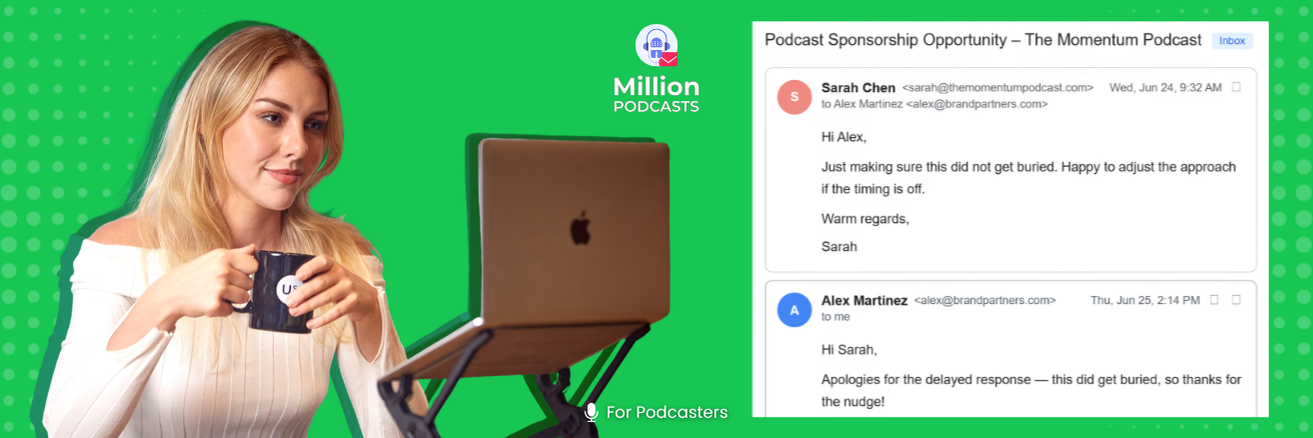
Just making sure this did not get buried. Happy to adjust the approach if the timing is off.
[Your name]
[Website]
Three sentences. No restatement of the original pitch. This email exists only to resurface your name. If they have a free minute, it gives them the opening to respond.
Day 12: The fresh angle
Subject: Episode that might be relevant for you
Hi [First Name],
Wanted to share something before following up again. We just released an episode on [topic directly relevant to their product or audience]. Our listeners left [X] comments asking about [problem their brand solves].
Original pitch still stands if it looked interesting. No pressure either way.
[Your name]
[Website]
This gives the sponsor a new reason to engage without repeating yourself. You are showing that your show is active and your audience is asking questions relevant to their product. The engagement is current, not hypothetical.
Day 20: The polite close
Subject: Closing the loop on this one
Hi [First Name],
I will stop following up after this one. If the timing is wrong or the fit does not feel right, completely understood.
If things change in the next quarter, I would be happy to revisit. Just reach out whenever.
[Your name]
[Website]
This email creates mild urgency by signaling you are moving on. Many sponsors reply to this one because the pressure is gone. It also keeps the relationship professionally intact rather than burning it.
9. What a Sponsor Reply Tells You and How to Respond
A sponsor reply is not a yes. It is an opening. What you say next determines whether the conversation moves to a signed agreement or quietly dies. Each type of reply has a specific correct response.
| Sponsor Says | What It Means | How to Respond |
|---|---|---|
| "Send more information" | Genuine interest | Reply within 24 hours. Send your media kit link, one proposed package with clear deliverables and a stated price, and two episode links. Close with a single question asking if a 15-minute call makes sense. |
| Asks about your numbers | Evaluating fit | Give your 30-day per-episode average, your completion rate if it is above 60%, and your growth direction over the last three months. Present these as facts, not apologies. If your numbers are modest, anchor them to niche precision: "We average 650 downloads per episode. Our audience is specifically procurement managers at manufacturing companies, so those 650 listeners represent an unusually qualified pool for your software." |
| "We don't have budget right now" | Timing, not rejection | Reply: "Completely understood. Would it help to reconnect next quarter? I can also flag if we have open inventory at a reduced pilot rate when it becomes available." |
| Goes quiet after expressing interest | Distraction or competing priorities | Use the Day 12 follow-up from section 8, then the Day 20 close. If there is still no reply, let it sit for 60 days. Budget cycles change. Team members change. The person who did not reply in February may be the one championing your pitch in May. |
10. When to Pitch, When to Wait, and When to Move On
Timing shapes how a pitch lands more than most podcasters account for. The same email sent in October can land an immediate meeting when resent in January. The email did not change. The budget situation did.
Most brands plan campaign budgets in Q4 for the following year and again in Q2 for the second half. January through February and July through August are when fresh budgets open and decisions get made. A pitch that went unanswered in November may land an immediate meeting in January.
Brands in launch mode move faster. A company that just released a new product or announced a funding round is actively looking for reach. Reply speed will be faster and risk tolerance will be higher. Watch for product launches and funding news as signals that a marketing team is in spending mode.
Wait if your show is not ready. If your media kit is outdated or your description is vague, fix those before you send. If you cannot explain your tracking plan in 20 seconds, fix that too. A pitch with those gaps answered will outperform the same pitch sent earlier without them every single time.
Move on after three touches with no reply across 30 days. Put that brand in a 90-day hold and come back with a fresh angle. Chasing past three attempts signals desperation rather than persistence, and it does not produce better results.
11. The Outreach Tracking System That Builds a Pipeline
The podcasters landing multiple deals per year are not sending better emails than everyone else. They are pitching consistently and tracking what happens so nothing falls through the gaps. A simple spreadsheet is all this takes.
Build a spreadsheet with these seven columns:
- Brand name and the specific product you pitched
- Contact name and title so you always know exactly who received the email
- Date of first email so follow-up timing is never guesswork
- Template used so you can identify which pitch structures convert over time
- Follow-up dates with the day 5, day 12, and day 20 sends logged as they go out
- Current status: pitched, followed up, replied, in discussion, closed, or 90-day hold
- Next action and date so every brand in the pipeline has a clear next step assigned
Update it every time you send an email, get a reply, or send a follow-up. Review it once a week. Put any brand back in the follow-up queue if the last status was "interested" and 60 days have passed. Use a fresh angle from the templates in section 1.
Aim for five to eight new first-contact pitches per month. Consistent, well-researched pitches at that pace give you 60 to 90 new brand conversations per year. Follow-ups convert some into pilots. Pilots convert into renewals. That is how consistent sponsorship revenue actually gets built.
| Outreach Type | Best For | Typical Reply Rate | Conversion Timeline |
|---|---|---|---|
| Direct niche pitch | Brands matching your exact audience | 8 to 15% | 2 to 4 weeks |
| Competitor sponsor pitch | Brands already spending on podcasts | 12 to 20% | 1 to 3 weeks |
| Local business pitch | Area-specific brands | 15 to 25% | 1 to 2 weeks |
| Affiliate-first pitch | Brands new to podcast advertising | 10 to 18% | 4 to 8 weeks |
| Re-engagement pitch | Warm contacts who went quiet | 18 to 30% | 1 to 2 weeks |
Pick the template that fits your situation and send it this week. The tracking system above tells you when to follow up. The reply handling guide in section 9 tells you what to say when they respond. One email is the start of a pipeline, not the end of a pitch.
12. Frequently Asked Questions
How do you write a podcast sponsorship email?
A podcast sponsorship email should be five sentences or fewer. Open with one specific audience detail that matches the brand's customer, state your 30-day per-episode download average, name a low-risk offer such as a 3-episode pilot or affiliate test, and close with a single yes-or-no question. Never open with the word I and never lead with your download numbers before your audience fit.
What should a podcast pitch email include?
A podcast pitch email should include five elements: a specific audience detail that signals fit, one honest download metric, a defined low-risk offer such as a 3-episode pilot or affiliate arrangement, a link to your one-page media kit, and a single easy-to-answer closing question. Everything else belongs in the follow-up, not the first email.
What is the best subject line for a podcast sponsorship email?
The best subject lines for podcast sponsorship emails are under 48 characters and lead with specificity: your audience type, a listener problem, or a specific data point. Examples include "480 physical therapists tune in every Tuesday", "Our listeners keep asking for a CRM tool", and "Noticed you sponsor The SaaS Podcast, quick thought". Never use the words opportunity, collaboration, or partnership in a subject line.
How long should a podcast sponsorship email be?
A podcast sponsorship cold email should be five to seven sentences total: enough to establish audience fit, name a metric, state an offer, and ask one question. The goal is a reply, not a closed deal. Save the full details for after they respond.
What is a podcast outreach email template?
A podcast outreach email template is a ready-to-use email script for a specific sponsorship scenario: a cold pitch, a follow-up after no reply, a post-pilot renewal, or a re-engagement after months of silence. The best podcast outreach templates are under 200 words, lead with your audience fit rather than your download numbers, and close with a single question the recipient can answer in one sentence.
How do you follow up on a podcast sponsorship email?
Send three follow-up emails across 20 days. On day 5, send a three-sentence check-in that does not restate the pitch. On day 12, share a relevant recent episode and note listener engagement with the sponsor's product category. On day 20, send a polite close that signals you will stop following up and leaves the door open for a future quarter. After three touches with no reply across 30 days, move the brand to a 90-day hold.
References
IAB and PwC. "Internet Advertising Revenue Report: Full Year 2024." April 2025. https://www.iab.com/research/iab-pwc-internet-advertising-revenue-report-full-year-2024/