
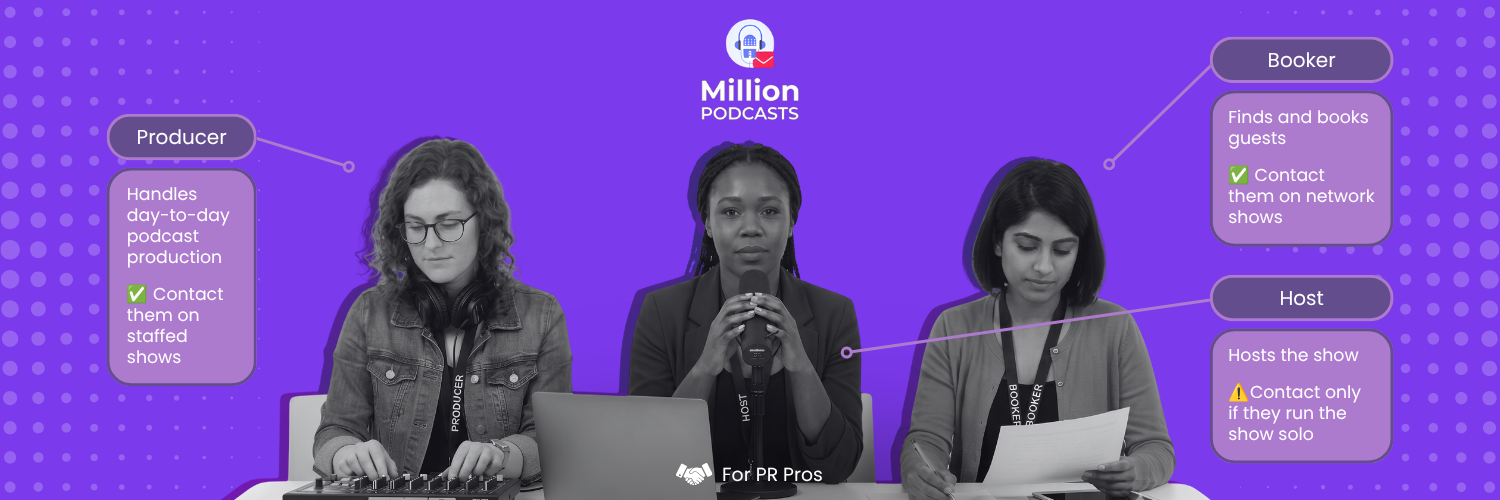
On a solo or small podcast, the host reads every pitch and books every guest. Once a show grows and adds a producer, a booking agent, or a network deal, that stops being true. The producer or booker then takes charge of guest outreach, so pitches sent to a host's inbox often go unread.
Staffed shows are often the ones with a budget, a team and a real audience behind them. Their booking contacts are also the hardest to find, because most show pages name only the host and give no other contact.
To contact podcast producers and bookers, first confirm that a team books the show. Then find the person's name on the site, LinkedIn or the RSS feed, and verify their address. For host-run shows, our guide to finding podcast contact information covers everything else.
How do you contact a podcast producer or booker? Find the name first, then the email. Show notes, the network page and LinkedIn usually name the producer or booker. The RSS feed, a targeted Google search or a verified database then supplies a working address.
1. Who Books Guests on a Podcast?
Staffed shows are the minority. In our August 2026 export of 6,285 contacts across 4,998 active shows, only 2.0% of role-recorded contacts were producers or booking agents. Hosts and co-hosts made up 93.6%.
Three roles can sit behind a podcast's booking decision:
| Role | What they do | When should you pitch them? |
|---|---|---|
| Host | Records the show. On solo or small shows, also reads pitches and decides who gets booked. | The show has no credited production staff. |
| Podcast producer | Manages technical, creative and administrative work, including planning, recording and publishing. | The show notes or About page credit a producer or production company. |
| Booker (or booking agent) | Manages the guest calendar, usually on larger or network-produced shows, and sometimes covers several shows at once for a network. | The show belongs to a network or agency that books centrally. |
Six quick checks tell you which of them to pitch. Most take seconds, so run all six before you write anything:
| Check | Pitch the host when | Look for a producer or booker when |
|---|---|---|
| Credits | The show is run by one or two people with no credited podcast producer. | The show notes credit a production company or name a podcast producer. |
| Staff | The About page, credits and LinkedIn show no separate production staff. | A team page or LinkedIn lists producers, editors or a booking coordinator. |
| Contact page | One general inbox carries the host's own name, and no other staff appear on the site. | The page offers a guest inquiries address, a booking inbox or an application form. |
| Network | The show is independent. | The show belongs to a network, such as iHeartPodcasts, NPR or Audacy. |
| Pace | New episodes arrive weekly or less often. | Several new episodes arrive every week, which usually takes a team. |
| Replies | The host has answered your earlier pitches directly. | A pitch to the host went unanswered for two weeks or more, so someone else may handle correspondence. |
One check in the right-hand column is only a hint. When two or more land there, find the producer or booker before you send anything else. No shortlist yet? The curated category lists on MillionPodcasts give you shows by niche to run these checks on.
Write the role next to every name you find. A booker reads for calendar fit, while a producer reads for episode fit, so the role changes how you open the email.
2. Check the Show's Own Site and Network Page
Many people go straight to Apple Podcasts or Spotify for contact info. Those pages rarely show more than a podcast description, so go to the show's own website instead:
- About or Credits. Look for a Produced by line naming a person or company, often on the About page or in the site footer.
- Contact page. Many shows split it into categories such as Guest Inquiries, Sponsorship, and General.
- Episode show notes. Producers and associate producers are sometimes credited only at the bottom of individual episodes. Check the three or four most recent episodes.
- Media kit or press kit. Shows running sponsorships often keep a one-page PDF with a booking contact separate from the sponsorship one. It sometimes links from the site footer or a pinned social post.
If the show belongs to a network, check the network's own page as well. Networks usually keep a public page under Shows, Our Podcasts or PR. It often lists a booking or press contact covering the whole slate of shows. Where a network books centrally, that contact is often faster to reach than anyone credited on the show.
Check who really owns the show
A network logo can mean three different things. The network may own and produce the show, license it from its creators, or only sell its ads.
Shows also change homes. In August 2025, Amazon split Wondery's shows between Audible and a new creator services team. Any Wondery contact saved before then may now reach the wrong desk.
| Setup | What the credits say | Where to pitch first |
|---|---|---|
| Owned and produced by a network | A network production credit, with network staff named as producers | The credited producer, then the network's booking or press contact |
| Licensed to a network | A network logo plus a separate studio or creator company | The creator's own producer or production company |
| Made by an independent studio | A studio production credit and no network | The studio's team page, where producers are often listed by show |
| Host-run with network ad sales | The network named only as an advertising partner | The host, exactly as for any independent show |
Studios often list producers show by show. Our list of the top podcast production companies helps you match a show to the studio that makes it.
Read the description of the newest episode for the current network or studio line. About pages and old press coverage often lag behind a move.
3. Search LinkedIn for the Producer or Booker
LinkedIn's search bar accepts exact phrases in quotation marks, which narrows results through Boolean search:
- Search by role and show. Try
"producer" "[Show Name]"or"booking agent" "[Show Name]", filtered to People. - Search the production company. If a production company makes the show, open the People tab on its LinkedIn page and search by title.
- Open Contact Info. The panel sits below the person's name and headline. Producers who freelance across several shows sometimes make it public and list a work email.
- Check the experience dates. Confirm the person still works on the show, because a producer who left last year cannot book you.
For shows where only the host appears anywhere online, drop the show name and search the parent network's name plus producer. Podcast producers who work across a network's full slate often list every show they run under their experience section.
If no email shows up, send a short connection request that names the show and your reason for reaching out. That is the most direct free way to contact podcast producers you have never met. As of 2026, LinkedIn's help center caps free accounts at just three personalized connection notes a month. Each note holds up to 200 characters, so save them for producers who never answer email.
Open the Featured section on any producer profile you find. Producers sometimes pin a media kit or a post on how to pitch the show there.
4. Use Google Search Operators to Surface Hidden Pages
Google indexes pages that a show's own search bar, or LinkedIn's internal search, won't surface. Recruiters call this X-ray search, and it runs on a handful of operators:
"[Show Name]" "producer"surfaces staff pages, interviews, or bios mentioning both terms.site:linkedin.com/in "[Show Name]"narrows results to personal LinkedIn profiles that list the show, working around LinkedIn's own search limits."[Show Name]" "media kit" filetype:pdfsurfaces a downloadable press kit, which often contains a podcast producer email."[Show Name]" "guest booking" OR "guest inquiries"finds pitch instructions a show may have published in a blog post rather than on its main contact page."[Producer Name]" "[Show Name]" after:2025keeps only pages updated since the start of 2025, which filters out stale staff lists.
Results depend on how much a show has published online. Still, this method turns up documents and staff pages that a manual visit to the show's site could miss.
Add the network or studio name to any search that returns too much. Staff pages and press releases then rise to the top.
5. Pull a Podcast Producer's Email From the RSS Feed
Almost every podcast publishes an RSS feed, and it carries fields most listeners never see. Two of them can lead you straight to the producer, and the whole check takes about two minutes:
- Get the Apple ID. Open the show on Apple Podcasts in a browser and copy the number after id in the address. For The Daily, that number is 1200361736.
- Look up the feed. Open
itunes.apple.com/lookup?id=followed by that number. Apple's public lookup returns the show's details, including afeedUrllink. - Load the raw feed. Paste the
feedUrllink into a new tab. If the show's website already links its RSS feed, start here instead. - Check managingEditor first. On a staffed show, this field often holds the producer's address, since producers tend to set up the hosting account themselves.
- Look for credited people. Search for
podcast:person, then look forrole="producer"orrole="booking coordinator"beside a name.
The itunes:email field usually belongs to whoever owns the show's account, which on most shows is the host. It is also blank more often now, because Apple stopped recommending that tag back in 2022.
Check pubDate while you're in the feed too. If the newest entry is older than two or three months, the show is probably dormant.
The catch: these fields are filled in once at launch and rarely updated afterward. An email pulled this way can be years out of date, even though it was correct on day one.
Search the feed for the word role first. It jumps straight to every credited person, even when a show uses a title you did not expect.
Treat every feed email as a lead, not an answer. Confirm the person still works on the show, then verify the address before you pitch.
Build the producer and booker list this guide runs on
Search 3M+ podcasts and filter to shows that accept guests in your beat. Unlock verified host, producer and booker emails on a paid plan. Then export the finished list to CSV or Excel for the outreach tool you already use.
Start your search free →6. Send the Producer a Message Worth Answering
If no email turns up anywhere, message the producer or booking team directly instead. Use the person's name if the show notes or LinkedIn gave you one. Keep it to two or three sentences and specific to the show. A generic message copied across dozens of accounts reads as a mass send.
By email or by message, a producer needs four things early:
- Name the show first. Put the show name and a topic in your opening line, since some bookers screen for several shows.
- Pitch a segment. Skip the long bio and give one angle with three talking points a producer can slot into an episode.
- Answer the logistics upfront. State your recording windows, your microphone setup and any date the topic is tied to.
- Link past interviews. Share one or two recent appearances, so the producer can hear how you sound.
For full wording, our podcast guest pitch email templates cover seven situations. Each one still works with a producer's name in place of the host's.
When you have both the host's and the producer's address, pitch the producer only. Two copies of one pitch make the team decide who answers, and sometimes nobody does.
7. Get Producer Contacts for Fifty Shows at Once
The methods above work for a handful of shows. They take hours to repeat across fifty or a hundred shows. Some producer or booker contacts also never surface through public sources, however long you search.
MillionPodcasts is a podcast contact database built for that problem. It indexes 3M+ podcasts, pairs 1.2 million of them with contacts, and holds contacts for about 6K podcast networks and producers. Those contacts go through manual research and SMTP verification rather than being pulled from an old RSS entry.
Each show profile includes a Podcast Contacts table listing the host alongside any producer, booking agent or general inbox. You then choose exactly who to pitch. Filter by Accepts Guests plus Has Email, then by Latest Episode Date. That leaves only shows that take guests and still publish.
Producer and booker contacts, along with social profiles, unlock on every paid plan. Paid plans start at $12 a month billed yearly, and the free plan covers search and show profiles with no card required. Business and Business Plus plans add a concierge service on top. Flag a show with a missing producer contact, and the research team finds it, usually within the same week.
Before you pay for any contact database, ask when its producer contacts were last verified and how. Producers change shows often, so the answer shows how much of a list still works.
When a podcast is staffed or networked, the host's address is usually the wrong target to pitch. For fewer than ten staffed shows, run the six checks and work by hand, since the site and LinkedIn often settle it. If you need to contact podcast producers at fifty shows, start from a database and research only the gaps. The right choice depends on how many of your shows sit behind a team, and on the time you have per contact.
8. Podcast Producer and Booker FAQs
Should I ever pitch the host instead of the producer or booker?
Yes. On solo or two-person shows, the host reads their own inbox and makes the booking decision, so a direct pitch is correct. Look for a producer or booker when the show notes or website point to a team or network behind the show.
What's the difference between a producer and a booker?
A producer typically handles a show's day-to-day production, including screening pitches and scheduling recordings. A booker, or booking agent, focuses on the guest calendar and sometimes works across several shows for a network. Smaller shows often combine both roles into a single person.
What is the best way to contact podcast producers?
Find the producer's name first, using the show notes, the network page or LinkedIn. Then find a current work email for that person and verify it. Name the show in your first line, since some producers screen pitches for more than one show.
Can I find a podcast producer's email in the RSS feed?
Sometimes. On staffed shows the managingEditor field often holds the producer's address, and newer feeds may name the producer in a podcast:person tag. Feed details can be years old, so verify any address before you pitch.
How do I message a podcast producer on LinkedIn without Premium?
Send a connection request with a short note that names the show and your reason for reaching out. LinkedIn caps free accounts at three personalized notes a month, so save them for producers you cannot reach by email.
References
MillionPodcasts. (September 2026). How to Find and Verify Podcast Host Emails for Outreach, including the August 2026 contact export. https://www.millionpodcasts.com/blog/find-podcast-contacts/ Cited in section 1. LinkedIn Help. (June 2026). Personalize invitations to connect. https://www.linkedin.com/help/linkedin/answer/46662 Cited in section 3 and section 8. MillionPodcasts. (September 2026). Our Database. https://www.millionpodcasts.com/ Cited in section 7. MillionPodcasts. (September 2026). Plans and Pricing. https://www.millionpodcasts.com/pricing Cited in section 7.