
Podcast sponsorship rates run $24 to $26 per 1,000 downloads for a 60-second host-read ad, according to Libsyn's published rate card. At that rate, a show with 5,000 downloads an episode would charge about $120 to $130 for one ad.
That's the market rate, and most sponsors start there. What you should charge also depends on what each episode costs you to make and what your audience is worth to the sponsor. This guide works through one example show and ends with a rate card you can copy.
Buying ads instead of selling them? Our podcast advertising cost guide covers the buyer's side.
What Podcast Sponsors Pay Per 1,000 Downloads
Sponsors price podcast ads by CPM, the cost per 1,000 downloads an episode gets in its first 30 days. Multiply your 30-day downloads by the rate, then divide by 1,000, and you have the price of one ad.
| Downloads per episode | 60-second host read | 30-second host read |
|---|---|---|
| 1,000 | $24 to $26 | $18 to $22 |
| 5,000 | $120 to $130 | $90 to $110 |
| 10,000 | $240 to $260 | $180 to $220 |
| 25,000 | $600 to $650 | $450 to $550 |
| 50,000 | $1,200 to $1,300 | $900 to $1,100 |
Host-Read Ads Pay More Than Inserted or Programmatic Ads
Libsyn Ads publishes a rate for each type of ad it sells. Ads the host reads into a new episode pay the most. Automated ads placed across many shows pay the least.
| Ad type | How it runs | Rate per 1,000 downloads |
|---|---|---|
| Host-read, baked in | The host reads it, and it stays in the episode for good | $24 to $26 |
| Dynamic, new episodes | Inserted into a new episode when it's downloaded | $18 to $22 |
| Dynamic, back catalog | Inserted into your older episodes | $14 to $16 |
| Programmatic | Placed automatically across many shows, usually not read by the host | $12 to $15 |
Business and Tech Shows Get the Highest Rates and the Most Sponsors
| Category | Host-read rate per 1,000 downloads | Active shows with a sponsor |
|---|---|---|
| Business | $30 | 23% |
| Health and Fitness | $27 | 21% |
| Technology | $26 | 24% |
| Education | $26 | 14% |
| Fiction | $24 | 9% |
| Science | $23 | 14% |
| Comedy | $23 | 17% |
| Society and Culture | $23 | 13% |
| Games | $22 | 17% |
| Leisure | $22 | 15% |
| Sports | Not published | 21% |
| True Crime | Not published | 17% |
| News | Not published | 10% |
Rates: Libsyn Ads. Sponsor share: our podcast database, fetched November 3, 2026, counting shows with an episode in the last 30 days.
Technology and Business carry the most sponsors as well as the highest rates, so sponsors there expect to pay near the top of the range. Sports has no published rate, yet about one show in five carries a sponsor, which shows clear demand at the general $24 to $26 range. In Fiction and News, about one show in ten has a sponsor, so expect to pitch more brands before one says yes.
Real Deals Usually Close Lower
In September 2024, the last month Libsyn published what its marketplace actually sold, a 60-second ad averaged $21.37 per 1,000 downloads, according to its release. Expect buyers to open below the published rate. Be ready to explain any price above $21.
Work Out What to Charge, Step by Step
The market rate is only your starting point. Your price should cover what an episode costs you, and it should be easy for the sponsor to justify by the customers it gets.
We'll use one example show throughout. For example, say you host a weekly B2B marketing podcast that gets 3,200 downloads per episode in 30 days.
Start with the CPM price
At the $30 Business rate, the example show's CPM price is $96 for one 60-second ad.
Add up what an episode costs you
- Your time: the hours you spend prepping, recording, editing and promoting, times what an hour of your time is worth.
- Paid help: an editor, producer or guest booker, per episode.
- Tools and fees: hosting and software split across your monthly episodes, plus any cut a network takes.
For the example show, 3 hours of the host's time at $40 an hour, $60 for an editor and $10 for tools come to $190 an episode.
That's about double the CPM price. When an episode costs more to make than CPM pays, don't quote CPM. Quote a set price per episode instead.
Work out what it's worth to the sponsor
Ask the sponsor two things: how many listeners usually sign up, and what a new customer is worth to them. If they won't say, use a past promo code result or a careful guess, and tell them which one you used.
For example, the sponsor sells software for $99 a month. If 0.5% of the show's 3,200 listeners start a free trial, that's 16 trials. If 20% of those become paying customers, the sponsor gets about 3 customers, each worth $1,188 in their first year.
At $400 an episode, each new customer costs the sponsor about $133, and it earns back almost nine times what it spent in the first year. Show them that number instead of the CPM.
Check what similar shows charge
Your size changes your odds of landing a sponsor at all. In our podcast database, the share of active shows with a sponsor rises from about 5% at up to 1,000 monthly listeners to about 40% at the top.
| Estimated monthly listeners | Shows with a sponsor |
|---|---|
| Up to 1,000 | 5% |
| 1,000 to 10,000 | 15% |
| 10,000 to 50,000 | 23% |
| 50,000 to 250,000 | 32% |
| 250,000 to 1M | 40% |
| 1M and above | 40% |
Source: our podcast database, fetched November 3, 2026. Shows with an episode in the last 30 days. Listener counts, not downloads.
Crossing 1,000 monthly listeners roughly triples those odds. If you're in the smallest band, expect to pitch several sponsors before one says yes, and start with a flat rate.
Before you send a price, ask two or three hosts with a similar audience who already have sponsors what they charge. You can find them in MillionPodcasts with the Has Sponsor filter, and each show's profile lists the sponsors it already works with. If they charge much less than you, check whether their audience is broader than yours before you lower your price.
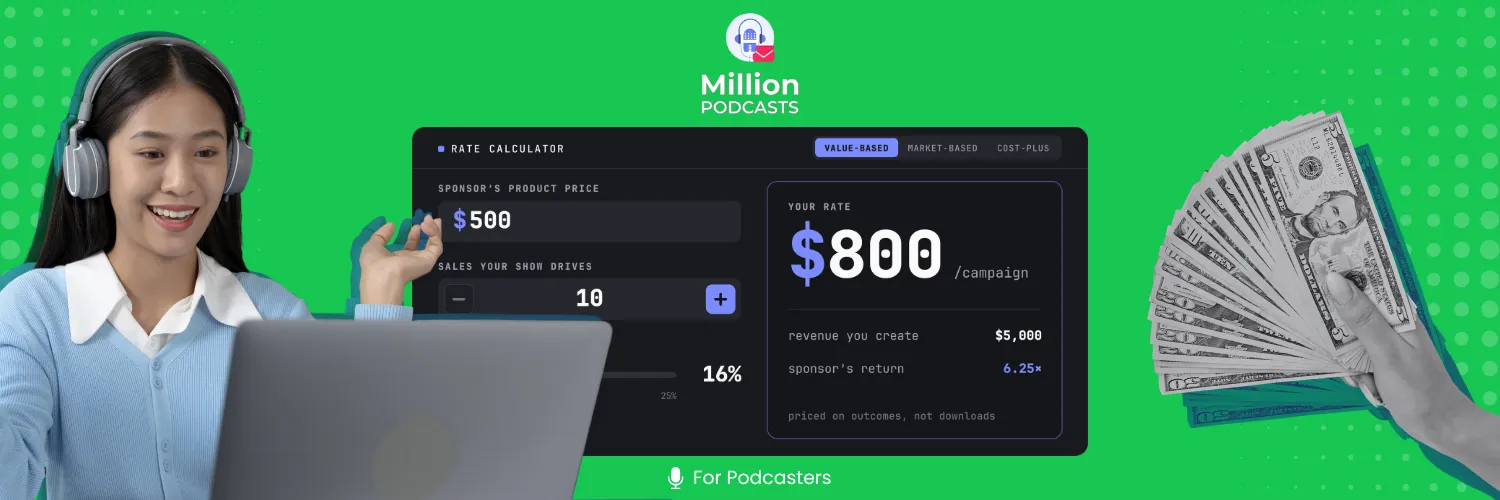
Podcast sponsorship pricing calculator
How it works: CPM price is downloads times rate, divided by 1,000. New customers is downloads times the share who become customers. Cost per new customer is your price divided by new customers. First-year return is new customers times year-one value, divided by your price.
Settle on a price that covers your episode cost and still gives the sponsor a cost per customer it's happy with. For the example show, $400 does both.
Choose the Pricing Model That Fits Your Show
Start with a flat rate, and switch to CPM once your downloads make the CPM price higher than your episode cost.
| Model | How you get paid | Works best when |
|---|---|---|
| Flat rate | A set price per episode or package | CPM pays less than your episode cost, or your audience is narrow and valuable |
| Affiliate | A commission for each sale or sign-up you bring in | You've never run a sponsored ad and need results to show |
| Hybrid | A lower flat fee plus a bonus per sign-up | The sponsor wants less risk and you want a guaranteed base |
| CPM | A rate per 1,000 downloads in 30 days | Your downloads make the CPM price higher than your episode cost |
Use a Flat Rate While CPM Pays Less Than Your Costs
A flat rate is a set price per episode or package, like the example show's $400. Small sponsors find it easy to approve, and it protects you in a slow month. If you're under 1,000 downloads, our guide to how small podcasts get sponsors covers how to land your first one.
Use Affiliate Deals to Earn Your First Results
If you've never run a sponsored ad, a commission per sale gets a sponsor to say yes with no risk on their side. Treat it as a way to collect the sign-up numbers you'll quote in your next flat-rate deal.
Offer a Hybrid When a Sponsor Wants Less Risk
A hybrid pays a lower flat fee plus a bonus for each sign-up. You keep a guaranteed base, and the sponsor only pays the full amount if the ad works.
Switch to CPM Once the Math Pays More
At 25,000 downloads, the published rate comes to $600 to $650 an ad, well above a $190 episode cost. Sponsors that buy ads on many shows compare on CPM, so quoting it makes their decision easier.
Build a Rate Card Sponsors Can Say Yes To
A rate card lists your audience, your results and your packages with exact prices, so a sponsor can pick a package without a back-and-forth.
Put These Five Things on It
- Your 30-day downloads: your average per episode, and whether it's growing.
- Who listens: the job titles, countries or age groups your sponsor sells to.
- One past result: promo code uses or sign-ups from an earlier campaign, if you have one.
- How each ad runs: host-read, its length and where it plays. Every ad opens with "This episode is sponsored by," because the FTC's Endorsement Guides say an endorsement in audio has to be disclosed in the audio itself.
- Packages with exact prices: three of them, set out as in the table below.
Our podcast media kit guide shows how to lay it all out.
Sell Three Packages, Not Single Ads
One episode rarely gives a sponsor enough results to judge your show. Build the middle package around four episodes, and give a small discount for longer commitments while staying well above your episode cost.
| Package | What's included | Price | Per episode |
|---|---|---|---|
| Entry | 1 episode, one 60-second host read, a tracked link | $400 | $400 |
| Standard | 4 episodes, a host read in each, a results report | $1,500 | $375 |
| Premium | 8 episodes, a host read in each, a results report | $2,800 | $350 |
| Exclusivity | No competitor in the sponsor's category runs during the campaign | $500 extra | Not applicable |
Standard is the package you most want to sell, so its price per episode drops only a little and stays well above the example show's $190 cost.
Charge Extra for Exclusivity
Exclusivity means you won't run ads from the sponsor's competitors during the campaign. You're turning down other business to give them that, so always charge for it separately. If competing brands have already asked about your show, charge more.
Send your rate card with every pitch, so price never becomes the first question.
Hold Your Price, Then Raise It
When a sponsor pushes back, offer fewer episodes instead of a lower rate. The cost per customer is your best argument, so lead with it.
When a Sponsor Pushes Back
- Show them the cost per customer: use their own sign-up numbers, so they can't dispute the result.
- Offer fewer episodes: one episode at your full rate is better than four at a discount.
- Only discount in exchange for something: a longer commitment, or permission to publish the results as a case study.
- Say no below your cost: a deal that pays less than an episode costs you to make loses you money.
Subject: Re: Sponsorship on [Show Name]
Hi [Name],
Thanks for getting back to me. Our rate is $[X] an episode. If [share]% of our [downloads] listeners try [product], that comes to about $[Y] for each new customer.
If four episodes feels like a lot to start with, I'm happy to run one episode at that rate and send you the results. Then you can decide on the rest based on real numbers.
[Your name]
When It's Time to Charge More
- Three sponsors in a row agree without pushing back: you're probably charging less than they expected to pay.
- Your ad spots are always booked: you're turning sponsors away at your current price.
- Your downloads grow three months in a row: raise prices for new sponsors right away. Give current sponsors a month's written notice before their renewal.
Your Next Step This Week
Before your next sponsor call, set aside an hour. Add up what one episode costs you to make, ask your best-fit sponsor what a new customer is worth to them, and price one episode from those two numbers. Then turn that price into three packages and put them on your rate card.