
Three episodes in, the attribution data was clean, the promo code tracked correctly, and not one conversion came through. The show had 40,000 downloads per episode, a credible host, and a topic that matched the product exactly. The vetting stopped there.
Media kits are sales documents. A topic match is not audience fit. Before committing to sponsoring podcasts in a niche, run a proper podcast evaluation checklist. To evaluate a podcast before advertising, request seven data items in writing, verify the audience, and score the show on eight criteria.
To build the initial candidate list, ranked directories such as the FeedSpot podcast rankings surface the leading shows in any category. These 11 checks then determine which of those candidates actually earns your budget. No check assumes the next one has been run.
What should a podcast evaluation checklist include? Eleven checks: IAB certification, audience authenticity, sponsor history, host credibility, and a scoring system. Request seven data items in writing, verify with Podtrac or Podscribe, and score the show. A score of 33 or above out of 40 is a confirmed buy.
1. Download Counts Set Your Vetting Up to Fail
Most advertisers enter vetting with the one number that tells them the least. Download counts record how many times an episode file was requested. They say nothing about whether a real person pressed play, or whether any of those listeners has a relationship with what you sell.
The Interactive Advertising Bureau (IAB) sets technical standards that filter out bots, duplicate requests, and automated pings from raw download numbers. But even IAB-certified figures represent compliant downloads, not verified human listeners. There is a gap between those two things. No media kit will flag it.
What the research says about show size and performance
A 2025 Magellan AI analysis found that mid-tier shows outperform larger ones on a per-acquisition basis for direct response campaigns. The sweet spot was 5,000 to 30,000 downloads per episode. Tighter audiences with smaller numbers almost always outperform bigger numbers with mixed composition.
The size of the room does not tell you who is sitting in it. The checks that follow do.
Always ask for per-episode averages from the last 90 days, not a lifetime total or annual figure. A show whose current numbers are strong will share them willingly and specifically. Reluctance to produce a 90-day figure is itself a data point.
2. Request These 7 Items Before You Vet a Show
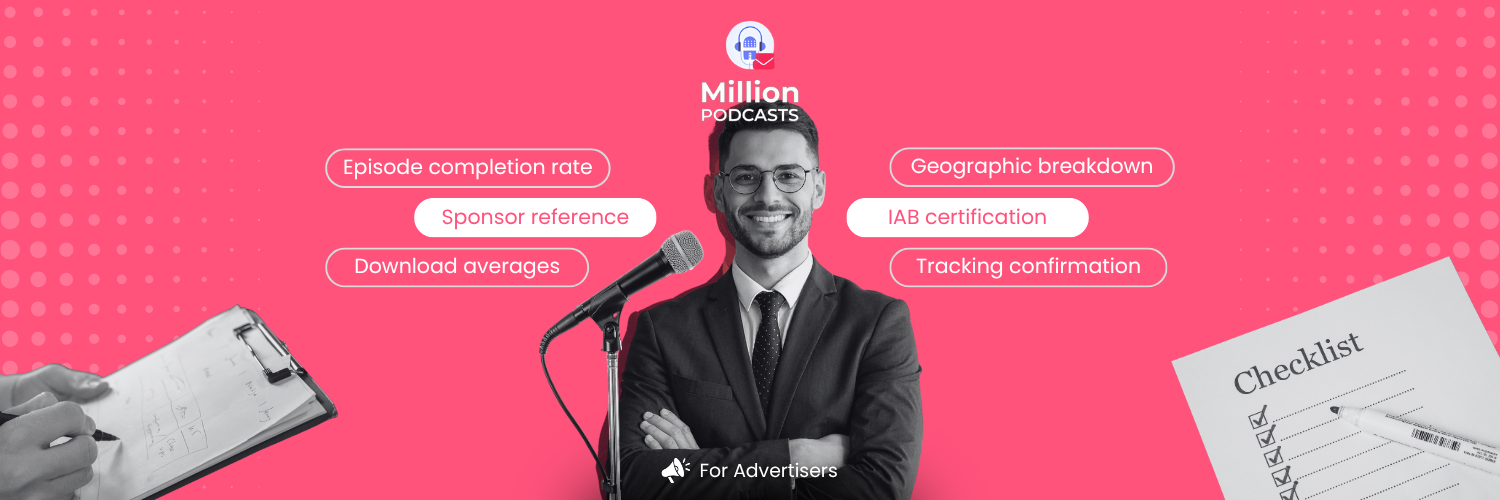
Before you listen to a single episode, ask the show for these seven things in writing. Everything that follows depends on having actual data, not media kit claims.
A show that responds quickly and completely takes sponsorships seriously. A show that pushes back on these requests is telling you something before you spend a cent.
Here is exactly what to ask for:
| Item | What to request |
|---|---|
| Per-episode download averages | From the last 90 days specifically. Not a lifetime total. Not an annual figure. Episode-level numbers from the most recent quarter only. |
| Episode completion rate | From their hosting analytics or Spotify for Podcasters dashboard. This tells you how long listeners actually stay, which determines whether your ad reaches an attentive audience. |
| Geographic breakdown | Of their listener base by country. You need to know what percentage of the audience is in the market your offer actually serves. |
| IAB certification confirmation | From their hosting platform. Ask which platform they use and whether it carries IAB Tech Lab certification. |
| One sponsor reference | A brand that ran a campaign on the show in the last twelve months and will take a quick call or reply to an email. |
| Two or three recent ad reads | Either timestamped in specific episodes or played on the discovery call. You need to hear how this host handles sponsor content before you commit. |
| Tracking confirmation | Can they set up a unique promo code and a show-specific vanity URL before your campaign launches? If not, attribution will be a problem from day one. |
Build a shared spreadsheet where each column is one of these seven items and each row is one show on your list. Gaps in that spreadsheet are data points, not missing fields. The shows that fill every column without prompting are the ones worth continuing with.
Build the list this guide runs on
Search 3M+ podcasts and filter by audience demographics, estimated monthly listeners, podcast niche, and whether a show already carries sponsors. Unlock verified host and producer contact details, then export your shortlist to CSV or Excel.
Start filtering free →3. How Do You Verify a Show’s Audience Is Actually Real?
You have the data you requested. Now the question is whether it reflects reality. Inflated numbers exist in podcast advertising, and they come from more places than most advertisers realise.
Automated bots request episode files without any human involvement. Some shows have used download-stuffing services to appear larger than they are. Legitimate but entirely passive subscribers download episodes they never play. None of these listeners convert.
Cross-reference the social footprint
A show claiming 80,000 monthly downloads should have some visible listener engagement. Podcast listeners do not always follow on social. But a show with six-figure claimed downloads and no detectable community interaction anywhere warrants a direct question. Ask the host where their listener base actually engages beyond the feed.
Look for third-party verification
Podtrac independently verifies podcast audience size. Shows carrying a Podtrac audit have a third party vouching for their numbers rather than self-reporting. Podscribe tracks impression delivery at the pixel level and connects listens to downstream conversions on a per-show basis. It has become the standard third-party attribution layer for podcast advertisers. Barometer adds episode-level brand suitability scoring, so you can assess whether the specific episode context is appropriate for your category.
If a show uses any of these three services, you are working with independently verified data. If it uses none and cannot explain why, weight the rest of its claims accordingly.
Read the actual review text, not just the star rating
Open Apple Podcasts and read the five most recent reviews. Look for reviews that name a specific episode or quote something the host said. Generic five-star reviews with no specifics tell you almost nothing. Detailed, emotionally specific ones signal a genuine listener relationship with the content, and that relationship is what carries your ad.
If a show has strong numbers but no third-party verification, ask for a raw download data export from the hosting platform directly. Any reputable host produces this in a few minutes. Refusal or inability to do so tells you something worth knowing before you proceed.
4. Platform and Feed Checks That Reveal the Truth
The technical health of a podcast tells you things about how seriously it is run that no media kit will mention. These checks take fifteen minutes per show and surface problems before they become your problems.
Confirm the hosting platform is IAB certified
You asked for this in section 2. Now verify it independently. Buzzsprout, Libsyn, Megaphone, Captivate, and Podbean all carry IAB Tech Lab certification. A certified platform counts downloads using standardised rules that exclude bots, duplicate server requests, and automated pings. A show on a non-certified host has no standard methodology behind any number it shares.
Run the RSS feed through a validator
Copy the show's feed URL and paste it into Cast Feed Validator or the W3C Feed Validation Service. A clean feed with no errors signals professional, consistent publishing. Persistent errors can affect distribution across Apple Podcasts and Spotify. Some listeners you are paying to reach may not be receiving episodes reliably.
Check distribution across directories
Is the show available on Apple Podcasts, Spotify, and at least two other directories? A show on five or more platforms has a broader, more resilient audience. A show that only exists on one platform is one algorithm change away from losing a significant portion of its reach.
If the feed returns errors, do not treat it as an automatic disqualifier. Ask the host which analytics platform they use and whether the errors have affected listener delivery. Errors alongside strong claimed data is a combination worth asking about directly.
5. Engagement Signals That Prove Listeners Stay
You have confirmed the numbers are likely real and the technical infrastructure is sound. The question now shifts: is this audience actively engaged or passively present? These four signals answer it.
Episode completion rate above 70%
You requested this number in section 2. Above 70% means your mid-roll ad reaches a listener who has already committed 30 to 40 or more minutes of sustained attention. That is meaningfully different from reaching someone who dropped off in the first eight minutes.
If the show cannot produce this figure, ask which analytics platform they use. Any show on Spotify for Podcasters, Podtrac, or Podscribe can pull retention data without much effort.
Publishing consistency over the last twelve months
Pull the full episode history. Check whether the show published on schedule without gaps for the past year. Every missed week represents a gap in your campaign continuity. A show with an unbroken weekly cadence for two or more years signals a production operation that takes its audience seriously.
Subscriber growth that held over six months
Ask for listener figures across the past six months. A steady upward trend signals organic word-of-mouth growth. A sharp spike followed by a plateau often signals a one-time event that brought in listeners who did not stay. One spike is not a growing audience.
Off-platform community activity
Search the show's name on Reddit, in Facebook Groups, and on LinkedIn. Are there listener conversations the host did not start? Are listeners recommending the show to each other in contexts unrelated to the podcast itself?
The difference between a show with a loyal community and one without it matters for direct response. Engaged communities carry and amplify sponsor mentions. Passive listener bases do not.
Treat completion rate and publishing consistency as your two minimum thresholds before anything else matters. If a show cannot provide completion data and has visible gaps in its publishing history, weight everything else it presents accordingly.
6. What One Full Episode Tells You No Kit Will
Reading a media kit tells you what a show wants you to believe about itself. Listening to one full, recent episode tells you what the show actually is. These two things are often different.
Block sixty minutes. Pick a recent episode from the last four weeks, not a highlights compilation or a best-of replay. Listen from start to finish with specific attention on three things.
How the host handles existing ad reads
Does the delivery shift noticeably when a sponsor break starts? A tone change listeners can detect disconnects your ad from the trust the host built in the first twenty minutes. The best host-read ads sound identical to the rest of the episode. If you can clearly feel the commercial moment begin, every listener can too, and many will tune out.
How the host explains complex topics
If your product requires any explanation at all, pay close attention to how this host handles nuance during the episode itself. A host who simplifies clearly will do the same for your product. A host who gets vague when topics get detailed will carry that vagueness into your ad read.
Whether a real audience is present in the episode
Does the host reference listener questions, community moments, or direct feedback? Shows where the host talks to a real, responsive audience feel different from shows where the host talks at an abstract one. That distinction carries directly into how listeners receive sponsor messages. The first kind of host is someone listeners trust and act on.
Listen specifically to how existing ad reads are placed, paced, and delivered. That is your clearest preview of what your ad will sound like in this show. If it sounds like an interruption rather than a continuation, adjust your brief or move the show down your list.
7. How to Read Sponsor History Like a Media Buyer
A show's sponsor history is commercial intelligence that other brands paid to generate. You are accessing their conclusions without running the experiment yourself.
Where to find it
Magellan AI tracks podcast sponsorship data across thousands of shows. Search a show's name and you see which brands have advertised, for how long, and whether they returned. You can also do this manually. Listen to episodes from six months ago and note every sponsor. Then check whether those same brands are still advertising today.
What a strong sponsor history signals
Two or three brands in your general category have advertised across multiple consecutive episodes. At least one ran a second campaign after a break. The relationships have duration, not just a single placement followed by silence. When brands return, it is because something moved.
Most advertisers have no baseline for that judgement. Two sponsors sounds thin until you know what comparable shows carry. So we pulled the sponsor field for 10,000 mid-tier shows from our own index.
That first number resets the bar. A mid-tier show with three sponsors is not impressive, it is ordinary. Sponsor volume tells you the show sells inventory, and nothing beyond that.
Sponsor load by how long the show has been running:
| Years active | Shows in sample | Median sponsors, 1K to 10K listeners | Median sponsors, 10K to 50K listeners | Median episode count |
|---|---|---|---|---|
| 2 to 4 years | 2,912 | 9 | 13 | 158 |
| 5 to 9 years | 4,879 | 9 | 12 | 245 |
| 10 to 14 years | 1,074 | 9 | 11 | 352 |
| 15 years or more | 243 | 10.5 | 10 | 359 |
The sponsor medians barely move as shows age. Episode counts more than double across the same bands. Older shows are publishing far more without carrying more brands. Age buys a back catalogue, not a deeper sponsor stack.
Audience size does move the number. Shows in the 10K to 50K band carry more sponsors than smaller ones at every age below fifteen years. The gap is widest among the youngest shows, then closes as both groups mature.
So treat the count as a floor, not a ranking. Above the median you learn nothing until you check whether any of those brands came back.
Figures come from the MillionPodcasts index, pulled in August 2026. The sample holds 10,000 sponsored shows with 1K to 50K estimated monthly listeners and a recent episode. The age table excludes 892 shows with no launch year on file.
What a weak sponsor history signals
A rotating cast of brands, none staying longer than one episode, no repeats of any kind. This pattern appears on shows that sell media slots to advertisers who do not measure carefully. If no category brand returned over two years, the show has a conversion problem it will not raise unprompted.
No single metric determines whether a podcast earns your budget. What matters is the pattern across all eleven checks. A show can have strong download numbers and a weak sponsor history. A show can have a credible host and a dead audience. The scorecard in section 10 combines all signals into one comparable number per show.
Ask the show directly which past sponsors in your category came back for a second campaign. The answer, and how readily they give it, tells you a great deal about what those earlier advertisers found.
8. Host Credibility Checks to Run Before Signing
The host is what you are actually buying when you book a host-read ad. Their credibility with the audience is the mechanism through which your ad works. A show can pass every technical check and still underperform if the host has no genuine connection to your category.
Search the host's name alongside your product category
Has this host written about, discussed, or engaged with topics related to what you sell without being paid to? A host who references your category in their newsletter and regularly interviews people in your space has real context for your product. That context makes an ad read feel like a natural extension of who the host is. Without it, the read is just a commercial that the audience can feel the edges of.
Run a quick controversy check
Search the host's name alongside "criticism" or "controversy." This takes five minutes and some results will be irrelevant. Finding a brand-safety issue before you sign is significantly better than finding it after placements have aired.
Check how they handle existing sponsors off-air
Look at the host's social content around the time of a recent sponsored episode. Do they mention the sponsor's product unprompted outside the show? A host who organically references a product they have promoted gives their audience continuous reinforcement of that message. A host who reads copy once and never references it again is giving you a different signal entirely.
On the discovery call, ask: "Describe a listener who would benefit from what we offer." A host who knows their audience names a specific person. A host who responds with generalities is describing a media kit.
9. Red Flags That Look Fine Until It Is Too Late
Some warning signs are obvious. Others read as harmless until the campaign ends and nothing converted. Any single one of the following warrants a direct follow-up question. Three together is a reason to pass.
The spike that did not hold
You pull the subscriber growth chart and one month, roughly eight or nine months back, downloads tripled. Then they dropped and barely moved since. One external event can temporarily inflate figures, and that number shows up in an averaged monthly total with no context. Ask: what caused the highest single month in the last twelve?
Lifetime downloads leading the conversation
A show that opens with "9 million downloads since 2017" is sharing its history. What you need is its current audience. Per-episode averages from the last 90 days is the only figure that matters for your campaign. Shows with strong current numbers share them willingly and specifically.
Every past sponsor was a one-episode buy
One-off placements are normal for newer shows. They are unusual for an established show with years of history. If every sponsor over two years ran one episode and none returned, the show has a conversion problem it will not volunteer.
The host cannot describe their own listener
If you ask on a call who listens and receive demographic generalities in return, that is a signal. A host who genuinely knows their community names a real person with real context, without hesitation.
No recent reviews anywhere
Reviews arrive continuously on shows with active, loyal audiences. A show where the most recent Apple Podcasts review is dated many months ago suggests the invested listener base has drifted. Loyal listeners leave reviews. Casual ones do not.
Before any negotiation call, spend five minutes: search the host on Apple Podcasts and read three reviews, then search the show name in Magellan AI. A red flag at that stage saves the entire call.
10. How to Score Every Shortlisted Show
Gut feeling is not a media plan. This podcast evaluation checklist distils every prior section into one comparable number per show. Rate each shortlisted show from 1 to 5 across these eight criteria, total the score, and use the thresholds below to guide your decision.
| Criteria | Score 1 | Score 5 |
|---|---|---|
| Audience fit | Vague category overlap | Near-exact match to your buyer |
| Completion rate | Below 50% or unavailable | Above 75%, confirmed in writing |
| IAB compliance | Platform not certified | Fully certified, confirmed |
| Audience authenticity | Self-reported only, no third party | Podtrac, Podscribe, or Barometer verified |
| Publishing consistency | Multiple gaps in 12 months | Unbroken cadence for 12 or more months |
| Sponsor retention | No repeats in any category | Two or more repeat sponsors in your category |
| Host credibility | No organic category connection | Deep, demonstrable alignment |
| Attribution readiness | No unique tracking available | Promo code and URL confirmed |
A score of 33 to 40 is a confirmed buy; move to negotiation. A score of 22 to 32 makes the show a test candidate. Budget for two to three episodes with tight attribution before scaling. A score below 22 is a pass; move to the next show on your list.
Build this scorecard in a shared spreadsheet with one row per show and one column per criterion. Build your shortlist with MillionPodcasts and filter data on audience, demographics, and sponsor activity flows into your first three columns. Add a notes column for anything the score alone does not capture.
11. Run a Pilot Before Committing Full Budget
Even after every check in this guide, the first campaign on any new show is still a test. Treat it as one.
Cap your initial run at two to three episodes. The full podcast evaluation checklist has already narrowed your list to shows worth testing. Now define in writing what a successful result looks like before the first episode drops. Set your target cost per acquisition before any negotiation begins.
What a working pilot looks like at 60 days
A show that delivers within 20% of your target cost per acquisition after a three-episode run is worth scaling. Double the episode count, negotiate a monthly package, and ask about category exclusivity for the next period.
A show that passes vetting but underdelivers in the first cycle deserves one honest review before you walk away. Was the brief clear? Did the host follow what you needed? Was attribution capturing everything? If all three were clean and results still were not there, redirect the budget.
Keep the tracking active after the campaign ends
If you ran baked-in ads recorded directly into the episode, those placements stay permanently. Every new listener who discovers the show through its back catalogue will hear your ad. Keep your promo code and landing page active for at least twelve months after the campaign ends.
Set a calendar reminder to check attribution data at the six-month mark. You may find conversions still arriving from episodes that aired months earlier. Most advertisers never account for this long-tail return.
Before you run any check in this guide, you need a shortlist worth running them on. MillionPodcasts filters 3M+ shows by audience demographics, listener income, age brackets, monthly listener estimates, niche, location, and sponsor activity. You arrive at a focused candidate list in minutes. The human work of listening, reviewing, calling references, and validating feeds still belongs to you.
Write your renewal threshold before the campaign launches. If a show delivers at or below your target cost per acquisition, renew it. If it misses that threshold by more than 40% after 60 days of clean attribution, move on. Having this number in writing before any episode airs removes the emotion from the decision.
Start here: pick one show from your current shortlist and spend 20 minutes on two checks only. Pull its last five Apple Podcasts reviews and read the actual text, not the star rating. Then search the show name in Magellan AI and confirm whether any brand in your category returned for a second campaign.
Two checks, 20 minutes, and you know whether this show clears the first bar. Acast's 2026 listener research found that four in ten podcast listeners have made a purchase after hearing an ad. That result comes from the right show, the right audience, and the right host. This guide is how you find that combination before you spend a cent.
12. Frequently Asked Questions
These are the questions advertisers most often ask when running a podcast evaluation checklist for the first time.
What is a good episode completion rate for podcast advertising?
Above 70% is the standard threshold. It means your mid-roll ad reaches a listener who has already committed 30 to 40 or more minutes of sustained attention. Below 50%, or when the show cannot produce the figure at all, your ad is likely reaching listeners who have already checked out. Any show on Spotify for Podcasters, Podtrac, or Podscribe can pull retention data in a few minutes.
How do I verify a podcast's download numbers are real?
Start by confirming the hosting platform carries IAB Tech Lab certification. Buzzsprout, Libsyn, Megaphone, Captivate, and Podbean all do. Then ask for third-party verification from Podtrac or Podscribe, both of which independently audit figures. If neither is available, request a raw download data export from the hosting dashboard.
What does IAB Tech Lab certification mean for podcast advertising?
It means the hosting platform counts downloads using a standardised ruleset that filters out bots, duplicate server requests, and automated pings. It does not guarantee that every download was a human who pressed play, but it removes the most common sources of inflated numbers. A show on a non-certified host has no standard methodology behind its numbers.
How many episodes should I buy for a podcast advertising pilot?
Two to three episodes is the standard pilot window. It provides enough data to separate show-level performance from single-episode variance, while keeping the initial risk contained. Define your target cost per acquisition in writing before the pilot launches. Judging performance after you see the data invites rationalisation, not measurement.
What should I look for in a podcast's sponsor history?
Look for two things: repeat sponsors and category-relevant brands. A brand running multiple consecutive episodes, then returning after a break, is the clearest signal that the show converts. A rotating cast of single-episode buys across two or more years with no repeats suggests a conversion problem. Magellan AI tracks this data across thousands of shows and makes it searchable by brand and category.
What is the difference between a baked-in and a dynamically inserted podcast ad?
A baked-in ad is recorded directly into the episode audio and stays there permanently, reaching every future listener through the back catalogue. A dynamically inserted ad is placed at the moment of download and can be swapped or removed at any time. Baked-in ads create long-tail attribution value while dynamic ads give flexibility on timing and messaging. Both formats require the same pre-campaign vetting process described in this guide.
References
1. Magellan AI. (May 2025). Q1 2025 Quarterly Podcast Advertising Benchmark Report. https://www.magellan.ai/news-insights/podcast-advertising-benchmarks-q1-2025 2. Acast and Differentology. (2026). The Ultimate Guide to Podcast Advertising. https://advertise.acast.com/news-and-insights/podcast-advertising-the-ultimate-guide 3. MillionPodcasts. (August 2026). Sponsor load across 10,000 mid-tier podcasts, MillionPodcasts index. https://www.millionpodcasts.com/