
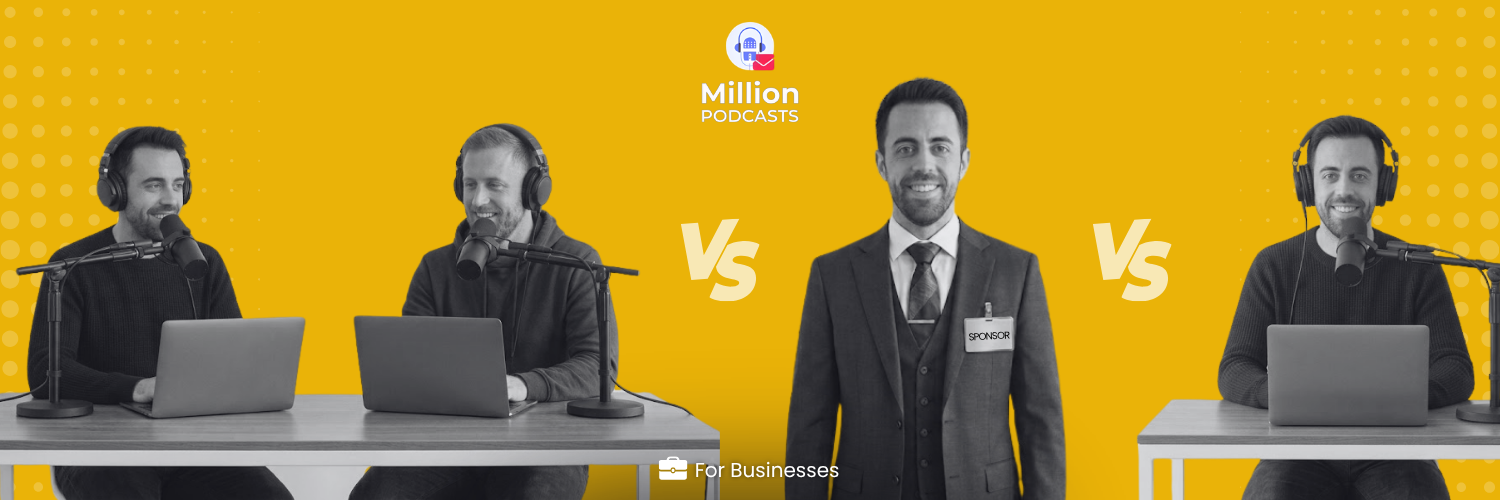
The right business podcast strategy is the one your scarcest resource can sustain. Time points to guesting. Cash points to sponsoring. Both, plus patience measured in years, is the only honest case for launching your own show.
Those three paths share a medium and little else. Guesting borrows an audience. Sponsoring rents one, and podcast advertising cost swings widely by genre and audience size. Launching builds an audience, and bills you every week until it works.
This guide prices each path in hours and dollars, and shows how fast each one returns. It also gives you the signal that tells you it is working before revenue lands.
Should your business guest, sponsor, or launch a podcast? Guest if you have more time than budget. Sponsor if you need reach this quarter. Launch only with a team and a two year horizon. Guesting returns fastest. Launching returns largest, and slowest.
1. Three decisions, not one
Podcasting is usually framed as a single yes or no. That framing hides the choice that actually matters, because guesting, sponsoring and launching spend completely different resources.
Guesting buys borrowed trust with your calendar. Sponsoring rents attention with cash. Launching builds an asset you own, and the bill arrives weekly long before the audience does. Treating them as interchangeable is like treating renting, leasing and building as one housing decision.
Supply decides more of this than most founders expect. Within the MillionPodcasts index of more than 3 million shows, roughly 379,700 accept guests. About 43,100 carry sponsors. Those counts are dated August 2026, and they work out at close to nine guest open shows per sponsor carrying show.
What that ratio looks like inside one beat
The market wide figure is not the ratio you buy against. We ran both filters beat by beat in August 2026, limited to shows that published an episode in the last 12 months. Fix the category and the gap narrows sharply.
| Beat | Shows accepting guests | Shows carrying sponsors | Guest open shows per sponsor show |
|---|---|---|---|
| Business | 10.7K | 3K | Nearly 4 to 1 |
| Marketing | 3.3K | 1.1K | About 3 to 1 |
| Technology | 5.6K | 1.7K | About 3 to 1 |
| Finance | 1.2K | 421 | Under 3 to 1 |
| Health and Fitness | 7.7K | 2.1K | Nearly 4 to 1 |
| Education | 7.8K | 1.3K | About 6 to 1 |
Guesting held the wider inventory in all six beats. Finance was tightest at under three to one, which is what a monetised niche looks like from the buyer's seat. Education was widest at about six to one, so sponsor slots there are scarce beside open guest chairs.
Read these counts as inventory, not advice. A narrow gap means paid placement is realistic without a huge shortlist. A wide one means your cash chases few shows while your calendar still has doors to knock on.
Run the same two counts on your own beat if it is not in the table. Filter for shows that accept guests, then for shows carrying sponsors, and pin both to the last 12 months. A gap under three to one means sponsorship deserves a real look this quarter.
2. What guesting costs and returns
Guesting is the cheapest way in, and for most companies it is the right first move. You appear on shows your buyers already chose. The host spent months earning that attention, and some of that credit transfers the moment they introduce you.
Podcast audiences make that transfer unusually easy. Edison Research's Podcast Consumer 2025 found 68 percent of weekly podcast consumers do not mind hearing ads. It also found 44 percent have bought a product promoted on a show. A vouched for guest sits closer to that goodwill than any sponsor does.
What one good appearance actually demands
- Finding and vetting shows. One to two hours to identify shows whose audience is genuinely your buyer, not just any show that will book you.
- Pitching. Thirty to sixty minutes per personalised pitch, plus one follow up round.
- Prep and recording. One to two hours sharpening your core message, then thirty to sixty minutes on the conversation itself.
- Promoting the episode. Thirty minutes to push it to your own list, which is what makes hosts invite you back.
Call it four to six hours per appearance, with no cash outlay. Returns arrive quickly because the audience already exists. A single well matched appearance can produce inbound conversations within days of the episode going live.
The real constraint is your calendar rather than the size of the market. Roughly 1.2 million shows in the index carry verified contacts. Before you decide guesting cannot carry a quarter, learn how to find podcasts worth appearing on. That is what stops the first ten pitches being wasted.
Build a landing page for each show and name it on air. Skip it and the interest the episode creates lands nowhere. The exception is a show with a no call to action policy. There, a memorable offer inside the conversation has to do the work.
3. When sponsoring wins the race
Sponsorship is the path for budget without time. You pay a show to reach an audience the host has already warmed up, at a volume guesting cannot match.
The mechanism is the same trust, rented. Nielsen's 2025 Podcasting Today research found 70 percent of exposed listeners recalled the advertised brand. Campaigns averaged a 10 point lift in brand awareness and a 6 point lift in purchase intent.
Fit beats reach, and the clearest example is public. Inc. reported in August 2025 that the compliance platform Vanta sponsored a single founder focused show in 2019. Podcast advertising became one of the channels that carried Vanta to a multibillion dollar valuation. The show was small. The audience was exactly right.
Sponsorship is the clearest choice when
- Speed matters more than cost. You need hundreds of qualified buyers faster than you could ever book guest slots.
- Your category is crowded. Association with a trusted show is worth paying for when competitors are already there.
- You can fund a flight. One placement rarely moves a B2B buyer, so budget for a run of episodes.
- Your buyer concentrates. A handful of shows covers most of your market, which keeps targeting cheap and waste low.
How the price is actually set
Sponsorship is priced per thousand listeners, so audience size sets your spend rather than a flat fee. Multiply the show's estimated listeners per episode by its rate per thousand. Then multiply by the number of episodes you plan to run.
Host read placements cost more than pre recorded ones, because listeners treat them as a recommendation rather than an interruption. Business and finance shows also command more, since those audiences convert. Skip this arithmetic and you will judge a rate card by its headline number instead of its cost per buyer reached.
Ask for estimated listeners per episode before you accept any rate. A show quoting a flat monthly fee without an audience number is asking you to buy blind. Twenty minutes of checking beats a quarter of unattributable spend.
4. What launching your own show demands
Launching owns an asset instead of renting one. It is also the path most likely to end quietly, because the costs hide where people rarely look.
Equipment is not the cost. A good microphone and editing software run a few hundred dollars. The fuller breakdown lives in our guide to the cost to start a podcast for business. Time is the cost, and it never stops.
A weekly show with serious standards takes eight to twelve hours per episode. That covers guest sourcing, recording, editing, show notes and promotion. The bill arrives every week, long before anyone is listening.
The payoff is real when it lands. Fame's 2025 State of B2B Podcasting reports that SMBs often reach positive return within six months by converting guests into customers. Enterprise shows run as longer term category plays. Either way, this is not a ninety day return.
What separates shows that survive is what they measure. Fame found that 22 percent of closed won deals include podcast touchpoints. Strong programmes drive 8 to 12 percent of total pipeline. None of that appears in a download report.
Launch only when all four are true
- You have production help. A dedicated team member or partner, not a founder squeezing it in at night.
- Leadership has committed. A two year publishing run before anyone judges the result.
- You need ownership. A specific reason to own an audience rather than borrow one, such as community or category creation.
- You know your angle. A tested point of view, ideally sharpened on other people's shows first.
If you cannot say yes to all four, the honest answer is not yet. Fund the show with the faster paths first. The one exception is a business built on repeat community engagement. There, owning the relationship is the product rather than a marketing choice.
Book your first ten guests before you record episode one. If you cannot fill ten slots from your target account list, you do not have a show yet. You have an idea, and an hour of outreach will tell you which.
5. Guest vs sponsor vs launch compared
This is the table to screenshot. Each column is unpacked in section 2, section 3 and section 4.
| Criteria | Guesting | Sponsoring | Launching your own |
|---|---|---|---|
| Upfront cost | Time only, 4 to 6 hours per appearance | Cash, audience size multiplied by rate per thousand, multiplied by episodes. Use a vetting checklist before you buy | Both, a few hundred in gear plus 8 to 12 hours every week |
| Speed to first result | Days to weeks after an episode airs | Weeks, across a multi episode flight | Months, often six or more |
| What you control | Your message, not the audience or timing | Your message and targeting, not the content | Everything, which is also the burden |
| What you own | Nothing, you are a visitor | Nothing, you rent attention | The audience and the feed |
| Main risk | Hard to scale past your own calendar | Spend with weak attribution looks like waste | Quitting before the asset compounds |
| Best fit | Time rich, cash poor, early authority | Cash ready, needs reach now | Resourced, patient, owns a long term goal |
The pattern is hard to miss. Guesting and sponsoring produce visible results inside a quarter. Launching is measured in years. They are not ranked best to worst, because they solve different problems on different clocks.
Match the path to your scarcest resource, then confirm the inventory exists in your beat. Cash without time points to sponsoring. Time without cash points to guesting. Both, plus patience, is the only case for launching.
Run the table against one show you already respect. Abstract comparisons stall. A named show forces you to price the ad, count the hours, and admit which path you would start on Monday.
Build the list this decision runs on
Whichever path you pick, it starts with the same shortlist. Search 3M+ podcasts and filter to shows that accept guests, carry sponsors, or match your buyer's listener profile. Unlock verified host and booker emails, then export to CSV or Excel.
Start free, no card needed →6. How do you measure podcast ROI?
Revenue is a lagging signal. By the time a path proves itself in closed deals, you have already spent a quarter or two. You need the measure that moves first.
That measure is unprompted reference. A prospect mentions your name before you do. Someone says they keep hearing about you. A buyer references a specific episode. The path is working.
Fame's 22 percent figure for closed won deals only surfaces if you measure pipeline influence rather than downloads. So capture the source in the place buyers actually tell you: your own forms and your own call notes.
The early signal looks different per path
- Guesting. Inbound mentions from people who heard you, and host to host referrals arriving without you asking.
- Sponsoring. Brand name search lift, and how did you hear about us answers naming the show even when last click credits paid search.
- Launching. Rising episode completion rates and guests who become opportunities, not download counts.
- All three. Sales calls that open warmer, with fewer questions about who you are.
Watch the right signal and you can double down in month two instead of month six. Watch downloads instead and you will kill a channel that was quietly working. The most common attribution mistake is a thirty day last click window. B2B buyers move on a ninety to one hundred and eighty day cycle.
Add a free text how did you hear about us field to your demo form this week. It takes ten minutes. It is the only place podcast influence reliably shows up before revenue does.
7. Run two paths without doubling work
You do not have to choose one path forever. The strongest business podcast strategy runs two in deliberate order. The cheap one funds and de risks the expensive one.
Months 1 to 6, guest
Land eight to twelve targeted appearances. Build a landing page per show. Track which audiences respond. This costs time rather than cash, and it sharpens your message in front of real listeners before you pay for anything.
Months 3 to 9, layer in sponsorship
Once guesting shows which audiences convert, sponsor the shows serving those exact listeners. You are now spending against a validated audience rather than a guess. Keep the flight long enough to build frequency, and measure it on the window described in section 6.
Month 9 and beyond, launch only if earned
If guesting and sponsoring proved your message lands, a branded show opens to a known audience instead of an empty room. Keep guesting afterwards to feed new listeners back to your own feed.
This avoids two expensive failures. You do not launch before you know what your audience wants. You do not buy shows before you know which audience converts.
Do not start the sponsorship phase until three appearances have produced a traceable inbound conversation. That threshold turns the second phase from a gamble into a purchase.
If you have more time than budget and are still earning name recognition, start guesting this week. If you have budget and your buyers concentrate in a few shows, sponsor those shows and run enough episodes to build frequency. If you have a team, a two year horizon and a reason to own an audience, launch. Fund it by guesting first.
The first move takes thirty minutes either way. Open the three shows your buyers most likely already listen to. For each, write one sentence. Is your fastest play there to pitch yourself, buy an ad, or study what your own show must beat?
8. Business podcast strategy FAQ
Should my business start a podcast or be a guest on other podcasts?
Be a guest first in almost every case. Guesting costs four to six hours per appearance and borrows an audience that already exists. Launching costs eight to twelve hours every week and builds an audience from zero. Start your own show only with a dedicated producer and a two year commitment from leadership. You also need a reason to own an audience rather than borrow one.
How much does it cost to sponsor a podcast in 2026?
Sponsorship is priced per thousand listeners, so the size of the show sets your spend. Multiply the show's estimated listeners per episode by its rate per thousand. Then multiply by the number of episodes in your flight. Host read placements cost more than pre recorded ones because listeners treat them as a recommendation.
Is a podcast worth it for a small business?
Guesting is worth it for almost any small business, because it costs hours rather than cash. Sponsoring is worth it when your buyers concentrate in a few shows and you can fund several episodes. Launching your own show is rarely worth it without production help. The weekly time cost arrives long before the audience does.
How long does a business podcast take to pay for itself?
Fame's 2025 State of B2B Podcasting reports that SMBs often reach positive return within six months by converting guests into customers. Enterprise shows run as longer term category plays. Guesting and sponsoring show results inside a quarter. Judge a branded show on a two year horizon, not a ninety day one.
How many podcasts accept guests?
Within the MillionPodcasts index of more than 3 million shows, roughly 379,700 accept guests and about 43,100 carry sponsors. Those counts are dated August 2026. That is close to nine guest open shows for every show selling ad inventory. Inside a single beat the gap is far tighter, from under three to one in Finance up to about six to one in Education.
What should I measure if downloads do not predict revenue?
Measure unprompted reference and pipeline influence. Track inbound mentions from people who heard you. Track how did you hear about us answers naming a show. Track guests who become opportunities. Fame reports that 22 percent of closed won deals include podcast touchpoints, which never appears in a download report.
References
Edison Research. (July 2025). Podcast Consumer 2025. https://podnews.net/press-release/podcast-consumer-2025 Nielsen. (August 2025). Podcasting Today, podcast ad brand impact norms. https://radioink.com/2025/08/21/nielsen-podcast-ads-boost-brand-metrics-across-verticals/ Fame. (July 2025). 2025 State of B2B Podcasting: Trends, Benchmarks, and Best Practices. https://www.fame.so/post/b2b-podcasting-trends-best-practices Inc. (August 2025). The Secret Strategy That Built These Billion Dollar B2B Startups: Podcast Ads. https://www.inc.com/elaine-appleton-grant/secret-strategy-built-billion-dollar-b2b-startups-podcast-ads/91223538 MillionPodcasts. (August 2026). Podcast Directory, guest and sponsor counts across the index and by beat. https://www.millionpodcasts.com/podcasts-directory