
About 43,100 podcasts carry a detectable sponsor. Across the 3M+ shows in the MillionPodcasts podcast directory, that works out at roughly one in seventy. So most brands end up bidding for the same thin slice of proven inventory.
The best podcast advertising examples came from outside that slice. Each one worked because the host made the product feel true to people who were already listening. Genre had almost nothing to do with it. Below are five reads, and every one of them won for a different reason.
You get the show, the audience data behind the buy, and the decision that made the read land. Budget context sits in our guide to podcast advertising cost and CPM rates.
What makes a podcast ad work? Audience fit, host credibility and creative freedom, in that order. Magellan AI measured host read ads converting at 2.45% in Q1 2026, against 1.51% for produced spots. Nielsen found 66% of listeners judged the advertised brand a good fit for the show.
1. What Actually Makes a Podcast Ad Work
Podcasting stopped being a niche buy some time ago. Edison Research measured 58% of Americans aged 12 and over consuming a podcast monthly in March 2026, an all time high. That is roughly 167 million people. More brands are chasing them, which is why the reads that stand out now are the ones that sound least like advertising.
Format explains part of the gap. Magellan AI published the channel's first quarterly conversion benchmark in June 2026, and the ordering was unambiguous.
| Ad type | Response rate, Q1 2026 | What you are buying |
|---|---|---|
| Host read | 2.45% | The host's credibility, transferred. Best response, hardest to scale. |
| Programmatic | 1.93% | Targeting without endorsement. Scales fast, cheapest cost per acquisition. |
| Produced, non host read | 1.51% | Tight message control. Weakest response of the three. |
Host read returns about 62% more response than a produced spot. All five examples below are host reads, and that is not a coincidence.
Still, the premium is narrower than most articles claim. Nielsen found host read barely beats produced work on plain brand recall. Where it pulls away is further down the funnel, on consideration and purchase. So buy it when trust has to move, not when reach does.
Chasing cheap reach? Then a host read is the wrong instrument and you will overpay for it. Buy host read when trust has to transfer, and buy programmatic when volume is the job.
2. HelloFresh Bought a Murder Podcast and It Paid
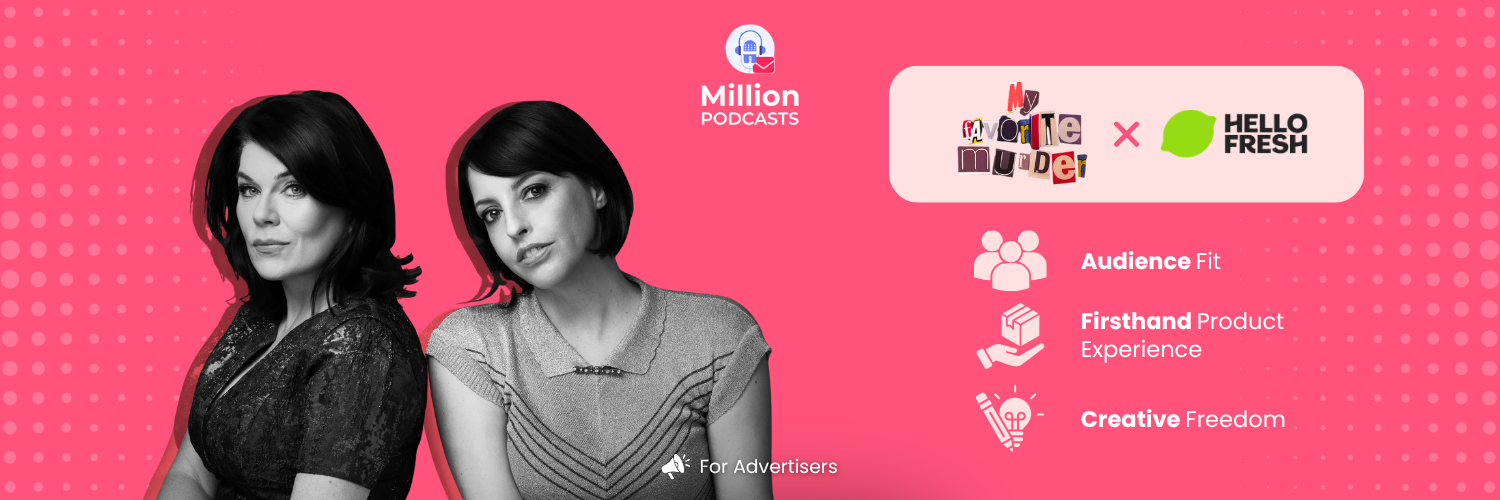
Picture yourself running sponsorships at HelloFresh. Someone proposes meal kit ads on a show called My Favorite Murder. Its sign off is "Stay sexy and don't get murdered." Would you approve it?
HelloFresh did, repeatedly. Magellan AI's March 2019 ranking put the brand among that month's biggest podcast advertisers, naming My Favorite Murder. Hosts talked about meals they had actually cooked. And every read closed on a vanity URL with $80 off the first month.
What made it land was the delivery. Georgia Hardstark told her co host that the coming month would be her HelloFresh month. She complained about being sick of takeout, then described getting back into cooking and enjoying it.
Then came the URL, the code and the offer. But Murderinos are famously loyal to their hosts. So an endorsement from someone who sounded like she needed the product read very differently.
Why the mismatch was the right call
The placement only looks reckless until you check who listens. Sounds Profitable and Libsyn surveyed the genre for The True Crime Podcast Listener Landscape in January 2025.
- Reach: true crime gets to roughly 42 million Americans a month, about 16% of adults.
- Time spent: fans give podcasts about seven hours a week, against six for everyone else.
- Gender: 56% women and 43% men, making it the number one genre choice for women.
- Age: 42% fall between 18 and 34, and another 36% between 35 and 54.
- Brand appetite: over 70% said they would be interested in podcasts about brands or products they like.
How much of that inventory you can actually buy
A survey tells you who is out there. It cannot tell you how many shows a buyer could approach this quarter. So we ran that question through our own database on 25 August 2026. True crime returned 1.4K shows active in the last 30 days, and 258 of them carried a sponsor.
Each row below is a separate count run on those 258 shows. The demographic filters sort shows by dominant listener skew. So the rows are separate counts, never slices of one pie. Read them as a map of inventory, not of the wider audience above.
| Filter run on 25 August 2026 | Shows | What it means for a buyer |
|---|---|---|
| Beats True Crime, active in last 30 days | 1.4K | The live genre pool before any sponsor test. |
| Plus Has Sponsor | 258 | Proven inventory, small enough to work through by hand. |
| Sponsored, Listener Gender Predominantly Female | 195 | Where a HelloFresh style read lands hardest. |
| Sponsored, Listener Gender Predominantly Male | 65 | A thinner pool, useful for splitting a creative test. |
| Sponsored, Listener Income Medium | 256 | Almost all of this inventory skews to middle income listeners. |
| Sponsored, Listener Income High | 0 | No sponsored true crime show skews high income. |
| Sponsored, Listener Income Low | 1 | A low income skew is close to absent as well. |
| Sponsored, Listener Age Millennials | 184 | Millennials are the dominant cohort on most of these shows. |
| Sponsored, Listener Age Gen Z | 3 | Very few shows here skew that young. |
| Sponsored, Listener Age Gen X | 1 | Gen X rarely leads the mix on a sponsored true crime show. |
The income rows carry the buying lesson. 256 of the 258 sponsored shows skew to middle income listeners. HelloFresh prices for the middle of the market, so the match was there to be found. No category label would have surfaced it.
Age points the same way. Millennials lead the mix on 184 of those shows, against 3 for Gen Z and 1 for Gen X. Meal kits are priced and marketed for exactly that cohort. Counts move weekly, so treat all of this as an August 2026 snapshot.
HelloFresh's buyer was already sitting in that audience. Chase cooking podcasts exclusively and you skip tens of millions of people who cook. Their only crime was listening to something else.
A title tells you what a show discusses. It tells you nothing about who is listening, or what those people buy.
Before you reject a show on category grounds, ask for its listener breakdown by age, income and gender. If the sales deck cannot produce one, that is your answer about how well the show knows its own audience.
3. Magic Spoon Let a Comedian Rewrite the Read
Rachel Dratch spent seven years on Saturday Night Live, and Debbie Downer is the character that stuck. Her podcast, Woo Woo, is a paranormal comedy show co hosted with Irene Bremis, where comedians swap stories about psychics and ghosts.
When Magic Spoon ran a mid roll there, Dratch brought Debbie Downer to the cereal pitch. The copy was scripted, but the performance was hers, and the joke ran the whole length of the sponsor message. Listeners stayed for an ad they would otherwise have skipped.
The brand gained from the association too. Magic Spoon sells childhood nostalgia by rebuilding old cereal recipes with better ingredients. So handing that pitch to a Saturday Night Live veteran carried the idea better than any script.
So people remembered the cereal because they remembered the read.
Approve the persona, not only the copy. Editing a host's voice out of a read strips away the exact thing the premium was paying for.
4. Lumen Ran a Five Minute Ad and It Worked
Some products cannot be sold in thirty seconds. Lumen reads carbon dioxide in your breath to say whether your body is burning carbs or fat. But none of that lands until metabolic flexibility is explained first.
On The Titus Podcast, the Lumen mid roll ran past five and a half minutes. Most mid rolls run 30 to 60 seconds, because that is what the published rate cards are built around. For almost any other advertiser, five minutes would have been a costly mistake.
But here the length was the point. Christopher Titus and his co hosts turned the sponsor slot into a conversation. They pulled anecdotes from their own routines rather than from a brief.
It held because they had genuinely used the device, so nothing felt padded. What Lumen bought was comprehension before consideration, and no thirty second spot delivers that.
Long reads only survive on shows where the hosts talk at length anyway. Buy five minutes on a tightly produced show and the ad becomes the moment listeners skip.
5. Alloy Sold the Problem Before the Product
On Sinisterhood, host Christie Wallace opened by saying she was a year into perimenopause. She said it plainly, the way you would mention it to a friend.
Then no pitch followed. She was candid about how confusing and isolating it had been. That went down to losing her way through a sentence in the brain fog. She was funny without making light of any of it.
So by the time Alloy was named, the audience had already leaned in. The want had been built before the product entered the read, so the offer arrived sounding like relief.
So copy this pattern when your product solves something people find awkward to raise. Lead with the problem in the host's voice, and the brand answers a question the listener is already asking.
6. Ogee Got an Endorsement It Never Paid For
The Dear Shandy read was booked for Ogee's Crystal Contour Collection, and nothing more. Partway through, the host went off script.
She stopped to name a different Ogee product, a lip gloss the sponsor was not promoting. Viewers see her wearing it constantly, she said. Nobody paid for that mention.
Yet an unprompted endorsement outside the buy is the strongest authenticity signal available to a brand. But you cannot script it. It happens only when the host already uses what you sell.
There is a cheap instruction buried in that. Seeding product weeks before recording is preparation rather than courtesy, because read quality is mostly settled before anyone opens a microphone.
Ship the product at least three weeks before the first recording date. Hosts who receive it the same week default to reading the brief, and briefs are what listeners skip.
7. Which Podcast Ad Format Should You Buy?
All five reads shared two choices, so start there: host read delivery and mid roll placement. Seeing where those sit against the alternatives makes the trade obvious.
| Decision | Option | What it does | Used above |
|---|---|---|---|
| Delivery | Host read | Moves the host's credibility onto your brand. Best response, slowest to produce. | All five |
| Delivery | Producer read | Voiced by someone else. Consistent message, weakest response. | None |
| Delivery | Programmatic | Automated placement on audience signals. Lowest cost per acquisition. | None |
| Placement | Pre roll | Opens the episode. Cheap awareness, easiest to skip past. | None |
| Placement | Mid roll | Lands once attention is committed. Highest rate, best conversion. | All five |
| Placement | Post roll | Closes the episode. Only completionists hear it. | None |
| Insertion | Baked in | Permanent in the audio file, so it keeps earning across the back catalogue. | Varies by show |
| Insertion | Dynamic | Added at download, so it can be swapped, capped or geo targeted later. | Varies by show |
Host read plus mid roll is the most expensive row on that table, though not the least efficient. It is also the only combination that buys an endorsement, which is what every example here was really selling.
Want those reads broken down line by line? Our guide on how to write a podcast ad script covers structure and where the offer belongs. It also covers the disclosure language every read needs.
Ask whether the read will be baked in or dynamically inserted before you sign. Baked in keeps working on old episodes for years, and it is rarely priced to reflect that.
8. What These Podcast Ad Examples Have in Common
Five reads, five mechanisms, but one shared logic. Every buy looked unconventional at the time and every one beat the safer option available.
They targeted the audience, not the content category
Filtering shows by topic instead of by listener is the most expensive habit in this channel. HelloFresh is the clean proof, because the audience matched even though the subject matter could not have been further away.
Listeners agree. Nielsen found 70% recalled the advertised brand and 66% felt it suited the show. That sense of fit came from delivery and from audience, never from a category label.
So the useful question is not whether a show talks about your product. It is whether the people listening need it.
The host had actually used the product
Hardstark described her own kitchen. The Titus hosts described their own week. The Dear Shandy host volunteered a product nobody had paid her to mention.
None of that survives once a host unboxes the product the day before recording.
The briefs left room for the host
So a brief should lock the offer, the URL, the product name and the disclosure. Everything around those four should belong to whoever is speaking.
Dratch's read is the extreme case. Take Debbie Downer out of it and you are left with a cereal ad nobody would remember a week later.
All five were disclosed as paid
Every read here is a paid endorsement, which carries obligations most examples articles skip. The Federal Trade Commission requires clear disclosure of a material connection between brand and endorser. A promo code does not count on its own.
The exposure is not only the host's. The FTC holds a company responsible for what others do on its behalf. So put the disclosure in the brief, then have someone check each read before it publishes.
Response data explains why these were host reads. It does not explain why they worked. Every one was won at the shortlist stage, before a script existed. The winning move was picking a show whose listeners already needed the product.
If you take one thing from these five campaigns, take the order of operations. Find the audience, seed the product, then write the brief.
Then the next step costs under thirty minutes. Write down four attributes of your buyer, then run that description across every genre instead of your own. Does the list contain shows you would never have shortlisted by category? That is the same opening HelloFresh found in 2019.
Build the shortlist these examples came from
Search 3M+ podcasts and filter by listener age, income, gender skew and job type across every genre. Narrow to shows that already carry a sponsor, then unlock verified host and booker emails. Export a pitch ready list into your CRM or mail merge tool.
Start free, no card required →9. Podcast Advertising Examples FAQ
What is an example of a podcast advertisement?
HelloFresh on My Favorite Murder is the most cited example. Host Georgia Hardstark told her co host that the coming month would be her HelloFresh month. She described being sick of takeout, then closed on a vanity URL and a code for 80 dollars off the first month.
Do host read podcast ads actually perform better?
Yes, on response. Magellan AI measured host read ads at a 2.45 percent response rate in Q1 2026. Programmatic came in at 1.93 percent and produced spots at 1.51 percent. The gap widens further down the funnel, on consideration and purchase.
How long should a podcast ad be?
Most mid rolls run 30 to 60 seconds, because that is what the published rate cards are built around. Go longer only when the product needs explaining before an offer can land. Lumen on The Titus Podcast is the case where that held true.
Does the podcast genre need to match my product?
No. Nielsen found 66 percent of exposed listeners felt the advertised brand suited the show. Fit is judged by who is listening and how the host delivers it, not by the category label. HelloFresh proved that on a true crime show.
Do podcast hosts have to disclose that an ad is paid?
Yes. The Federal Trade Commission requires clear disclosure of a material connection between a brand and an endorser. A promo code is not disclosure on its own. The advertiser also carries responsibility for what the host says on its behalf.
How many podcasts actually carry sponsors?
About 43,100 shows carry a detectable sponsor. Set against the 3M+ podcasts indexed, that is roughly one in seventy. A single genre is thinner still. On 25 August 2026, MillionPodcasts counted 258 true crime shows that carried a sponsor and had published in the last 30 days.
References
Edison Research at SSRS. (March 2026). The Infinite Dial 2026. https://www.edisonresearch.com/the-infinite-dial-2026/ Magellan AI. (June 2026). Podcast Measurement Benchmark Report, Q1 2026. https://www.magellan.ai/news-insights/podcast-advertising-benchmarks-q1-2026 Magellan AI. (2019). March Top 15 Podcast Advertisers, including HelloFresh on My Favorite Murder. https://magellanblog.medium.com/marchtop15podcastadvertisers-3808a0f21c3f Nielsen. (August 2025). Podcast Ad Effectiveness findings on brand recall and brand fit, via Radio Ink. https://radioink.com/2025/08/21/nielsen-podcast-ads-boost-brand-metrics-across-verticals/ Nielsen. (2023). In Emerging Media, Brand Recall Is the Biggest Driver of Lift. https://www.nielsen.com/insights/2023/in-emerging-media-brand-recall-is-the-biggest-driver-of-lift/ Sounds Profitable and Libsyn. (January 2025). The Truth About True Crime Listeners, from The True Crime Podcast Listener Landscape. https://soundsprofitable.com/article/the-truth-about-true-crime/ PodScripts.co. (August 2020). My Favorite Murder Episode 237, Anti Hype Man transcript. https://podscripts.co/podcasts/my-favorite-murder-with-karen-kilgariff-and-georgia-hardstark/237-anti-hype-man ADOPTER Media. (August 2026). Podcast Advertising Examples 2026, source for the Lumen, Magic Spoon, Alloy and Ogee reads. https://adopter.media/podcast-advertising-examples/ Libsyn Ads. Published rate card and ad length formats, retrieved 18 August 2026. https://advertising.libsyn.com/podcast-advertising-ultimate-guide Federal Trade Commission. The FTC's Endorsement Guides, What People Are Asking. https://www.ftc.gov/business-guidance/resources/ftcs-endorsement-guides-what-people-are-asking MillionPodcasts. (August 2026). True crime inventory counts. Result counts on Beats True Crime with Latest Episode Date Last 30 Days, then Has Sponsor, Listener Gender, Listener Income and Listener Age applied one at a time. Retrieved 25 August 2026. https://www.millionpodcasts.com/podcasts-directory MillionPodcasts. Database scale and sponsor coverage, retrieved 18 August 2026. https://www.millionpodcasts.com/podcasts-directory