
The quote an agency sends you is the least reliable thing in the pitch. Two firms can bid the same number and spend your money in completely different ways. One buys mid-roll slots on shows your buyers already trust. The other clears cheap leftover inventory, then reports the downloads as a result.
Choosing a podcast advertising agency is a transparency problem more than a taste problem. You are hiring someone to spend your budget in a market where rate cards stay soft. Audience numbers come from the seller. So before you compare bids, it helps to know what podcast advertising costs across genres and show sizes.
To choose well, ask how the firm makes money, which shows it will name before you sign, and how it proves conversions. The firm that answers all three plainly is usually the right one. Everything below turns those three answers into a process you can run in about six weeks.
How do you choose a podcast advertising agency? Judge it on three things: fee transparency, named shows before signature, and conversion level measurement. Get all three in writing during one short paid test flight. Then scale only the shows the numbers support.
1. What a podcast ad agency actually does
An agency sits between you and the shows. It plans the buy, negotiates rates, books slots, and reports what came back. You are paying for buying leverage and for judgement about which shows fit your product.
The market is big enough to support real specialists. US podcast ad revenue reached $2.9 billion in 2025, up 17.6 percent year over year. That is the IAB and PwC figure. That count covers audio spending only, so video sponsorships sit outside it.
The five deliverables you are buying
- Show research: matching real listener profiles against your buyer, not just category labels
- Rate negotiation: pushing published rates down using volume the firm already books
- Slot booking: securing the placement and date, then holding shows to the schedule
- Creative direction: writing the host brief so the read sounds native instead of scripted
- Tracking and reporting: setting up attribution and reporting results show by show
What an agency does not do
It does not produce your podcast. It does not own the shows it buys, which is the whole point of hiring one. And it cannot guarantee a placement on a specific episode, because hosts and networks control their own calendars.
It also cannot fix a weak offer. A host read makes a product feel personally recommended, but it will not rescue a confusing landing page. Sort that out before you buy the media, or the flight will read as a show problem.
Ask which of these five deliverables the fee actually covers. Some firms quote a media buying fee and then bill creative separately, which shifts your real cost. The fee models below show where that lands.
2. Agency, network, or in-house: which fits?
An agency is not the only route. Networks sell inventory across the shows they represent, and plenty of brands buy directly with no help at all. Each route trades money against control.
The honest test is inventory. The MillionPodcasts podcast directory tracks 43.1K podcasts with sponsors out of 3M+ shows. Paid inventory concentrates in a narrow band of titles, so your category may be thinner than a media plan suggests.
That concentration is why relationships matter in some categories and not others. In a crowded beat like finance or true crime, an agency's standing booking volume gets you dates you could not get alone. In a thin niche, you can often email six hosts yourself and be done.
| Route | Best when | What you give up | Fee shape |
|---|---|---|---|
| Independent agency | You are buying across many shows and want one party accountable for results | Margin, and some visibility into what each show really cost | Commission, retainer, or project fee |
| Podcast network | Your audience sits inside one network's roster and you want speed | Independence, because the network sells its own inventory | Built into the rate you are quoted |
| In-house buying | You are testing under ten shows and have someone to own it | Time, negotiating leverage, and access to busy shows | Your team's hours only |
Most brands start in-house, hit a ceiling around ten shows, and then hire. That ceiling is a scheduling problem more than a strategy one. Still deciding who to approach? Our list of the top podcast ad agencies in the US is a fair starting shortlist.
Count the live shows in your beat before the first call. Under about thirty active titles, a firm's leverage matters less than its research. Buying direct may serve you better, and the vetting questions will tell you which case you are in.
3. How podcast ad agencies charge for work
Four fee models cover almost every firm you will meet. Three are visible on the invoice. The fourth is not, and it is the one worth understanding before your first call.
| Model | How it works | What to watch |
|---|---|---|
| Commission on spend | A percentage of the media budget, billed on top of the media itself | The firm earns more when you spend more, so ask what triggers a scale recommendation |
| Flat retainer | A fixed monthly fee covering planning, buying, and reporting | Confirm what happens in a month when you pause spending |
| Project fee | One price for a defined campaign or a single test flight | Get the scope in writing, especially creative revisions and added shows |
| Media margin | The firm buys at one rate, bills you at a higher one, and keeps the difference | You never see the underlying rate unless you ask for it directly |
The fee that hides in the media
Media margin is legal and common. It becomes a problem when a firm presents itself as a neutral advisor while quietly earning more on some shows than others. That creates a reason to recommend inventory that pays the firm best.
You do not need to ban the practice. You need it disclosed. Ask whether the firm ever buys as principal, then resells that inventory to you. Ask about rebates and volume bonuses too.
Ask for one sample invoice from a live client with the client name removed. If media cost and agency fee sit on separate lines, the firm is used to being audited. That habit tells you more than any answer on a call.
Rate transparency also affects what you can negotiate later. Once you know the real show rate, you have room to push. Our guide on how to negotiate podcast ad rates covers the levers that work.
4. What should you ask before hiring?
Every firm sounds good on a first call. The difference shows up in how specific the answers get when you push once more. Below are nine questions that separate operators from salespeople, grouped by what they test.
On money
| Ask | Strong answer sounds like | Weak answer sounds like |
|---|---|---|
| How much of my budget reaches the shows, and how much is your fee? | A number, a fee model, and an offer to show it split on the invoice. | A blended figure, or a claim that the rates are proprietary. |
| Do you take commission, rebates, or volume bonuses from any network you book? | A direct yes or no, and if yes, exactly which relationships. | A pivot to how well the firm knows the market. |
| Do you ever buy inventory as principal and resell it to me? | A clear position, with the disclosure written into the contract. | Confusion about the term, from a firm that buys media for a living. |
On shows and fit
| Ask | Strong answer sounds like | Weak answer sounds like |
|---|---|---|
| Which specific shows would you buy for me, and why those? | Named titles with a reason tied to your buyer, before signature. | Categories and reach estimates, with names promised after the contract. |
| How do you verify a show's download and audience numbers? | A named third party plus the IAB podcast measurement technical guidelines. | The show's own media kit, treated as fact. |
| Have you bought in my category before, and what happened? | An anonymised flight with real numbers, including something that failed. | A logo wall from a different vertical. |
On measurement
| Ask | Strong answer sounds like | Weak answer sounds like |
|---|---|---|
| Which attribution tools do you use, and who owns the data? | Named tools, plus confirmation that you keep access after the contract ends. | An in-house dashboard you cannot export. |
| How do you separate podcast conversions from other channels? | A described method, including how they handle overlap with your paid social. | Last click only, with no mention of the gap it creates. |
| What do you do in week three when a show underperforms? | A rule they already follow, such as cutting a show at a set threshold. | A promise to optimise, with nothing behind it. |
Money: How much of my budget reaches the shows, and how much is your fee? Do you take commission, rebates, or volume bonuses from any network you book? Do you ever buy inventory as principal and resell it to me?
Shows: Which specific shows would you buy for me, and why those? How do you verify a show's download and audience numbers? Have you bought in my category before, and what happened?
Measurement: Which attribution tools do you use, and who owns the data? How do you separate podcast conversions from other channels? What do you do in week three when a show underperforms?
Close: Can you send one sample invoice with the client name removed, and a shortlist of named shows before we sign anything?
When a firm names shows, check them yourself before the call ends. Look up any title in the podcast directory first. You can see episode frequency, latest episode date, estimated listeners, listener demographics, and sponsor history.
Two checks catch most problems. A show with no episode in six weeks is not a live buy. And a listener profile that skews away from your buyer will not convert, no matter how large the audience looks. For reading the numbers a show sends you, see our guide on how to read a podcast media kit.
Sponsor history is the third check
Sponsor history answers a question no media kit will. It shows whether a title is proven inventory, and whether a rival brand already sits in the same ad break. It also shows how crowded the slot really is.
We pulled that number ourselves. On August 25, 2026 we exported 9,999 sponsored shows from the MillionPodcasts directory. Every one had published an episode in the last 12 months. The median show carried 6 different sponsors, and a quarter carried 14 or more.
| Estimated monthly listeners | Shows in sample | Median sponsors carried | Share carrying 10 or more |
|---|---|---|---|
| Up to 1K | 5,711 | 5 | 29 percent |
| 1K to 10K | 3,309 | 7 | 41 percent |
| 10K to 50K | 767 | 11 | 54 percent |
| 50K to 250K | 199 | 17 | 68 percent |
Read the table as a pricing argument. Bigger shows already share their ad breaks with more brands, so scarcity is rarely what the rate buys. At the other end, 15.8 percent of the sample carried exactly one sponsor. Only 13 shows above 250K listeners appeared, too few for a median.
No single advertiser dominates either. BetterHelp was the most common name in the sample and appeared on 171 shows, under 2 percent of the total. Shopify followed with 144 shows and NordVPN with 139.
So add one line to the vendor script. Ask who has already advertised on each named show, and how many brands share the rotation now. A firm that cannot answer has not opened the show's file.
Ask all nine questions in one call rather than three. Firms answer differently under mild time pressure, and that gap tells you more than a polished follow up email.
Verify the shortlist before you sign
Search 3M+ podcasts and filter on 17 dimensions including beat, location, audience size, listener demographics, and whether a show already has sponsors. Unlock verified host, producer, and booker contacts, save a shortlist, and export it to CSV or Excel.
Check any show free →5. What a fair test flight looks like
No firm can tell you in advance which shows will convert. A test flight exists to find out cheaply. What matters is whether the proposal is built to produce an answer or built to produce a renewal.
Six things a good proposal contains
- Four to six shows: enough spread to compare titles, few enough to read cleanly
- Three insertions per show: one drop tells you nothing about a title
- A named placement mix: which slots on which shows, agreed before the buy
- Show level reporting: results broken out per title, not one campaign total
- A six to eight week window: a flight that stops on its own unless you renew it
- An exit clause: the right to walk after the flight with no further obligation
The end date matters more than people expect. A flight with no stop date quietly becomes an ongoing buy. The decision you were trying to make never gets made. So write the date into the contract.
Budget the flight so one bad show cannot sink the read. Cap any single title at about thirty percent of the test spend. Past that point you are testing a show, not the channel.
A firm that resists a short paid test is telling you something. Good operators like tests because tests prove them right. Pressure to skip straight to a long contract is the clearest signal you will get. It arrives before you have spent anything.
6. How to judge the measurement promised
Measurement is where most podcast budgets get misjudged in both directions. Some brands cut a channel that was working. Others keep paying for shows that never converted a single listener. The method decides which mistake you make.
The four methods, and what each misses
Promo codes and vanity URLs are the classic approach. A listener types a code, so the credit is unambiguous. The catch is scale. Podscribe benchmark data puts promo codes at roughly 15 percent of attributed conversions.
That leaves most of the effect invisible. Pixel based attribution closes much of the gap. A pixel on your site connects the download of an episode with a later visit and purchase. It catches the listener who heard an ad on Tuesday and bought on Sunday.
Surveys and brand lift studies work differently. You ask buyers how they found you, or you measure recall around a flight. They are slower and softer, but they catch awareness effects that no pixel will ever see.
Incrementality testing is the strongest and the rarest. You compare exposed and unexposed audiences to isolate the lift the ads actually caused. Few firms offer it at test flight budgets, so treat it as a scale stage tool.
What to require in the reporting
Insist on results broken out by show. A campaign total hides the two titles carrying everything and the four that did nothing. Without the breakout, you cannot make the only decision the flight was for.
Then confirm you keep the data. If attribution runs entirely inside the agency's dashboard, switching firms means losing your own history. Ask for export access in writing, and revisit the measurement questions if the answer stays vague.
Set attribution up before the first ad runs. A pixel added mid-flight cannot backfill the listeners it already missed. That gap will look exactly like a failed show.
7. Green flags and red flags before you sign
By this point you have enough to judge a firm quickly. These signals tend to predict how the engagement goes. They come from how the money and reporting are handled, not how the pitch sounds.
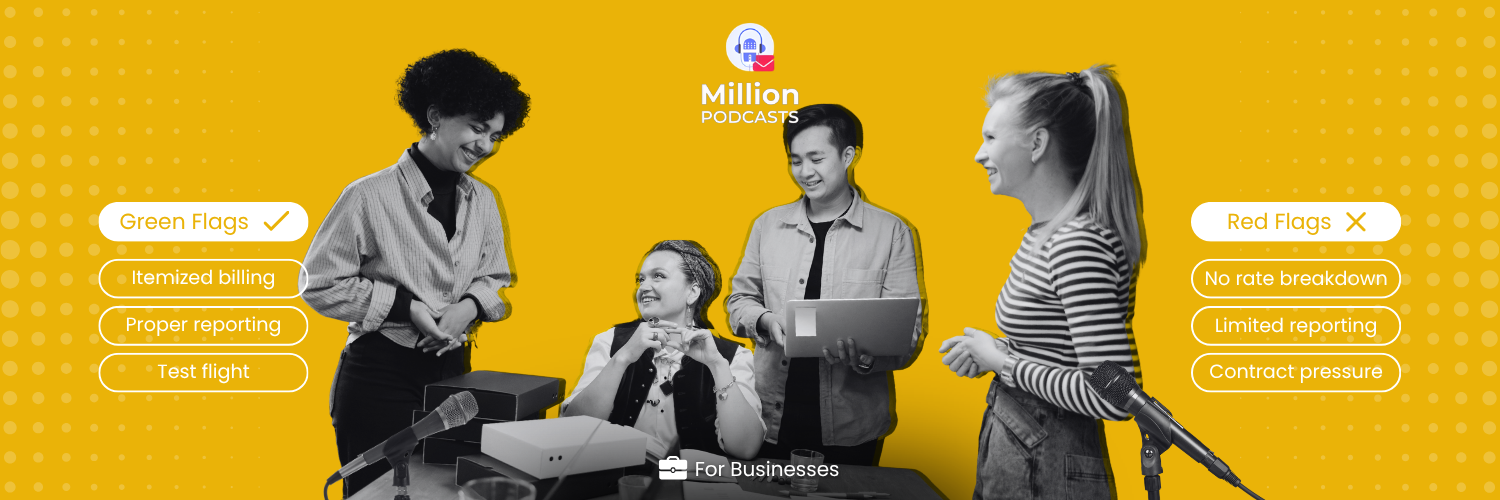
Green flags
- Itemised billing: media cost and agency fee on separate lines, offered without being asked
- Named shows early: a real shortlist before signature, with reasons attached
- Data you keep: attribution access that survives the end of the contract
- Comfort with a test: a short paid flight proposed before any long commitment
- Callable references: clients in your category you can speak to directly
- An honest failure story: a campaign that did not work, explained without blame
Red flags
- Blended rates only: one CPM across all shows with no per show breakdown
- Contract before test: pressure to commit for a year before anything has run
- Downloads as results: reporting that stops at impressions and never reaches conversions
- Shows named after signing: titles withheld until the money is committed
- Undisclosed rebates: vagueness about network bonuses when asked directly
- Guaranteed cost per acquisition: a promise no honest buyer can make upfront
One red flag is worth a conversation. Two together usually means the firm's economics are not aligned with yours. No amount of goodwill on the account team fixes that. Check them against the test flight terms before deciding.
Score each firm against these twelve signals on paper before the final call. The firm that felt best in conversation often lands third once the flags are written down.
Wrapping up
If you are spending under about $20,000 a year on podcasts, buy directly and keep the fee. You will learn the market faster, and the shows at that level answer their own email. Revisit an agency when scheduling across shows starts costing you more time than it saves.
If you are past that point, run the process above rather than the referral. Shortlist three firms, ask the nine questions, and buy one short flight from the firm whose answers were most specific. Specificity is the signal here, because it is the one thing a firm cannot fake under follow up questions.
The smallest useful next step takes under an hour. Pick five shows you believe your buyers listen to, then check their episode frequency and listener profile. Bring that list to your first vendor call. You will learn more from a firm's reaction to your list than from its deck.
8. Podcast advertising agency FAQ
What does a podcast advertising agency do?
A podcast advertising agency plans, negotiates, and manages ad placements across shows and networks on your behalf. It researches shows, negotiates rates, books slots, and briefs hosts on creative. It also sets up tracking and reports results at show level.
How much do podcast advertising agencies charge?
Most firms charge a commission on media spend, a flat monthly retainer, or a fixed project fee. Some build a margin into the rate they quote you. The number matters less than the disclosure. Ask for billing that separates media cost from agency fee on every invoice.
Do I need an agency to advertise on podcasts?
No. You can buy directly from shows, through a network, or on a self serve platform. An agency earns its fee when you buy across many shows at once. It also helps when you lack negotiating time or need independent show level reporting.
How many sponsors does a podcast usually carry?
In a MillionPodcasts export of 9,999 sponsored shows pulled on August 25, 2026, the median show carried 6 different sponsors and a quarter carried 14 or more. Sponsor load rises with audience size. Ask how many brands share the rotation before you accept a rate.
How long should a podcast ad test flight run?
Long enough for repeated exposure on the same shows, which usually means several weeks rather than a single episode. Listeners often hear an ad more than once before acting. A one episode buy tells you almost nothing about whether the show works.
How do agencies prove podcast ads worked?
Through promo codes, vanity URLs, pixel based attribution, post purchase surveys, and incrementality tests. Promo codes alone capture only a fraction of real conversions. A firm that reports codes and downloads is showing you an incomplete picture.
References
Interactive Advertising Bureau and PwC. (April 2026). IAB Internet Advertising Revenue Report: Full Year 2025. https://www.iab.com/insights/internet-advertising-revenue-report-full-year-2025/ Podscribe. Podcast Advertising Performance Benchmark Reports. https://podscribe.com/ppb-reports MillionPodcasts. Podcast Directory. https://www.millionpodcasts.com/podcasts-directory MillionPodcasts. (August 2026). Sponsor load analysis, directory export of 9,999 podcasts with sponsors and an episode in the last 12 months. https://www.millionpodcasts.com/podcasts-directory